

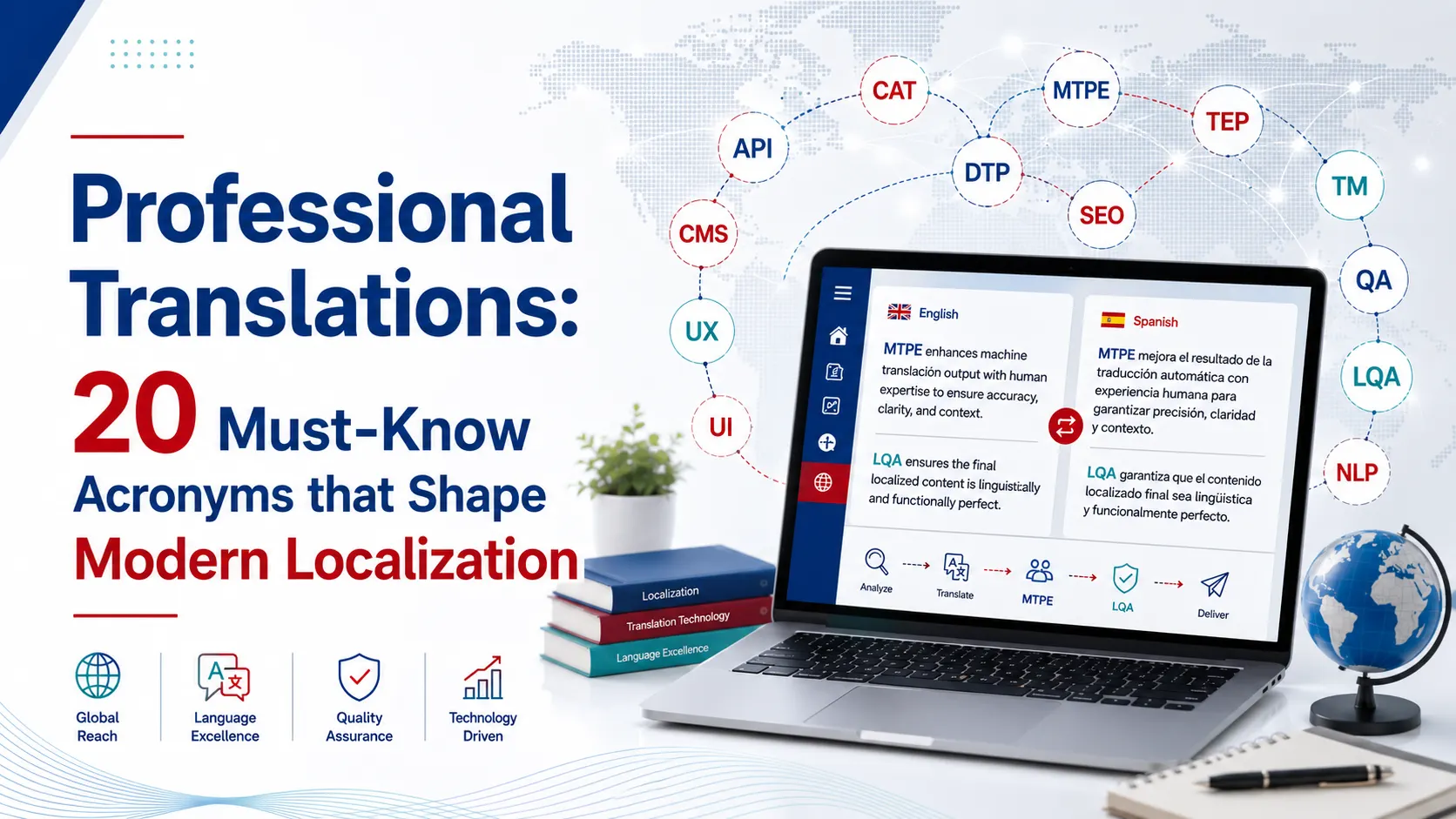
When you join a discussion regarding AI-powered translations, it is likely that you will hear terms like NLP, NMT, MTPE, and LQA. They may sound complex, but in reality, they are the foundation of professional translations that use AI. And, for expert translators, these acronyms are basically a part of everyday communication. However, for people outside of the localization industry, these acronyms can sound like an entirely different language.
Understanding these acronyms can help businesses make sound decisions when choosing language localization services and allow professionals to work more efficiently with translation teams.
In this blog, we will explore 20 key acronyms that are essential to the AI translation and localization process. We will also group them into core categories to make them easier to understand and apply.
What Are Acronyms in Professional Translations?
In professional translations, acronyms are shortened industry terms that are used to describe technologies, workflows, quality processes, and localization strategies. These acronyms are essential to maintain clear communication between teams that are managing multilingual content.
Knowing about these acronyms helps an organization when it is working with a professional translation company, managing multilingual content, or investing in AI-powered translation solutions.
Let us take a deeper look at some common acronyms grouped into four categories:
- AI and Machine Learning Foundations
- Core Localization Strategies
- Workflow and Technology Platforms
- Vendor and Process Terms
Before learning about these acronyms, let us ask a vital question: how do professional translation services translate acronyms?
Check out our must-read blog to know how: Translating Acronyms: How Do Three Letters Create So Many Challenges?
AI and Machine Learning Foundations
These acronyms form the backbone of modern machine translation and localization workflows.
AI: Artificial Intelligence
AI refers to a smart system that performs complex tasks requiring human-level intelligence. These tasks may include language analysis, pattern recognition, and content generation.
MT: Machine Translation
Machine translation is the automated process of converting content from one language to another. This is done by using online tools or high-grade machines. They are mainly used for translating high-volume content with speed and efficiency.
NMT: Neural Machine Translation
NMT uses complex learning models and large sets of databases to produce more natural and contextually aware translations.
NLP: Natural Language Processing
NLP is a system that enables machines to understand, interpret, and process language like humans. In the modern era, NLP plays a vital role in machine translation and content analysis.
NLG: Natural Language Generation
NLG helps AI tools to generate human-sounding text from structured information, making multilingual content creation more accessible and scalable.
Core Localization Strategies
For content, like website landing pages, marketing snippets, and e-commerce checkout pages, translation alone won’t give you the desired results. In these cases, content must feel natural, relevant, and adapted to different cultural aspects. This is where localization strategies are important. Some vital acronyms used in this context are:
L10N: Localization
Localization is the process of adapting content, design, and user experiences to suit the expectations of a specific market, language, or culture.
RAG: Retrieval-Augmented Generation
RAG is an enhanced AI-generated output that is derived by retrieving information from outside sources such as glossaries, translation memory, and content databases.
CAG: Context-Aware Generation
CAG helps AI models to access broader context databases when generating translations. This improves consistency and readability of the translated content.
NLI: Natural Language Inference
NLI helps determine whether translated content accurately reflects the intended meaning of the source material.
10. TAAF: Translation as a Feature
TAAF is the process of integrating translation capabilities directly into digital products, websites, applications, and platforms. Today, TAAF is helping businesses deliver real-time language accessibility to global audiences.
Workflow and Technology Platforms
Efficient translations are essential to meet client deadlines while ensuring high quality. Today, language localization services rely on powerful technologies to streamline global collaboration and improve translation consistency.
11. TMS: Translation Management System
A TMS centralized platform that helps organizations with multilingual project management, linguist assignments, automated workflow, and other translation resources. TMSs are generally used by top-tier translation companies that manage high-volume tasks.
12. CAT: Computer-Assisted Translation
CAT tools are used to support expert translators by providing terminology suggestions, translation memory phrases, and productivity-enhancing features like spell checks.
13. TM: Translation Memory
A translation memory is a process that is used to store previously translated content and suggest approved translations for similar content in the future.
Some benefits of using TM are:
- Quick turnaround time
- Greater consistency
- Reduced translation costs
- Improved translation quality
14. APE: Automatic Post-Editing
APE is a process that uses AI tools to automatically improve machine-generated translations before a human reviews them.
15. LPU: Language Processing Unit
LPUs are specialized processors that are designed to handle language analysis workflow in a more efficient and streamlined manner. This improves translation performance.
Vendor and Process Terms
These acronyms specifically focus on quality assurance, translation evaluation, and workflow optimization.
Looking to Get Your Content Translated Professionally? Trust Somya Translators for Expert Translation Services!
16. QA: Quality Assurance
QA is a process that involves reviewing the translated content for errors, inconsistencies, formatting issues, and terminology accuracy before delivering it to the client.
17. LQA: Linguistic Quality Assurance
LQA specifically focuses on linguistic quality, including grammar, tone, writing style, terminology, and fluency.
18. MTPE: Machine Translation Post-Editing
MTPE is a vital process that combines machine translation with human expertise. In MTPE Service, an expert linguist reviews and refines machine-translated content to ensure language accuracy, cultural relevance, and regulatory compliance. Today, MTPE is widely used for content from various industries.
19. BLEU: Bilingual Evaluation Understudy
BLEU is a precision-based automated scoring method used to measure the quality of machine translation output by comparing it with simultaneous human reference translations.
20. MTQE: Machine Translation Quality Estimation
MTQE predicts translation quality without requiring any human translation reference. This helps the translation team to identify any additional content that may need review.
Importance of These Acronyms in Modern Professional Translations
These acronyms don’t just reflect industry-specific terms. Together, they represent the various technologies and processes that make professional translations more efficient, scalable, and reliable.
For example,
- AI and NLP improve the scope of understanding a language.
- NMT provides more natural translations.
- MTPE combines machines and human insight to provide quick and acceptable results.
- CAT tools help translators provide exceptional results.
- LQA and QA strengthen the process of quality control.
- RAG and CAG improve the contextual accuracy of AI translations.
As a result, modern translation technologies can deliver multilingual content faster while maintaining high quality across different markets.
Whether one is working with a translation company in India or managing international content operations, familiarity with these acronyms can help make more informed decisions.
Key Takeaways
Before we wrap up the blog, let us examine some key takeaways.
- AI is rapidly transforming the translation and localization industry.
- Understanding translation industry acronyms improves collaboration and decision-making.
- Quality processes like QA and LQA are vital despite advances in machine translation.
- MTPE, NMT, NLP, and RAG are common technologies used in modern localization processes.
- The most effective language solutions combine AI innovation with in-depth review from human linguists.
You May Also Wonder
Q1) What is MTPE in translation?
Ans. MTPE, or machine translation post-editing, involves human linguists reviewing and improving machine-generated translations to ensure accuracy, fluency, and cultural relevance.
Q2) How is AI improving professional translations?
Ans. AI helps to automate repetitive translation tasks, accelerate workflows, and improve consistency. However, relying on AI alone is perhaps not a good idea, as human review always remains vital for quality assurance.
Q3) Why is NMT important in machine translation?
Ans. Neural machine translation uses advanced AI models to produce natural and contextually relevant translations.
Q4) Can machine translation replace human translators?
Ans. Today, machine translations are highly useful for producing quick results. However, they cannot replicate human translators in handling cultural nuances, industry-specific terms, creative messaging, and quality control.
Wrapping Up
With the rapid evolution of the language and translation industry, understanding specific terminology and acronyms has become increasingly important. Be it for machine translation, MTPE, or localization, these acronyms represent the foundation of what makes modern multilingual communication powerful.
And just like knowing the correct meaning of these acronyms, choosing a professional translation company is just as important. Somya Translators, one of the most reliable translation services in Delhi, is reputed for its expert language solutions that cater to global industries.
Whether you require:
- Website localization
- Software localization
- App localization
- Certified translations
- Interpretation services
- DTP services
Or any other multilingual content support; our team is thoroughly equipped to help you with it.
Are you ready to take your content to the global stage? Let’s start with professional translations.
Contact Somya Translators today and explore how we can help you!
Call: +91-9990094796
Email: info@somyatrans.com