

You’ve probably heard of the terms “NASA,” “WHO,” or “GST.” They are quick to read, easy to recognize, and widely used. These are called acronyms—shortened forms of longer phrases that simplify communication. But is it also easy to translate acronyms?
The short answer is NO.
Translating acronyms is one of the most head-scratching tasks a linguist does. Not because the words themselves are difficult, but because preserving the intended meaning behind the acronym changes in translation.
Acronym translation is a common challenge in global communication. While they make content more efficient to understand in some languages, they also tend to shift the meaning in other languages.
In this blog, we will explore why translating acronyms is important in global communication and what challenges are faced while translating them.
What Are Acronyms and Why Are They Important?
Acronyms are a process of shortening phrases by using the first letters of each word. For example:
- NASA (National Aeronautics and Space Administration)
- WHO (World Health Organization)
- GST (Goods and Services Tax)
Acronyms save time, reduce the repetition of words, and make communication efficient. However, the real advantage of using acronyms is their use in specific domains. They act as standardized and widely understood shorthand for complex terms in industries like healthcare, law, and finance.
But when a business communicates across borders, acronyms become necessary to translate. But without language localization services, their meaning can be distorted.
Hence, professional acronym translation becomes essential.
Consider this:
- An acronym of a legal term can be easily mistranslated, leading to confusion.
- A misinterpreted medical acronym can risk patient safety.
- An error in an acronym in a user manual can disrupt operations.
Therefore, domain-specific translation is necessary to ensure that acronyms retain their true meaning, regardless of the language or the region.
Why Translating Acronyms Is More Complex Than It Seems
People, from outside the translation industry, may assume that translating acronyms is a simple replacement task. However, several hidden layers make it challenging.
One Acronym, Multiple Meanings
Acronyms are often ambiguous. For example,
- “CT” could either mean “computed tomography” (in medical) or “Connecticut” (in tourism).
- “ERP” may mean enterprise resource planning (in corporations) or emergency response plan (in aviation).
Without any context, the translation will merely be guesswork.
Acronyms vs. Initialisms
While both have shortened letters, they behave differently.
- Acronyms are produced as words. Like NASA, it is pronounced na-sa.
- Initialisms are pronounced by spelling out the letters. For example, the FBI.
Both require a different approach during translations, especially when adapting to a language that emphasizes phonetic structures.
Do you want to learn the role of phonetic structures in educational transcriptions? Check out our must-read blog: Phonetic Transcriptions: When Educational Language Sounds Precise.
No Direct Equivalent in the Target Language
In some cases, the target language simply doesn’t have a way to describe the acronym.
In these cases, translators face a dilemma.
- Write the original acronym as it is.
- Translate the full form.
- Create a localized version.
This decision is vital as it directly impacts the meaning of the content.
Regional and Cultural Variations
In many languages, such as English, different acronyms can mean the same thing:
- “ZIP Code” in the US and “PIN Code” in India.
- “AIDS” becomes “SIDA” in Spanish.
These differences highlight the need for cultural awareness during translations.
Challenges of Translating Acronyms in Different Domains
Different industries bring forth different challenges in acronym translations.
Healthcare
- High risk of misinterpretation.
- Strict regulatory requirements.
- Multiple meanings of the same abbreviations.
Legal
- Precision is a must.
- Acronyms are often related to jurisdiction.
Technology
- Rapidly evolving terms.
- Heavy reliance on English language acronyms.
Business and Finance
- Region-specific acronyms.
- Compliance-driven communication.
These examples show the challenges of translating acronyms in different industries.
Why Acronym Translation Errors Can Impact Business
Mistakes in translating acronyms are not just simple errors; they are risks that can severely affect businesses.
Here’s how:
- Loss of Credibility: Inconsistently translated acronyms can weaken a brand’s communication, therefore affecting its reputation.
- Regulatory Penalties: Incorrect acronyms can lead to regulatory compliance issues.
- Operational Delays: Miscommunication due to incorrect acronyms slows down processes.
- Financial Loss: Errors may require costly revisions.
By understanding why acronym translation errors can impact business, professional translators can avoid them.
Translate All Types of Content With High Accuracy!
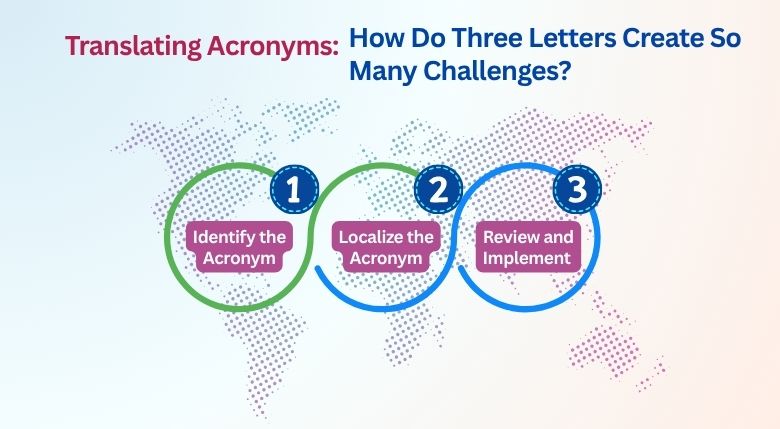
Workflow for Accurate Acronym Translation in Localization Projects
A reliable process makes all the difference. Here is a value-driven workflow for acronym translation in localization projects:
- Identify and Expand: Understand the full form of the acronym in the source language.
- Analyze Content: Determine industry, target audience, and intent. Achieving contextual accuracy is vital for translating acronyms properly.
- Check Localization Rules: Translators need to decide which terms to translate, which terms to retain, or which terms to adapt.
- Apply Quality Checks: Using glossaries and translation memory tools can help the linguist create accurate translations.
- Perform Back Translation: Validate the accuracy of the translated content by translating it back to the source language.
- Finalize and Update Glossary: To ensure long-term consistency, it is necessary to keep the glossary updated with new terms and acronyms derived from the present project.
This structured approach helps to ensure accuracy in acronym translation effectively.
Which Tools Support Acronym Translation?
Handling acronyms correctly doesn’t just rely on one person’s linguistic expertise. It also depends on the tools used during the translation process.
Some widely used tools that help with translating acronyms are:
- Translation Memory Tools: These tools store previously translated terms (including acronyms) and provide suggestions in new projects. Some popular TM tools are SDL Trados Studio, MemoQ, and Wordfast.
- Terminology Management Systems: These tools help to maintain a centralized glossary of approved terms and their translations. Some widely used tools are SDL MultiTerm, TermWeb, and MemoQ Term Base.
- CAT (Computer-Assisted Translation) Tools: These tools are vital in translations. They integrate translation memory and terminology databases into one system to streamline the whole process. Some examples are Smartcat, Phrase, and Across.
- AI-Powered Translation Tools: While AI tools justifiably improve the speed of translations, they still require human review to determine the context and industry of the acronyms used. Some examples are DeepL, Google Translate, and Microsoft Translator.
People Also Ask
Q1) Why translating acronyms is important in global communication?
Ans. Accurate acronym translations ensure clarity, prevent misunderstanding, and maintain consistency across languages.
Q2) How to avoid mistakes in translating acronyms?
Ans. There are several steps that help to avoid mistakes in translating acronyms. Focus on the context, verify meanings, and work with professional document translation services.
Q3) Who do I choose for acronym translation?
Ans. Working with an ISO-certified translation agency, like Somya Translators, can ensure accurate acronym translations. We combine domain expertise, work with native linguists, and use advanced quality assurance tools to ensure expert-level accuracy in all translations, including acronyms.
Wrapping Up
Acronyms may look small, but their impact is anything but. When handled professionally, they streamline communication, but when mishandled, they create confusion and risk.
At Somya Translators, we understand the different layers of acronym translations and provide results that match the brand’s expectations.
Are you ready to eliminate confusion and communicate clearly—with the right use of acronyms?
Reach out to Somya Translators today!
Call: +91-9990094796
Email: info@somyatrans.com