

Language is the heart of every translation project, right? But is language the only thing that matters?
A legal contract contains clauses that need to be adapted according to the jurisdiction. A technical manual includes specific measurements and terms, and a website contains several meta files.
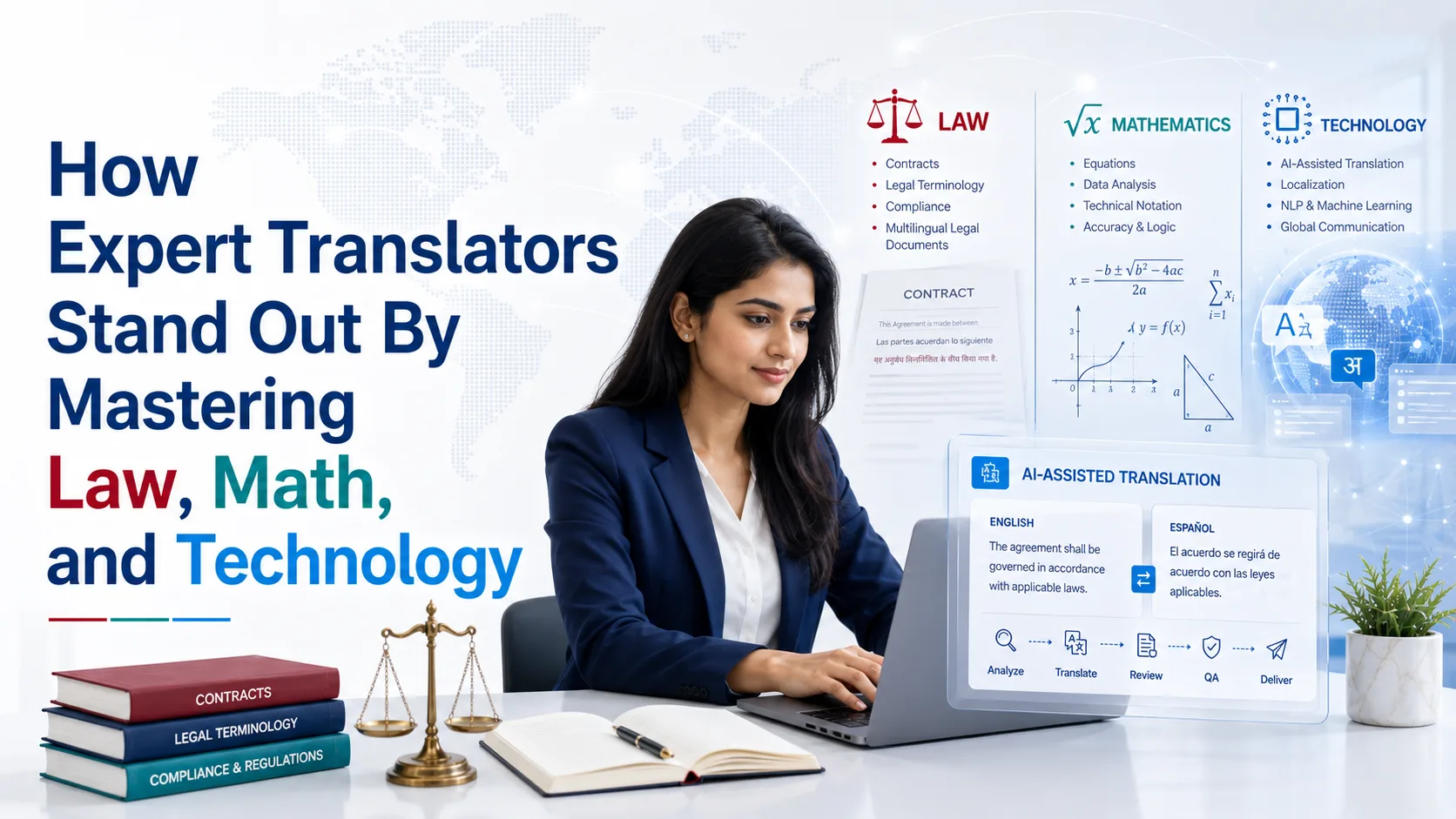
Though expert translators require exceptional knowledge of the source and target languages, with the need for diverse content, they also need to master other subjects.
The best translations today are brought by experts who possess more than linguistic knowledge. Translators are required to understand the industry they work in, whether it involves legal systems, scientific measurements, or financial terms.
In this blog, we will explore how expert linguists need to master diverse fields such as law, finance, and technology to produce the most suitable translation results.
Quick Thought: Why do expert translators need knowledge beyond language?
Ans. Translators need knowledge of law, medicine, finance, and technology because many projects contain specialized terminology, technical concepts, numerical data, and industry-specific requirements. Understanding these fields helps improve accuracy, reduce compliance risks, and reflect the intended meaning of the original content.
Importance of Legal Knowledge in Translations
Legal documents are one of the most sensitive types of content a translator handles. A small error can lead to misunderstandings, financial losses, compliance complexities, or legal troubles.
Hence, professionals providing legal translation services need to understand more than the vocabulary alone.
Legal Terminology in Context
In some cases, legal documents contain terms that may not have a direct equivalent in different languages.
These documents may include:
- Contracts
- Court Notices
- Intellectual Property Documents
- Employment Agreements
- Affidavits and Wills
Each of these documents needs a translator who understands the legal purpose or intention behind every clause.
Avoiding Costly Misinterpretations
Words in a legal document may carry different meanings in different regions. For example, a rent agreement in the U.S. won’t contain the same clauses as a rent agreement in France.
A translator who possesses knowledge about both language and law understands:
- Legal obligations and liabilities
- Jurisdiction-specific terminology
- Regulatory language
- Contractual nuances
Are you interested in learning about the 10 mistakes in legal translations that must be avoided at any cost? Check out our interesting blog: Legal Translations for Law Firms: 10 Costly but Avoidable Mistakes.
The Surprising Role of Math for Translators
Numbers and languages are surprisingly more connected than we might comprehend. This is because numbers appear in countless translation projects.
Engineering manuals, financial reports, and bank statements are just a few documents in which numerical accuracy is just as important as linguistic accuracy.
Many technical documents contain:
- Dimensions
- Weight measurements
- Temperature values
- Currency figures
- Statistical information
A translator must ensure these figures are converted correctly.
For example, confusing metric and imperial units in an engineering document can create significant operational problems. Therefore, numerical accuracy becomes a vital skill.
Modern businesses also frequently publish reports filled with:
- Performance metrics
- Market research
- Financial statements
- Statistical analysis
With high knowledge of numbers, expert translators ensure the context behind the data is accurate.
The Growing Importance of Technology in Translation
Evolution in technology has transformed every industry, and translation is no exception. Today, translators don’t just work with documents but also translate websites, apps, software, e-learning platforms, and digital marketing content with the help of the latest tools.
Mastering Translation Technology
To keep up with demand while ensuring accuracy, professional translators commonly use:
- Computer-assisted translation (CAT) tools, like SDL Trados and memoQ
- Translation management system (TMS), like Smartling
- Quality assurance software, like Xbench and QA Distiller
- Localization platforms, like Lokalise and Crowdin
Using these tools improves consistency, productivity, and quality. However, using them effectively requires deep technical knowledge. Also, with the growing demand for translations, it is absolutely necessary to focus on quality assurance tools.
Translators who embrace technology can manage large projects while maintaining high levels of accuracy.
The Peculiarity of Website and Software Localization
A project that involves websites also involves more than just text.
Translators often need to consider:
- Cultural and Visual Elements: Different regions have different meanings for symbols, colors, and images. For example, the color red may represent love in some regions and danger in others.
- Technical Formatting: Date formats, measurement systems, and currencies require precise adaptation according to the target region.
- Local SEO Requirements: A website needs to be optimized according to local SEO guidelines for higher visibility. This includes adding proper URL tags, keywords, and meta titles.
- User Interface and Experience: Diverse users need to feel comfortable on a particular website. Proper localization that matches the UI design expectations of the target audience and includes relevant payment gateways makes the website feel natural and easy to navigate.
Today, reliable technical translation services have become very vital, as they help brands adapt and curate their websites to make them feel natural to the target users.
The Competitive Advantage of Cross-Disciplinary Knowledge
Successful translators don’t just rely on their linguistic skills. They strive to possess knowledge beyond languages.
When translators master multiple disciplines, they can:
- Expertly handle more in-depth or specialized projects (legal, finance, healthcare)
- Deliver translations with greater accuracy and contextual relevance.
- Build a long-term trust factor with the client or the translation company they work for.
- Command greater respect and professional value.
Let’s consider a translator who is working on a software localization project. The project involves several legal terms, technical concepts, and numerical data.
A translator who has knowledge of all three domains (law, software, and numbers) can approach this task with greater confidence and precision.
Ensure Expert-Level Translations in Multiple Languages!
How Do Translators Hone Their Skills?
Knowledge and specialization in these subjects do not happen overnight.
Many professionals strive for years and build expertise through:
- University education
- Industry certifications
- Professional training programs
- Online courses
- Conferences and webinars
- Practical project experience
Continuous learning is vital for translators because legal frameworks, technologies, and industry standards constantly evolve.
Expert translators always treat learning as an ongoing part of their profession.
Frequently Asked Questions (FAQs)
Q1) Why do expert translators need legal knowledge?
Ans. Having legal knowledge helps translators to precisely interpret clauses and terms in sensitive legal documents. This boosts the translation accuracy and keeps the intended meaning intact.
Q2) Is math important for translators?
Ans. Yes, math is important, especially when a translator needs to translate technical manuals, engineering drawings, or financial reports. Accurate translation of symbols, numbers, and region-specific measurements in these documents maintains cross-border/linguistic clarity.
Q3) What are some trendy technologies that translators should learn about?
Ans. Translators should understand CAT tools, localization platforms, and translation management systems to boost speed, efficiency, and accuracy.
Wrapping Up
Language may be the foundation of translation, but it is not the sole skill that matters today. Today’s expert translators need to thoroughly understand the industry they are working in.
Legal knowledge, mathematical understanding, and a grasp of technology can help translators in the long run.
If your business requires professional legal translations or technical translation services, partnering with experts like Somya Translators can help.
We work with highly qualified translators and conduct deep reviews to ensure every piece of content translated is of the highest quality.
Reach out to us today!
Call: +91-9990094796
Email:
Email: info@somyatrans.com