

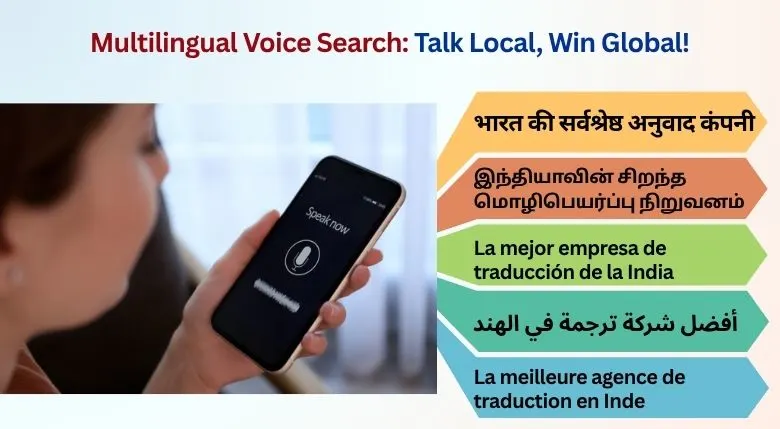
Today, if you ask your phone a question, you will expect to get a clear and focused answer within mere seconds. But can this also happen in different languages, like Hindi, Spanish, German, or Japanese? With the help of multilingual voice search, yes, it is possible.
Modern translation companies provide supportive multilingual voice search services by adapting content for spoken queries across different languages. They optimize to be easily recognized by natural speech patterns, regional dialects, and conversational keywords. By doing so, translation companies help businesses appear in voice assistants and AI-driven search results.
In this blog, we will explore how multilingual voice search has evolved by professional translation companies and how the process is not just about translating words but so much more.
What Is Multilingual Voice Search?
Multilingual voice search means enabling users to ask questions in multiple languages using various devices, such as smartphones, smart speakers, or virtual assistants.
How does it work?
- Users speak instead of typing.
- Systems interpret the voice using natural language search.
- Results are provided in the user’s preferred language.
Voice Search vs. Text Search
There is a difference between how people speak and how they type:
- Text search: A short, keyword-focused query. For example, “Translation services in India?”
- Voice search: A more detailed query is asked in a conversational way. For example, “Which company provides the best translation services in India?”
Why Is Multilingual Voice Search Growing So Rapidly?
Voice search is growing fast due to several factors:
- Increased use of smart devices.
- Demand for a hands-free approach.
- Growth in multilingual internet users.
Hence, many businesses are combining their multilingual digital marketing approach with voice-search strategies to boost global reach.
Importance of Multilingual Voice Search in B2B Businesses
Is voice search only applicable to regular individuals? Not anymore.
B2B buyers are increasingly using voice search to make quick decisions.
Some common B2B voice search queries include:
- Vendor research
- Services companies
- Immediate problem-solving
The benefits of a B2B service using voice search in their app or website include:
- Better global visibility: Businesses appear in search results in multiple languages, boosting presence.
- Improved customer experience: Users feel more satisfied when they get solutions to their queries in their native language.
- Higher conversion potential: Search results in regional languages can often result in quick decision-making.
For example, a global company that is looking for localization support might conduct a quick voice search by merely asking, “Who offers reliable website localization services for European markets?”
How Do Translation Companies Help with Voice Search Optimization?
The biggest impact voice search has brought is that consumers and businesses are leaning more towards using native languages rather than English.
A professional translation companyhelps businesses communicate in regional languages by using an approach called “adapting content to include conversational keywords.”
This includes:
- Rewrite the content in a conversational tone that can accommodate regional keywords.
- Include long-tail, question-based keywords to ensure higher local visibility.
- Reflect natural speech patterns and local consumer search behavior.
Furthermore, businesses also optimize their content to better suit regional search engines and ensure high visibility in regional languages.
Strategies used by voice search optimization services include:
1. Keyword Localization:
A keyword may rank very high in English-speaking markets, but that probably won’t be the case in a region that speaks different languages.
Therefore:
- Local research is essential to derive high-ranking keywords that suit the market.
- Search patterns of the local consumers must be studied carefully.
2. Cultural Adaptation:
Voice search should also include the cultural nuances of the region. Translation companies:
- Adapt the tone and phrasing.
- Align the content with local communication styles.
3. Structured Content for AEO:
Answer engine optimization (AEO) requires:
- Content that is clear and direct.
- FAQ-style formatting.
- Featured snippets.
4. Integration with Multilingual SEO Services:
Translated content, when combined with SEO services, results in:
- Higher rankings of the content.
- Better results in voice searches.
- Consistent message across regions.
SEO and localization services will play an integral part in a company’s website growth in 2026. Want to know how? Check out our related blog to know more: Website Localization in 2026: Which Trends Will Redefine Global Growth?
Translate Your Audio and Video Files into Multiple Languages!
How Does Technology Boost Multilingual Voice Search?
Today, modern voice searches rely on:
- AI-powered speech recognition systems.
- Natural language processing systems.
- Semantic understanding approaches.
However, voice search does not rely on machines alone.
Translation companies bring in their expertise to:
- Refine AI-generated outputs.
- Ensure cultural accuracy.
- Improve conversation flow.
As a result, businesses can deliver consistent human-like search experiences in several languages.
How to Choose a Professional Translation Company for Voice Search Optimization?
Are you a business looking to optimize your content to align it with the voice search patterns of different regions?
Here’s what to look for:
- Expertise in multilingual SEO services.
- Access to native linguists who have high cultural knowledge.
- Strong understanding of AEO content practices.
- Ability to provide website localization services.
- Knowledge of the global markets and consumer search behavior.
- Past experience in voice search optimization services.
A reliable translation company like Somya Translators can support businesses looking to adapt their content for global markets. We offer translation, localization, and SEO services to help businesses with smoother and more effective global expansion.
What Do People Commonly Ask?
Q1) What is multilingual voice search?
Ans. It allows users to search for products or services using voice commands in different languages. Businesses align their digital content with multilingual search patterns to make it more accessible globally.
Q2) How do businesses benefit from multilingual voice search?
Ans. It improves online visibility, enhances user experience, and increases conversions by delivering content in the user’s native language.
Q3) How do translation companies help with voice search?
Ans. Translation companies help to optimize digital content for conversational queries, localize keywords, and adapt content to boost cultural relevance.
Q4) Is translating digital content enough for voice search optimization?
Ans. No, it is not enough. Businesses also need multilingual SEO services and tailored content to rank high in consumer voice searches.
Q5) Which industries benefit the most from multilingual voice search?
Ans. Industries like gaming, e-commerce, SaaS, healthcare, and media benefit significantly by working with voice search optimization services.
What Do We Conclude?
Multilingual voice search is reshaping how consumers interact with information and make decisions. Hence, businesses are transforming their digital content to meet the consumer’s search requirements.
Translation companies play an important role in this transition by delivering culturally accurate, conversational, and search-optimized content.
With renowned services like website localization and multilingual SEO services, Somya Translators helps businesses to unlock new markets and build strong global connections.
Do you want your business to show up when a potential customer searches for a service using voice search? We can help!
Contact Somya Translators today for a free quote!
Call: +91-9990094796
Email: info@somyatrans.com