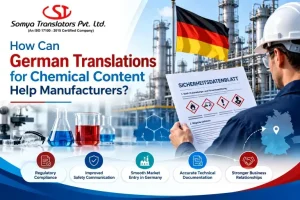
Germany is one of the world’s leading chemical-producing nations, and its industry serves markets around the globe. In 2024, Germany exported €134 billion worth of chemicals and related products, making it the EU’s largest exporter of these products to global markets. To serve international customers effectively, manufacturers need accurate German translations for chemical content. These translations help manufacturers translate complex documents like product specifications, safety data sheets (SDS), laboratory reports, and operating instructions.
This blog will explore German chemical document translation, what makes the work specialized, and how to protect accuracy throughout the process.
Why Do Chemical Manufacturers Need German-to-English Translation?
Chemical manufacturers need German-to-English technical translation to communicate clearly with international customers and clients. Professional translations help buyers clearly understand specifications, support research collaboration, and reduce confusion when following instructions.
Here are some reasons why manufacturers opt for German-to-English translation:
- Growing International Sales: English-speaking customers and distributors need clear product specifications and usage information to evaluate and purchase a product.
- Sourcing and Procurement: Suppliers need accurate details about materials, composition, and quality requirements to maintain global distribution.
- Research and Development: Laboratories need to analyze test results, procedures, and research findings originally written in German.
- Manufacturing Coordination: Production teams and chemical manufacturers managing several plants and facilities simultaneously need consistent and clear communication.
- Reduction in Safety Hazards: Precise technical language helps prevent misunderstandings about handling, storage, and product use.
German chemical document translation supports communication throughout the product’s lifecycle, from research and development to manufacturing, distribution, and sale.
Which Chemical Industry Documents Need Translation?
The document that needs translation generally depends on the product it is associated with. Chemical manufacturers generally get the following documents translated:
| Document Type | Information to Preserve |
|---|---|
| Safety Data Sheets (SDS) | Hazards, precautions, first aid, storage, and emergency guidance |
| Specifications and Technical Data Sheets | Composition, purity, properties, and test methods |
| Laboratory Reports | Test results, analytical findings, and research methods |
| Labels and Packaging | Product identification, warnings, and usage instructions |
| Manuals and Work Instructions | Operating procedures, equipment guidance, and process steps |
Safety Data Sheets (SDS) and Chemical Safety Information
German SDS translation or German safety data sheet translation requires particular care because they communicate hazards, precautions, and safety measures.
An SDS for the US market follows a 16-section structure under the US Occupational Safety and Health Administration’s Hazard Communication Standard. [Source: Occupational Safety and Health Administration]
Similarly, an SDS meant for the European market follows the guidelines specified under the EU CLP Regulation of the United Nations Globally Harmonized System of Classification and Labelling of Chemicals (UN GHS). [Source: European Agency for Safety and Health at Work]
These regulations cover product identification, hazard classification, first aid, firefighting, accidental releases, handling, storage, exposure controls, and other technical information.
A trusted safety data sheet translation converts:
- Hazard statements, signal words, and precautionary information.
- Instructions for safe handling and storage.
- Emergency procedures and first-aid guidance.
- Exposure limits, protective equipment details, and relevant technical values.
- Section headings, tables, and other essential formatting.
Professional German-to-English translation services also handle any market-specific regulatory requirements needed for compliance.
You can explore more about the importance of multilingual SDS in our blog: Technical Translations: Mastering Multilingual SDS with High Accuracy and Compliance.
Chemical Specifications and Technical Data Sheets
Chemical technical document translation covers specifications, technical data sheets, and documents that describe a product’s properties and performance. These documents may include purity levels, ingredient information, density, viscosity, pH levels, solubility, test methods, and acceptable quality limits.
Accurate chemical specification translations help buyers and production teams assess whether the products meet their requirements. Manufacturers should also keep chemical technical data sheets consistent with related labels and safety documentation.
Laboratory Reports and Research Documents
Laboratory reports record analytical findings, experimental methods, test conditions, and measured results. A professional translator must ensure that every word and unit of measurement is converted as required.
Research papers, toxicology reports, and lab procedures may also need expert German-to-English translations when shared with international partners.
Product Labels, Packaging, and Operating Instructions
Labels and packaging communicate product name, warnings, handling directions, and other essential information. Equipment manuals, manufacturing procedures, and product instructions explain how people should use materials and machinery.
Consistent terminology across these documents helps users understand the product and follow the intended process.
What Makes German Chemical Translation Different from General Translation?
The German translation of chemical content is not just about language fluency. Translators also need to understand scientific concepts, industry-specific terminology, technical content and formatting, and the consequences of a small error.
Chemical Terminology and Industry-Specific Vocabulary
German chemical terms often have precise English equivalents, and context defines which term fits. The following table discusses some common German chemical terms, their usage, and their English equivalents.
| German Term | English Term | Note |
|---|---|---|
| Sicherheitsdatenblatt | Safety Data Sheet | Usually shortened to SDS |
| Flammpunkt | Flash Point | Lowest temperature at which vapor can ignite when an ignition source is present |
| Zündtemperatur | Ignition Temperature | Temperature at which a substance ignites on its own |
| Schmelzpunkt | Melting Point | Temperature at which a solid becomes liquid |
| Gehalt | Content or Assay | Assay is a procedure used to measure the presence of a substance |
Accurate Units, Formulas, Symbols, and Numerical Values
German uses a comma for decimal values while English uses a point. For example, 0,5% in German is written as 0.5% in English. German also uses a point for a thousand separator. So, 1.000 Kg in German is the same as 1,000 kg in English. An English speaker can easily confuse this figure with 1 kg.
To add to the peculiarities, in German, “Milliarde” means the English “billion.” And “Billion” means the English “trillion.” Other elements like temperature, concentration, and formulas need similar attention. After translation, each value must be checked against the source file.
Consistency Across Technical Documents
During translation, use the same name to define the same substance, process, or component across all documents of the project. For example, Flammpunkt and Zündtemperatur are two different properties. Translating both using the same English term can confuse users and create safety risks.
Professional German chemical terminology management solves this by utilizing approved glossaries, reference documents, and terminology records. Such expert steps ensure German-English terminology consistency when several people work on a project.
How To Maintain Accuracy in German-to-English Chemical Documents
Review the Source Document and Its Target Audience
Before translating the document, identify the document type, intended readers, its purpose, and destination market. A laboratory report for in-house engineers may require a different approach from a safety data sheet for global distributors.
Use a Verified Chemical Glossary
Create a glossary of client-approved terms for substances, processes, and equipment. Add reliable technical references and previously approved translations to it. When a new term appears, verify it and record the approved equivalents so the team can use it consistently in future documents.
Implement Technical and Linguistic Quality Checks
To ensure chemical translation quality control of the highest level, work within the ISO 17100:2015 standards and use second linguists for review.
These second linguists, who are as qualified as the initial set of translators, look for:
- Missing sentences, table rows, and warnings
- Inconsistent application of industry-specific terms
- Numbers, formulas, and units that do not match the source
- Errors in tables, footnotes, and diagrams
- Formatting and layout problems
These QA checks help maintain high technical translation accuracy across the complete project.
What Should Chemical Manufacturers Check Before Translating Documents?
Define the Purpose and Target Market
Mention whether the translation is required for internal engineering, an overseas buyer, product documentation, or a regulated market. They influence the review process and chemical document translation requirements.
Identify Confidential or Proprietary Information
There are several confidential chemical documents that require translation, such as formulations, unpublished reports, and process details. Mark which sections contain proprietary formulations, limit access, and sign a confidentiality agreement before sharing the files. Best confidential technical translation practices also include working on encrypted file management systems.
Confirm Any Applicable Regulatory and Language Requirements
Requirements may vary by document type and destination market. For regulated chemical products, confirm the current regulations with a qualified compliance professional. Chemical regulatory document translation implements legally approved wording, but translation alone doesn’t establish regulatory compliance.
Common Problems to Avoid When Translating Chemical Documents
Some common chemical translation errors occur for the following reasons:
- Translating Technical Terms Without Checking the Source: Let’s take an example to understand this better. “Natronlauge” is a sodium hydroxide solution, commonly referred to as a caustic soda solution. Translating it as “sodium hydroxide” is incorrect since it omits that it is in solution form. Such minor technical elements must be carefully cross-checked against the source file.
- Changing Number, Units, Formulas, or Decimal Notation by Accident: Intricate values, units, chemical formulas, and symbols must be converted accurately. Something like converting bar to psi during translation is easy to get wrong.
- Using Different Terms Across Documents: Several chemical terms can be written in different ways. The translator must choose the approved terms and use them consistently across related files.
- Overlooking Tables, Footnotes, Diagrams, and Warnings: Support content in a document is as important as the text. Converting them accurately is paramount to help readers truly understand the product.
- Relying on Unreviewed Machine Translation for Critical Documents: Machine translations are quick and save a lot of time. However, critical documents that talk about safety instructions, storage, and handling need an expert reviewer who is highly knowledgeable about the industry.
Implementing chemical document quality checks is an easy way to prevent these technical errors.
How to Prepare Chemical Documents for English Translations?
Gather Editable Files and Reference Materials
Send editable source files wherever possible, such as Word or InDesign documents. Extracting translatable text from PDF scans or screenshots has formatting challenges that can end up taking more time. Include approved glossaries, earlier translations, and reference documents with the source file.
Flag High-Priority Sections and Required Deadlines
Identify sections that carry the most risk, such as hazard information and test methods, and provide a clear deadline. These details help the translation team plan the work and allocate enough time for quality checks.
Review the Final Deliverables in Context
Check the final translated file in its intended layout, with tables, labels, and warnings. For safety-critical documents, ask a subject-matter expert to review the file wherever needed.
Building Clearer Communication for Chemical Manufacturers
Expert German translations for chemical content are vital for three things:
- Accurate technical terminology
- Linguistic consistency among the documents
- In-depth quality checks to ensure high quality
For help with safety data sheets, product specifications, or lab reports, you can check out our German translation services webpage.
Frequently Asked Questions (FAQs)
Which German chemical documents can be translated into English?
Common examples include safety data sheets (SDS), technical data sheets, specifications, laboratory reports, packaging labels, manuals, and work instructions.
Why is specialist knowledge important for chemical translation?
Chemical translation involves specialized terminology, formulas, and units. A qualified specialist helps preserve technical meaning and maintain consistency across documents.
How can manufacturers help improve translation accuracy?
Manufacturers can provide glossaries, editable source files, and context of the document’s intended use. This makes the task of the translation agency simpler, and they can fully focus on accuracy and quality.
Should chemical safety documents be reviewed after translation?
Ans. The requirement for review depends entirely on the document and its use. Safety-critical documents need appropriate checks, ideally by a reviewer who is an expert in the subject.
What should manufacturers provide when requesting a German-to-English translation?
Manufacturers must provide the source files, the intended use, the target audience, the deadline, terminology preferences, and any compliance instructions.
Need to translate German chemical documents accurately?
Somya Translators is globally renowned for expert German translations for chemical content.
Contact us today for a free quote!
📞 Call: +91-9990094796 📧 Email: info@somyatrans.com