

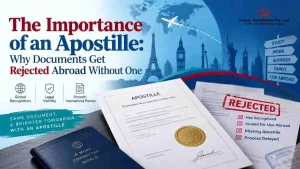
It’s not a missing document or a wrong signature.
It’s just one official stamp that most people only hear about when they urgently need it the apostille.
If you’ve ever tried submitting an Indian birth certificate, marriage certificate, or degree abroad, you already know how important this stamp can be.
In this article, we’ll clearly explain what an apostille is, why it matters, how it differs from notarization, and what role certified legal translation plays in the process.
What Is Apostille Attestation?
An apostille is a form of document authentication recognized under the Hague Apostille Convention of 1961.
The Convention was created to simplify the process of making public documents valid across countries. Instead of going through multiple embassy legalizations, a single apostille certificate confirms that the signature, seal, or stamp on a document is genuine.
Here’s what an apostille actually does:
- It does not change the content of the document
- It only confirms that the signature, seal, or stamp is authentic
- Once apostilled, the document becomes legally valid in all member countries of the Hague Convention
As of 2026, around 130 countries are part of the Hague Convention, making the apostille one of the most widely accepted forms of document legalization worldwide.
India joined the Hague Convention in 2005. That means Indian citizens have had access to this simplified process for more than two decades. Yet many people only discover its importance when they apply for a foreign university, an overseas job, or a visa.
Apostille vs Notarization: What’s the Difference?
Many people confuse apostille with notarization. Here’s a clear comparison:
| Feature | Notarization | Apostille |
|---|---|---|
| Who issues it | A licensed notary public | A designated authority (e.g., Ministry of External Affairs in India) |
| What it confirms | The signature was made in the notary’s presence | The document and its previous certifications are genuine |
| Where it is valid | Mostly within the home country | In all Hague Convention member countries (~130) |
| When it is used | Usually the first step | Usually the final step before using the document abroad |
In simple terms:
Notarization is often the starting point.
Apostille is the finishing step that makes the document ready for international use.
Why Is an Apostille So Important?
An apostille is not just a bureaucratic formality. In many cases, it decides whether your documents will be accepted or rejected.
Here are the most common situations where an apostille becomes essential:
- Higher education abroad — Foreign universities often reject degrees and transcripts that do not carry an apostille.
- Overseas employment — Employers and background verification agencies frequently ask for apostilled degree certificates and police clearance certificates.
- Visa and immigration — Most work, spouse, and student visas require apostilled personal documents.
- Business expansion — Power of attorney, company incorporation papers, and export documents usually need an apostille to be legally recognized overseas.
- Marriage and family matters — Birth and marriage certificates often require an apostille for spouse visas, family reunification, or overseas marriage registration.
Without an apostille, even a completely genuine document can be treated as invalid in another country.
Apostille Process in India: Step by Step
Here’s how the apostille process generally works in India:
- Document review — Check the type of document, the issuing authority, and the destination country.
- Notarization (if required) — Personal documents such as affidavits often need a notary’s signature first.
- State-level authentication — Depending on the document, verification is done by the Home Department, State HRD (for academic documents), or the Chamber of Commerce (for commercial documents).
- MEA Apostille — The Ministry of External Affairs applies the final apostille stamp, making the document valid in all Hague Convention member countries.
Processing time usually ranges from 5 to 10 working days, though it can vary from state to state.
Note: The MEA generally does not accept applications directly from the public. Documents usually go through authorized service providers or the required state-level verification first.
Which Documents Commonly Need an Apostille?
Personal documents
Academic documents
- Degree certificate
- Diploma
- Mark sheets
- Letter of recommendation
Commercial documents
- Power of attorney
- Company registration papers
- Export and import licenses
Apostille Around the World: A Quick Look
| Country | Issuing Authority | Typical Process |
|---|---|---|
| India | Ministry of External Affairs (MEA) | Notarization → State authentication → MEA apostille |
| United States | Secretary of State (state docs) or U.S. Department of State (federal docs) | Direct apostille request — no extra embassy step |
| United Kingdom | Foreign, Commonwealth & Development Office (FCDO) | Documents submitted directly for apostille |
What Role Do Certified Legal Translation Services Play?
An apostille only confirms that a document is authentic. It does not check whether the language is accurate or correctly formatted.
This is where translation becomes critical:
- An apostille is not a translation
- Documents issued in Hindi or other Indian regional languages almost always need to be translated into the required language before or alongside the apostille process
- Even a small spelling error or formatting issue can delay or derail the entire process
- Certified legal translation services use professional linguists and quality checks to ensure accuracy and proper formatting
In many cases, the quality of the translation is what makes the difference between a smooth process and unexpected delays.
Key Advantages of Getting an Apostille
- One certificate works in many countries — No need for separate embassy attestation in each destination country
- Faster process — Fewer steps compared to full consular legalization
- Lower cost — Fewer authentication stages usually mean lower overall fees
- Wide recognition — Accepted in approximately 130 Hague Convention member countries
- Simpler compliance — Reduces paperwork burden for students, professionals, and businesses
Frequently Asked Questions
What is apostille attestation?
Apostille attestation is a certification under the Hague Convention that confirms a public document is authentic, allowing it to be accepted in other member countries.
Why do students going abroad need an apostille?
Many foreign universities reject academic documents that do not carry an apostille. The stamp confirms that the degree or transcript is genuine.
What is the difference between apostille and notarization?
Notarization confirms that a signature was made in the presence of a notary. An apostille confirms the overall authenticity of the document and is recognized internationally.
How long does the apostille process take in India?
Most cases are completed within 5 to 10 working days, though timelines can vary depending on the state and document type.
Which documents commonly need an apostille?
Birth certificates, marriage certificates, degree certificates, mark sheets, power of attorney, and commercial documents are among the most common.
Do all countries accept an apostille?
No. Only the member countries of the Hague Convention (approximately 130 as of 2026) accept apostilles. Non-member countries still require full embassy or consular legalization.
Can I apply for an apostille directly with the MEA in India?
In most cases, no. Documents usually need to go through authorized service providers or the required state-level verification first.
Why do I need certified legal translation before or with an apostille?
If your documents are not in the language required by the destination country, they must be accurately translated. Certified legal translation ensures both linguistic accuracy and proper formatting.
What happens if there is a spelling mismatch?
Even a small spelling inconsistency between documents can cause rejection or delay. Always review documents carefully before submission.
Is an apostille the same as embassy legalization?
No. An apostille is a single-step process for Hague Convention countries. Embassy legalization is a longer, multi-step process required only for non-member countries.
Making the Apostille Process Easier
Understanding what an apostille is only solves half the problem. The real challenge lies in navigating notarization, state verification, MEA processing, and accurate legal translation especially when documents are in regional languages.
This is where Somya Translators can help.
As an ISO 17100:2015-certified legal translation service, we support students, professionals, and businesses with accurate, guideline-compliant document translations that align with apostille requirements.
Need your documents translated and ready for apostille without the usual confusion?
Contact Somya Translators today for a free quote and consultation.
📞 Call: +91-9990094796
📧 Email: info@somyatrans.com