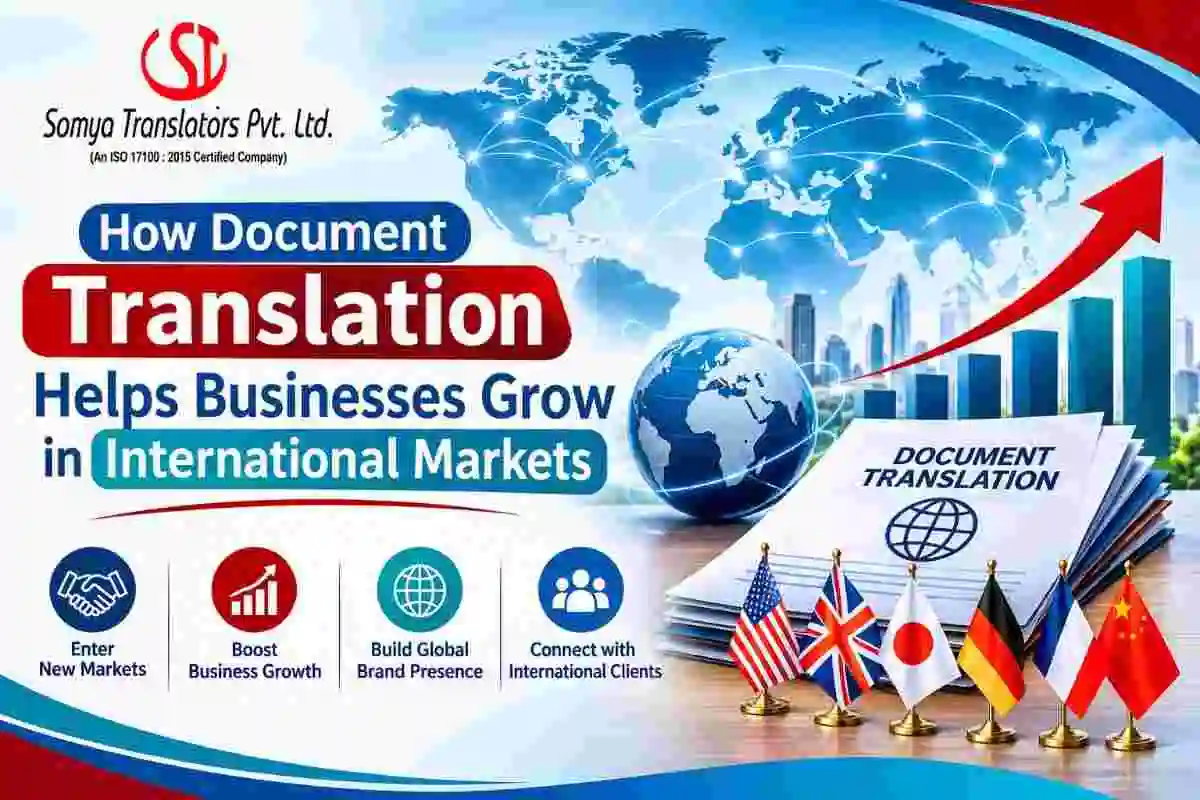
Document translation helps a business grow internationally by making contracts, product documents, policies and marketing material clear, accurate and legally usable in the buyer’s own language. When partners, regulators and customers can read what you send without guessing, deals close faster and trust builds sooner.
If you are planning to enter a new country, this guide explains why translated documents matter, which ones to prioritise, how AI changes the process in 2027, and how to avoid the mistakes that cost companies money.
Key Takeaways
- Translated documents build trust and shorten the sales and approval cycle in new markets.
- Start with documents that carry legal, financial or safety weight, then move to marketing content.
- In 2027 the best results come from combining AI speed with human expert review.
- Translation alone is not enough. Terminology, formatting and local rules need attention too.
- A simple preparation checklist saves time and cost.
What Does Document Translation Mean for a Business?
For a business, document translation is the process of converting official and operational files such as contracts, invoices, manuals, HR policies and compliance papers into another language while keeping the meaning, tone, layout and legal intent intact.
It is different from casual translation of a sentence or message. Business documents are read by lawyers, auditors, customs officers and decision makers, so one wrong term can delay approval or change an obligation. If you want a broader overview of the different formats and specialisations, read our guide on types of translation services.
Why Document Translation Matters When You Go Global
1. It builds trust with new customers and partners
Buyers are more comfortable with companies that communicate in their language. A well-translated proposal or product sheet signals that you take the market seriously.
2. It supports legal and regulatory compliance
Many countries require documents to be submitted in the local language, sometimes with an official stamp or declaration. In such cases, certified translations are accepted by authorities where a plain translation would be rejected.
3. It reduces costly misunderstandings
A vague clause, a wrong unit of measurement or a mistranslated warning can lead to disputes or product recalls. Accurate translation protects both your reputation and your budget. For a legal-specific view, see our article on the role of legal translation in expanding company horizons.
4. It speeds up market entry
When onboarding documents, product specifications and policies are ready in the local language from day one, teams spend less time waiting on clarifications and approvals.
5. It strengthens your search visibility
Translated and localised content helps people find you in their own language. Search engines reward pages that match the language and intent of the searcher, which is why document translation often works hand in hand with multilingual SEO.
Which Business Documents Should You Translate First?
You do not need to translate everything at once. Prioritise by risk and by how directly the document affects revenue.
|
Priority |
Document type |
Why it comes first |
|---|---|---|
|
High |
Contracts, NDAs, terms and conditions |
Legal enforceability |
|
High |
Financial statements, invoices, tax papers |
Audit and banking requirements |
|
High |
Product manuals, safety sheets, labels |
User safety and import rules |
|
Medium |
HR policies, employee handbooks |
Compliance for local teams |
|
Medium |
Company profiles, brochures, case studies |
Credibility with buyers |
|
Lower |
Blog content, newsletters |
Awareness and organic reach |
Some sectors have extra rules. For example, companies in banking and finance, healthcare and e-commerce usually need subject-specific terminology and stricter quality checks. If your documents are for internal teams abroad, see how HR and company policy translation is handled.
Document Translation Trends to Watch in 2027
AI plus human review is becoming the standard
AI translation is fast and useful for large volumes, but it can miss context, legal nuance and industry terms. Many businesses now use a hybrid approach in which a machine produces the first draft and a trained linguist corrects it. You can read more about how machine translation post-editing (MTPE) works, or how AI-powered human translation combines both strengths.
Human expertise still matters for high-stakes content
For sensitive content, a professional who understands the subject and the culture remains the safest option. We explain the value of this approach in enhancing global reach with manual translations.
Localisation is replacing literal translation
Words are only one part of the job. Date formats, currencies, units, tone and examples must feel natural to the reader. This is the idea behind localization, and it matters most when documents are customer-facing or tied to a website, which is where website localization comes in.
Quality and data security are now buying criteria
Companies increasingly ask how a translation provider handles confidentiality, version control and quality checks. Understanding a provider’s translation process and quality measures helps you compare options with confidence.
Which Translation Approach Fits Which Document?
|
Situation |
Suggested approach |
|---|---|
|
Internal drafts, large reference files |
AI translation with a quick human check |
|
Customer-facing guides, marketing documents |
AI draft with professional editing (MTPE) or full human translation |
|
Contracts, court or government submissions |
Specialist human translation, often certified |
|
Medical, technical or safety content |
Subject-expert human translation with review |
Common Mistakes That Hurt International Growth
- Relying only on free software for contracts or official files.
- Ignoring local requirements such as notarisation or certification.
- Inconsistent terminology across documents, which confuses partners and customers.
- Broken formatting in tables, charts and PDFs after translation.
- Skipping a final review by someone who knows the subject.
A Simple Checklist Before You Send Documents for Translation
- Confirm the target country and language variant (for example, Brazilian vs European Portuguese). You can browse the languages we work in to plan this.
- Decide whether the document needs certification or a stamp.
- Share editable source files where possible.
- Provide a glossary of brand and product terms.
- Tell the translator who will read the document and what it will be used for.
- Allow time for review, especially for legal and technical content.
Frequently Asked Questions
How does document translation increase international business?
It removes language barriers in contracts, product information and compliance papers, which builds trust, avoids delays and helps you meet local requirements in each market.
Can I use AI to translate business documents?
Yes for low-risk or internal content, but important documents should be reviewed by a qualified human translator to protect accuracy and legal meaning.
Do all documents need certified translation?
No. Certification is generally required for official submissions such as immigration, court, academic or regulatory filings. Marketing and internal documents usually do not need it.
Which documents should a company translate first when expanding abroad?
Start with legal, financial and product-safety documents, then move on to HR, sales and marketing materials.
How long does business document translation take?
It depends on length, subject and language pair. Complex or certified documents take longer because they need extra review.
Conclusion
Document translation is not just a language task. It is a growth tool that supports compliance, speeds up approvals and shows new customers that you understand their market. Start with high-risk documents, use AI where it makes sense, and keep experts in the loop for anything that carries legal or financial weight.