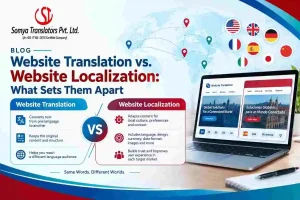
Contrary to what many businesses believe, translating a website and localizing one are not the same task. Translation converts words. Localization adapts the website for the target audience by curating the entire experience. While translation solely deals with language, localization includes currency, dates, layout, and visuals. With such crucial differences, it is evident why the website translation vs. website localization debate is such a hot topic among businesses.
But is website localization and translation really that important?
Many researchers, including the CSA, have concluded that 76% of online consumers prefer to buy from a website that is translated into their language. This number explains why translation matters. However, it does not tell you that many translated websites fail to convert visitors into customers.
Let’s take the following example to understand.
A website translated into French can still leave a visitor from Paris confused. The words may be correct. However, without professional localization, the prices won’t be in Euros (€), the dates may not be in DD/MM/YYYY, and the product descriptions may not be adapted with the appropriate units of measurement.
This gap is the reason why it is vital to learn about website translation and localization and choose the right plan of action for your business.
In this blog, we will cover the understanding of both website translation and localization, how they differ in practice, and which one a business needs to reach the global stage.
What Is Website Translation?
Website translation converts words on a page from one language to another while keeping the original meaning intact. So, a product description written in English becomes the same content in Japanese, word for word, sentence for sentence.
While translation focuses on language accuracy, it hinges on one very important question: does the translated content resonate with the target audience?
For product specifications, blog posts, or “About Us” sections, translation often does a good enough job.
But mere translation might not be enough in some other situations, such as:
- Currency in prices
- Date format used in delivery dates
- Images, icons, or colors on the page
- Payment methods offered at the checkout flow
Hence, a page can be perfectly translated but still feel alien to the target audience.
What Is Website Localization?
Website localization takes care of the finer details that go beyond translation. It adapts the entire page, not just the text, according to the expectations of customers in a specific region.
This includes:
- Currency and pricing format: A price shown as $49.99 becomes ₹4815 for an Indian shopper. This is not just a converted number but the correct local currency, symbol, and format.
- Date and number formats: The date 03/04/2026 means March 4 to a US customer. However, it means April 3 in the UK and India. Localization helps to adapt the date format according to the region.
- Layout direction: Languages like Arabic and Hebrew are written and read from right to left. A localized website helps to adapt the layout to accommodate right-to-left languages.
- Color and images: Colors have regional significance. Red symbolizes celebration in China but mourning in some parts of South Africa. A localized website adjusts the visuals to avoid misinterpretation.
- Legal compliance: A site made for the EU must comply with GDPR cookie notices and privacy language. However, this compliance changes according to the region. Professional website localization services are familiar with such regional regulatory requirements and adapt the site to comply with them.
The goal isn’t just a readable page but something that feels native to the target audience.
Website Translation vs. Website Localization: A Deep Dive
| Factor | Website Translation | Website Localization |
| What it changes | Text only | Text, design, currency, date formats, and legal content. |
| Main goal | Linguistic precision | Cultural and functional accuracy |
| Who is involved | A native translator | Translators, designers, and in some cases, legal reviewers |
| SEO impact | Makes content readable | Improves local search rankings through keywords and hreflang tags |
| Best suited for | Technical documents, legal texts, and product manuals | Marketing pages, e-commerce storefronts, and checkout pages |
| Typical outcome | Understandable content | Content that feels native to the reader |
Each approach solves specific problems, and most of the globally successful websites use both.
Translation Memory and Transcreation: The Support Tools
For some projects, professional translation services rely on tools that make website translation and localization faster and more consistent.
- One word can be translated into multiple synonyms. Translation memory stores a glossary of previously translated sentences and phrases, so the same term gets translated consistently during different projects. This ensures efficiency and accuracy in large-scale website translations.
You can explore more about how professional language service providers utilize translation memory in our blog: Why Do Smart Translation Services Rely on Translation Memory and Glossaries?
- Some jokes, slang, and puns make no sense when translated word-to-word into another language. Transcreation is a specialized linguistic service that is used to rewrite culturally oriented content like marketing slogans, taglines, and emotional content from scratch in the target language, aiming to recreate the same feeling rather than the same words. So, with transcreation, a joke, pun, or wordplay that works for English customers can also work for audiences who speak other languages.
Which Path Should a Business Choose: Translation or Localization?
The main decision revolving around website translation vs. website localization depends on the content type and goal.
- Choose website translation if the business priority is to test interest in a new market or if the content is technical, legal, or informative in nature.
- Choose website localization if the goal is to build long-term trust, increase conversions, and compete seriously in a specific regional market.
- Use both for most e-commerce and content-heavy sites. Translate the texts and then localize the website for best results.
Why Work with a Professional Website Localization Company
Handling multilingual transcreation, cultural adaptation, and multilingual SEO all at once takes more than a single translator. A capable website localization company brings:
- Native linguists who understand the language and cultural requirements.
- Designers who adjust the layout of the website.
- SEO specialists who work on local keywords and implement proper hreflang tags.
- Legal reviewers familiar with regional regulatory requirements.
Working with professional localization services helps keep the tone, terminology, and quality consistent across several languages.
Frequently Asked Questions (FAQs)
What is the main difference between website translation and localization?
Translation converts the text from one language to another. Localization adapts the entire website, including design, currency, and formats, to fit a specific region.
Is website translation enough to enter a new market?
Although it can work as the first step, full-scale localization is required to resonate with the public and build trust in a new market.
What does website localization typically include?
Several crucial elements are covered by localization, such as currency, date formats, layout direction, images, colors, and legal compliance.
How does localization improve SEO?
Localization services implement high-ranking regional keywords, appropriate URL structures, and hreflang tags, which help search engines show the right page to the right audience.
What is translation memory?
Translation memory is a database that stores a glossary of previously translated phrases and sentences that ensures consistent terminology and high accuracy across a website.
What is transcreation, and how is it different from translation?
Transcreation rewrites content to recreate the same emotional impact in a different language. Translation, on the other hand, simply changes the language of the content word-to-word.
Do I need localization for every page on my website?
Not necessarily. Simply localizing high-impact pages like the homepage and checkout page can usually be beneficial. Other pages can work perfectly well with translation.
How can a website localization company help my business?
A professional localization company helps by combining native-language expertise, design adjustments, SEO strategy, and legal compliance into one coordinated, consistent process across different target regions.
What is the cost of website localization services?
The cost can vary based on several factors, such as the number of webpages, content complexity, language pairs, and deadline. You can get a free quote according to your requirements by clicking here.
How do I start?
You can simply contact us, Somya Translators, a leading website localization company in India, via phone (+91-9990094796) or email (info@somyatrans.com).
Let’s Launch Your Website to the Global Markets
We, Somya Translators, are an ISO 17100:2015-certified website translation and website localization company. We pride ourselves on providing fast, secure, precise, and legally compliant services for over 170 global languages.
Reach out to us today and take your website to the global level—effectively and efficiently.
📞 Call: +91-9990094796 📧 Email: info@somyatrans.com