

Many translators often encounter a particular moment. A sentence appears in a new project that feels familiar. Not similar, but exactly the same. Something that was already translated weeks ago suddenly reappears, requiring the same effort all over again.
Due to the repetition of many phrases in the content, translation processes lose time, consistency, and, most importantly, money.
However, modern translation services choose to take a different approach. Instead of using human linguists to repeat the work, they rely on two proven systems:
- Translation Memory
- Glossary Creation
These two are foundational tools that improve translation consistency, linguistic accuracy, and translation quality assurance.
But to understand their importance, we first need to break them down systematically.
What Is Translation Memory in Translation Services?
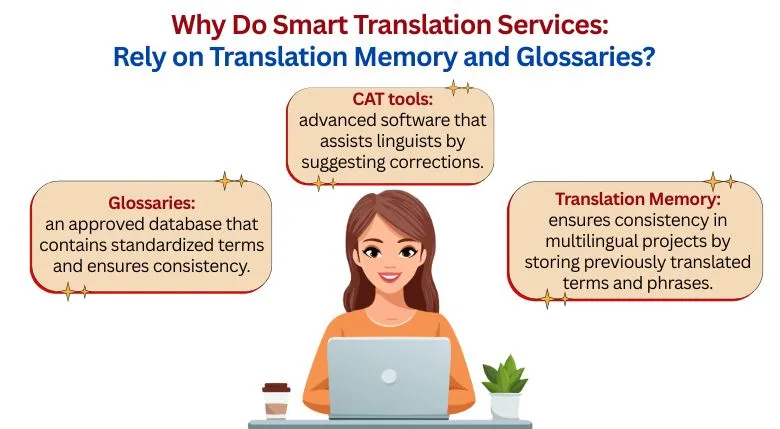
Although the name, translation memory (TM), basically gives it away, it is a smart language database that stores previously translated content in small units called segments.
The segments in a translation memory can include:
- Sentences
- Short phrases
- Headings
- Labels and Instructions
Each segment is saved as a translation unit, linking the source text with its approved translation.
So, translation memory is a structured archive of past translations that can be reused whenever similar content appears again.
How Does Translation Memory Function?
TM is perhaps one of the most efficient tools used in a translation process. It works on a simple loop:
- The system scans incoming texts.
- It compares segments with stored translations.
- It identifies:
- 100% matches (exact repetition)
- Fuzzy matches (similar content)
- No matches (new content)
- Then, the translator:
- Accepts suggestions
- Edits partial matches
- Translates the new segment manually
Once approved, every translation is stored again for future use.
This creates an enriching learning environment, where the database becomes more useful with every project.
Now, let’s shift our focus to glossaries.
What Is a Translation Glossary in Localization?
As we have discussed earlier, translation memory focuses on full sentences. A translation glossary, on the other hand, focuses on specific terms.
A glossary is a comprehensive and controlled list that includes:
- Industry-specific terms
- Brand names
- Technical expressions
- Legal or medical terminology
- Acronyms
And each of these entries includes:
- Source term
- Approved translation
- Usage context
- Sometimes it also includes what NOT to translate
A translation glossary is vital for technical translation services and legal translation services, where precision is a must.
So, to wrap up:
- Translation memory stores sentences and segments.
- Glossary stores individual terms and their terminology context.
Together, they prevent inconsistency and boost accuracy across large-scale multilingual content.
Why Are Translation Memory and Glossaries Important in Translation Services?
Because they save time. But that’s not all. The true impact of using translation memory and glossaries goes much deeper.
- Ensuring complete translation consistency across all documents.
- Supporting translation quality assurance.
- Maintaining linguistic consistency across teams.
- Reducing repetitive translation effort.
- Improving scalability for global multilingual projects.
How Does Translation Memory Improve Translation Efficiency?
The biggest advantage of using TM is speed.
And TM goes a step further by providing accuracy with speed.
TM helps translation services by:
- Reducing manual work in translation.
- Reusing previously accepted translations.
- Speeding up the review cycle.
- Eliminating the scope of mistranslation in large projects.
Let us consider the following example.
A software manual contains the following terms:
- Toolbar
- Alert
- Preferences
As you may know, these are general terms for a software manual and might be used repeatedly. With the help of TM, these terms are never translated twice.
Get Expert-Level Accuracy in Multilingual Translations!
How Do Glossaries Ensure Consistency in Translation Projects?
Glossaries are maintained for consistency in the translation and localization process. A well-maintained and precise glossary ensures:
- The same term is translated in the same way every time.
- Brand identity remains consistent across languages.
- Technical meaning is preserved without distortion.
A glossary is vital in situations where multiple translators are working on a single project.
Although translation glossaries are quite helpful, they can easily carry some mistakes. Check out our related must-read blog to know more: Translation Glossary Gone Wrong? Avoid These 8 Common Mistakes.
Benefits of Translation Memory in Multilingual Content
Some key advantages include:
- Faster turnaround time
- Cost savings on long-term projects
- Better consistency in multiple projects
- Better handling of repetitive content
- Significantly reduced workload for translators
Additionally, repetition in high-volume content like manuals, research papers, and website pages becomes cheaper to translate over time.
Such high-yielding benefits are the reason why many companies are pivoting towards reliable translation services.
But most businesses that approach a translation company are worried about the cost and time. So let us explore in depth how TM helps to save cost and time.
How Does Translation Memory Reduce Translation Cost and Time?
TM reduces costs by:
- Eliminating the human effort on repeated translations.
- Charging only for new and modified translations.
- Reducing the workload during reviews.
TM reduces time by:
- Offering instant suggestions.
- Speeding up the initial translation process.
- Accelerating the review process.
Over time, this creates a compounding effect. Which means that each project becomes faster and cheaper than the previous one.
Some Common Questions
Q1) Why are translation memory and glossaries important in translation?
Ans. They improve efficiency, reduce costs, and ensure consistent multilingual communication across all projects.
Q2) What are translation memory and glossaries in localization?
Ans. Translation memory stores reusable segments and repeated content, while glossaries store approved terms for consistent and precise usage.
Q3) How does translation memory improve translation efficiency?
Ans. TM reuses previously translated segments, reducing manual effort and speeding up the delivery time.
Q4) How does glossary creation ensure consistency in translation projects?
Ans. A glossary standardizes terminology so all translators working on a particular project use the same approved terms across documents.
Do Translation Services Really Matter?
Translation has always been about precision. But as businesses need more and more content translated into many languages, speed, cost, and efficiency have also started to play a vital role.
We, Somya Translators, believe that translation memory and glossaries have become the backbone of modern translation services. We integrate these systems in every stage of our translation and localization process, ensuring we remain focused on precision, consistency, and long-term value.
For any business or individual looking for high-quality translation and localization services, Somya Translators offers end-to-end linguistic solutions that can fulfil global communication needs.
Explore how our services can help you: https://www.somyatrans.com/services/.
Want to get started? Reach out for a free quote!
Call: +91-9990094796
Email: info@somyatrans.com