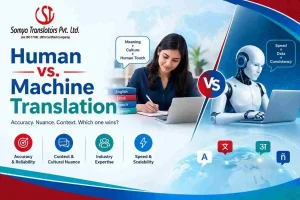
In order to grow globally, an aspiring business translates its website into five different languages. Three months later, it notices a bizarre situation. Visitors from different countries come to the website, but they are not buying anything. In such situations, the first question to arise is how the translation was done in the first place.
Was it done by a machine, a team of human translators, or by different means?
Each choice comes with its own set of pros and cons. And most businesses struggle to make a clear choice between human vs. machine translation for websites.
Fortunately, our blog will help you make the right choice for your business. It covers what each approach does, where it performs well, where it falls short, and why a growing number of businesses are pivoting towards machine translation post-editing.
What Is Machine Translation for Websites?
Machine translation for websites uses AI models trained on a high volume of bilingual data to convert website content from one language to another instantaneously. Smart tools like Google Translate, DeepL, and browser-based translation extensions are some examples of this category.
Modern neural machine translation systems have improved significantly in the last few years. Google, in particular, shifted to neural machine translation in 2016. The result? Their translation errors have been cut by 60% compared to their older phrase-based system.
As 2026 progresses, AI website translation has achieved accuracy rates between 82% and 96%, depending on which engine is being used, language pair, and content complexity. [Source: EliteAsia, 2026]
What Is Human Translation for Websites?
Professional human translation services work with experts who read the source content, understand its intent, and convert it into the target language with attention to tone, context, and cultural expectations. The process also involves judgement calls, a decision a translator must make when a text does not have a word-for-word translation in the target language. Since it is a subjective matter, it cannot be replicated by machine translations.
Human website translation typically includes:
- Translation: Converting content accurately while preserving the original meaning.
- Localization: Adapting content to fit regional dialects, currency, and cultural norms.
- Transcreation: In this, marketing content, slogans, and emotionally driven texts are rewritten in the target language.
Compared to AI and high machine translation accuracy, human translators can achieve 98% to 99% accuracy, even in complex and industry-specific content.
Where Can You Use Machine Translations?
Automated website translation is exceptional when it comes to speed and volume. It can be used for low-risk content, such as:
- Large Product Catalog: An online store with thousands of SKUs can translate listings in a matter of hours.
- User-Generated Content: Reviews, comments, and forum posts don’t usually need culturally adapted language.
- Internal or Low-Visibility Content: Internal documentation or low-traffic pages often don’t need a full-scale human translation.
For content like this, machine translation keeps costs down while making up for it with speed and efficiency. However, there are many types of content that cannot rely on machine translations.
Where Can You Use Human Translations?
Certain types of website content carry high weightage and can have serious consequences in case of mistranslation.
- Legal Pages and Terms of Service: A mistranslated clause can create a compliance risk or damage a contract’s legality.
- Checkout and Payment Pages: Confusing instructions at the payment stage can lead to cart abandonment and directly loss of the sale.
- Marketing Copy and Brand Messaging: Humor, idioms, and brand tone need human expertise to capture the true original essence.
- Medical, Financial, or Technical Content: These specialized fields use specific terminology that must be translated by experts. Professional human translators who have extensive experience in these fields can translate such terms with absolute accuracy.
Every piece of high-stakes content goes through a multi-step review framework. In these scenarios, human translation is the best bet.
You can further check out a detailed explanation about human translation in our blog: Human Translations: Expertise When AI Can’t Get It Right.
Human vs AI Translation: A Side-by-Side Comparison
The following table provides a more specific perspective on human vs. AI translation for websites.
| Factor | Machine Translation | Human Translation |
| Speed | Very fast, often instant | Slower, requires time for translation and review |
| Cost | Low | Higher |
| Accuracy on complex content | 82-96% | 98-99% |
| Cultural and contextual accuracy | Very limited | Very strong |
| Best suited for | High-volume, low-risk content | High-stakes, brand-critical content |
Speed and cost are important factors to consider while choosing an approach.
You can explore the key factors that affect pricing, including word count, language pair, and content complexity, by clicking here. How much does professional website translation cost
Similarly, you can learn about the process of a typical web page translation and factors that affect the turnaround time by clicking here. Turnaround time & process for web page translation
Machine Translation Post-Editing: The Modern Solution
MTPE services, or machine translation post-editing, are a more effective solution to the human vs. machine translation for websites debate.
Here is how it works:
- A machine translation engine produces a first draft of the content.
- A professional human translator reviews and edits that draft for accuracy, tone, and context.
- Industry-specific terminology and cultural details get corrected or added where needed.
This model helps businesses become more efficient and accurate. MTPE services are exceptionally useful for websites with high-volume content that need expert quality.
Frequently Asked Questions (FAQs)
What is the main difference between human and machine translation for websites?
Machine translation for websites uses AI models to translate the content instantaneously, while human translation involves a person translating the content while preserving tone and cultural context.
Is machine translation accurate enough for websites?
It always depends on the content that needs translation. Machine translation performs well on simple or high-volume content but struggles with high-risk and culturally driven content.
Which type of website content should utilize human translation?
High-stakes content like legal pages, terms and conditions, checkout pages, marketing content, and specialized content requires human translation due to higher accuracy needs.
What is machine translation post-editing (MTPE)?
This is a hybrid process where an AI engine produces a translation draft, and a human translator reviews and refines it for accuracy and tone.
Is MTPE cheaper than full human translation?
Yes, MTPE generally costs 30% less than a full-scale human translation while still offering exceptional quality and accuracy.
Can AI handle website localization?
Website localization with AI can automate much of the translation process. However, it may not fully understand the cultural nuances, local expressions, or brand tone. In such cases, human translation for websites is advisable.
Why do specialized websites for the legal, medical, and financial industries need human translators?
Specialized legal, medical, and financial content cannot afford mistranslation, as it could lead to severe consequences. Human translators are experts in these fields, and hence they implement accurate terminology and quality checks to avoid mistranslations.
How does a website translation company decide which method to use?
A professional website translation company evaluates each piece of content and analyses whether it needs machine translation, human translation, or MTPE.
How accurate is machine translation for websites in 2026?
Modern AI translation engines can reach accuracy rates between 82% and 96%, depending on the engine, language pair, and content type.
How do businesses find a professional website translation company?
Many trusted LSPs like Somya Translators provide high-quality website translation services. You can reach us via phone (91-9990094796) or email (info@somyatrans.com).
Wrapping Up
Looking for reliable website translation? Explore our professional website translation services for businesses and organizations here. They are designed to help your business create accurate, culturally relevant, and user-friendly multilingual websites.
As a leading ISO 17100:2015-certified website translation company, Somya Translators offers expert human and MTPE services for all types of businesses. Our reliable approach keeps both cost and quality in balance, rather than sacrificing one for the other.
Reach out to us today and get a free quote according to your requirements.
📞 Call: +91-9990094796 📧 Email: info@somyatrans.com