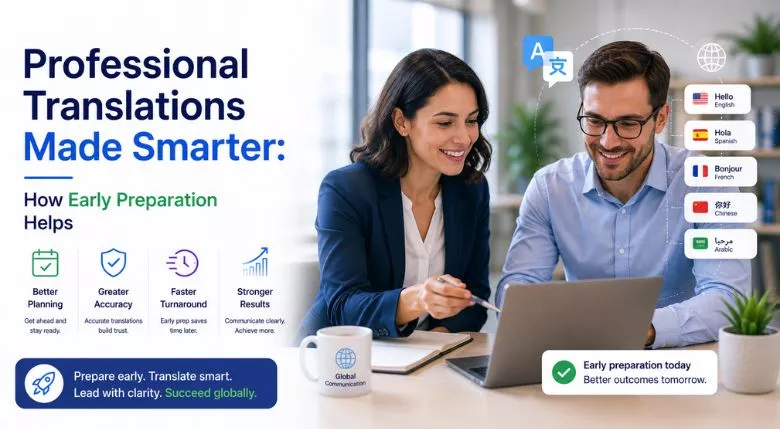
Do you know which factors significantly influence the quality of a translation?
Is it the translator’s skills?
Or the language pair?
Interestingly, in most cases, a good translation depends on how good the source content is.The way the content is written, and its structure directly impact the clarity, accuracy, and quality of its translation.
Factors like using clear phrases, consistent words, and editable content make the translator’s job much easier.
These features are all part of the preparation of professional translations as they aim to provide accurate and high-quality content.
“No matter how good one is, all would fail with a lack of preparation.”
Preparing content before translating is the unsaid, golden rule of the translation industry. Proper preparation helps with consistency, efficiency, and accuracy. It also displays a high grade of professionalism to businesses and clients.
In this blog, we will explore the practical steps that professional content writers, localization teams, and businesses use for preparing content for translation services.
How Can Problems Arise Before Translations?
Professional translations are a complicated process. There are several steps involved:
- Document analysis
- Finding the most suitable translator
- Translating and reviewing the file
- Formatting the translated file according to the client’s needs.
However, these steps are all secondary to preparing a file for translation.
During file preparation, a translator works with:
- Tone
- Context
- Industry Terminology
- Cultural Relevance
- User Intent
- Formatting Structure
But if the source itself is unclear, even the most capable linguists will face difficulties.
For instance,
- Long sentences can create ambiguity and distort the original meaning.
- Inconsistent terminology weakens brand authenticity and credibility.
- Idioms can lose meaning and not be communicated properly across languages.
- Poor formatting can disrupt the multilingual layout.
- Undefined abbreviations may cause confusion.
This is exactly why professional translation services prepare the content before starting the translation work.
What Does Translation-Ready Content Look Like?
Translation-friendly content is not something that is over-simplified. It can also have persuasive nuances and writing layers.
An important feature of translation-ready content is clarity.
“It’s not wrong if it is understood.”
This is what translation-ready content includes:
1. Consistent Terminology
A term that has been repeated several times in a document should not have different names.
For example,
- Client dashboard
- Customer portal
- User control panel
Even if all three refer to the same thing, a translator may interpret them differently, which would create inconsistencies.
2. Clear Sentence Structure
Shorter sentences increase reading clarity.
For example:
- Users accessing the platform after verification may proceed depending on regional compliance protocols.
- Verified users can access the platform after regional compliance approval.
Sentence “b” is shorter, clearer, and easier to understand.
Cleaner sentence structure improves:
- Readability
- Translation accuracy
- Localization speed
- SEO Clarity
Additionally, simpler sentences are much more accurately translated by AI or machine translations.
3. Context Matters More Than Most People Think
A phrase or a word can have different meanings in different places.
For example,
- Apply now
- Continue
- Submit
So, are these website buttons, CTAs, or submission of a loan application?
It is difficult to interpret without knowing the context.
Hence, linguists working on business translation solutions often request:
- Screenshots
- UI previews
- Reference links
- Brand tone guidelines
This helps them understand the context of the phrase better.
Want To Translate Your Content into Multiple Languages?
How Do Professional Translations Prepare from Day One?
Behind every high-quality translation lies a preparation project designed to reduce errors and confusion.
1. Build a Terminology Glossary
A terminology glossary includes:
- Product items
- Industry-specific terms
- Approved abbreviations
- Preferred spellings
Furthermore, in some cases, translation agencies also request additional comments/suggestions regarding ambiguous phrases.
This prevents inconsistencies and improves collaboration between translators and reviewers.
It is easy to make a mistake while creating a translation glossary. Check out our must-read blog to identify these mistakes and how to correct them: Translation Glossary Gone Wrong? Avoid These 8 Common Mistakes.
2. Use Editable Source Files
Sometimes, delays happen because the source files are difficult to work on. This includes:
- Scanned PDFs
- Locked Layouts
- Non-Editable Documents
However, professional translators prefer using:
- Word Files
- Google Docs
- XML
- HTML
- InDesign Files
Editable content speeds up the workflow and lowers the overall cost of the translation project.
3. Leave Space for Language Extension
Some languages, like German, take up more space than English.
These expanded texts can impact:
- Buttons
- Menus
- Mobile Apps
- Website Headers
If layouts in the source files are too rigid, it becomes harder to accommodate the expanded texts.
However, professional translation company always plan for text expansion.
4. Review Before Sending the Content
A translator’s job is to translate, not to proofread.
So, before sending the content for translations, it is important to review the source material by:
- Fixing grammar errors
- Removing duplicate texts
- Standardizing formatting
- Verifying dates and numbers
A clean source material would directly mean clean translations.
These issues are often reviewed by the project team of a certified translation company.
Readers Might Wonder
Q1) How early should businesses prepare content for professional translations?
Ans. Preparation should begin during content creation itself. Waiting until after the content is prepared can create high costs, delays, and inconsistencies.
Q2) Why do translators ask for style guides and glossaries?
Ans. Glossaries help to maintain consistency during the translation process. Style guides, on the other hand, help translators align with the brand guidelines and tone.
Q3) How to prepare documents for certified translations?
Ans. Preparing documents for certified translations isn’t very different from general translation. A certified translation company attaches a certificate of accuracy and the translator’s credentials to make the translation authentic and globally accepted.
Q4) Why do multilingual websites require extra planning?
Ans. Different languages affect layout, navigation, SEO structure, and user experience. Early planning for a multilingual website helps to accommodate these features while avoiding technical and design problems later.
Wrapping Up
Multilingual communication needs proper preparation before translation.
It is vital to organize terminology, think about the audience context, and understand that good source content plays a huge role in creating professionally translated content.
Somya Translators, an ISO 17100:2015-certified translation company, helps businesses build the foundation of multilingual communication by providing:
- Certified translations
- Localization services
- Legal and technical translation
- Multilingual DTP support
And many more language solutions.
Our team focuses on accuracy, cultural relevance, and long-term multilingual consistency so your content performs confidently across borders.
If your business is preparing for global communication, investing in a professional translation service from day one can save time and money and improve credibility.
Trust Somya Translators for professional translations!
Reach out to us today for a free quote!
Call: +91-9990094796
Email: info@somyatrans.com