

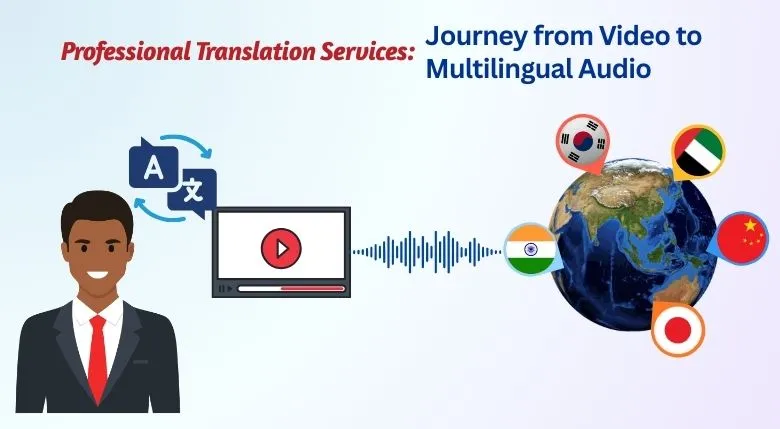
Think about the last time you watched a video in a language you didn’t understand—maybe a Spanish movie or a Korean drama. Although the video had subtitles, wouldn’t it be better to watch it in your ow
n language?
Did you know that many European countries like Germany (61%), Italy (54%), and France (52%) favor dubbing over subtitling? This is not because subtitling has any fault per se, but because dubbing has the potential to resonate better with viewers.
Businesses today face this exact challenge!
A single-language video—even with subtitles—limits how many people resonate with it. Companies today produce enormous amounts of video content for different purposes, like advertising, promotional campaigns, product tutorials, employee training programs, and e-learning modules.
To truly communicate across the world, businesses must convert that video into something global: multilingual audio. And to achieve this, businesses work with professional translation services.
Professional translation services offer a specialized process called video-to-audio translation. This allows various businesses to convert their videos into multiple languages without reshooting the entire thing.
The benefits?
- Original visuals remain the same.
- Audio is professionally translated to suit the cultural elements of the language.
- The clarity of the video significantly increases which boosts the global reach of the video.
So, the combination of linguistic expertise, some technical know-how, and cultural awareness helps companies ensure globally relevant videos.
In this blog, we will decode the steps used by professional translation company in converting video files into multilingual audio content—with precision, clarity, and comprehension.
What is Video-to-Audio Translation?
Video-to-audio translation is the process of converting spoken dialogues in the video into multilingual audio files. So rather than creating a new video from scratch, professional translation services adapt the audio component to meet business and consumer expectations.
Businesses rely on three techniques to ensure a boost in their videos’ reach:
- Subtitles: These are the small texts that are generally displayed at the bottom of the screen. These texts are translated and synchronized to ensure multilingual clarity. They are used in press interviews, documentaries, or corporate training videos.
- Dubbing: This is a highly effective technique where the original audio track is replaced with a translated one. Professional voice actors speak the translated dialogues in the required tone while synchronizing with the video.
- Voiceover: Voiceovers are narrative overlaps on the original video. These are generally descriptive in nature, i.e., they are used to describe the events occurring in the video. Voiceover translation services ensure that translated audio is used to increase the reach and understanding of the video. Are you interested in learning more about the world of voiceovers? If so, check out our related blog: Voiceover Localization: The Power to Speak to the World.
Let’s consider the following example:
Imagine a British company needs to adapt its corporate training video for the Spanish employees. Using multilingual audio translation and other services (dubbing, voiceover, and subtitling), the company can do the following:
- Add effective Spanish texts at the bottom of the screen.
- Translate the audio content of the video into the Spanish language and add it to the original video.
- Add descriptive audio tracks or voiceovers in the Spanish language to ensure better comprehension.
This would help the Spanish-speaking employees to learn the company’s practices in their preferred language.
How Do Professional Translation Services Convert Videos into Multilingual Audio?
A successful multilingual video-to-audio conversion relies on how well the process is executed. Professional translation company employ experienced teams to ensure efficient workflow and high-quality results.
Step 1: Video Transcriptions
The most vital step is the first step itself. It involves extracting the original dialogues from the video. Transcribing the video creates a written format of everything that has been said. This process includes:
- Audio extraction from the video.
- Labeling the speakers (for multiple speakers).
- Creating the writing transcription.
- Timestamping the dialogues.
- Proofreading and editing the transcription.
An accurate transcription process builds the foundation of specialized audio translation services.
Step 2: Translating the Transcribed Script
Next comes the magic of multiple languages.
Expert translators are employed to translate the script into the target languages. While they do so, they need to maintain the:
- Context
- Tone
- Cultural Elements
Sometimes, even localization services are used to adapt idioms and references according to the target language.
Step 3: Voice Recording
Once the script is translated, native voice artists are used to record the audio. The artist must be selected according to the needs and necessities of the audio. For example,
- Corporate training videos need confidence and clear diction.
- Educational videos need calm and soothing voices.
By using native and skilled speakers, businesses can ensure natural-sounding narration.
Many modern audio translation processes also use AI voice recording tools, such as ElevenLabs, Murf AI, and Speechify, to derive quick results. While this process may seem efficient, AI tools do not capture the required tone of the speaker, something easily achievable by expert human voice artists.
Step 4: Audio Synchronization with Video
It is essential that the translated audio matches the video’s timing. By using audio engineers, professional translation services adjust pacing, pauses, background audio, and speech length to synchronize them with the video timeline. This ensures a smooth viewing experience for the native audience.
Step 5: Quality Review and Final Delivery
Before delivering the translated content to the company, professionals conduct multi-step quality reviews. This includes:
- Language proofreading
- Audio clarity testing
- Synchronization checks
- Format optimization for different platforms
After the final check, the multilingual versions are delivered to the client, ready for global distribution.
Translate All Your Multimedia Content with Ease and Efficiency!
Who Benefits the Most from Audio Translations?
Several industries rely on specialized video translation services to meet their multilingual content needs.
- E-Learning Corporations: Online educational platforms translate lectures and tutorials into multiple languages so that global students can learn better in their native languages.
- Global Corporations: Global companies translate onboarding videos and safety training content to ensure that their diverse workforce comprehends the instructions clearly.
- Media and Entertainment: Streaming platforms adapt films, TV series, and documentaries using multilingual dubbing and voiceover services.
- Healthcare: Medical institutions translate instructional procedure videos so that doctors, nurses, students, and other professionals from different countries understand them completely.
- Marketing and Advertising: Brands localize promotional videos and advertisements to reach diverse viewers with the aim of improving conversions and sales.
How to Choose a Video Translation Partner?
Selecting an appropriate translation service provider is vital if a business wants to convey its message precisely to global audiences.
When you are hiring professional video translation services, consider the following:
- Expertise in multiple languages. Some highly demanding languages for video-to-audio translations are:
- Spanish
- Japanese
- French
- Arabic
- Turkish
- Chinese
- German
- Hindi
- A pool of skilled, native, and diverse voice artists.
- Deep experience with multilingual audio production and synchronization.
- Strong and robust quality assurance steps.
- High knowledge of the workings of several industries.
Somya Translators, one of the leading professional translation services, delivers unmatched video translation services to help businesses convert their videos.
We believe that video is one of the most powerful communication tools for global businesses. When emphatic videos combine with diverse languages, the result resonates with global audiences.
For any business that is looking to expand globally, our expert audio and video translation services can prove to be truly effective.
Contact us today to convert your videos into multilingual audio and get a free quote!
Call: +91-9990094796
Email: info@somyatrans.com