We all know about the vital role of a language in communication. However, language is not just limited to being a medium for communication. It is also a powerful instrument to express thoughts and feelings. In the modern world, language has also become globalized, making translations very important. Various translation services help businesses reach people across the globe by providing translations of different languages into English.
But the focus of this blog will be a bit different from translation services. We will explore the problems faced by translators purely based on the language characteristics and nothing else.
The World of Language Translation Services
Translation is not a direct replacement of words into other languages. It involves a comprehensive structure that includes adapting culture, replicating intended feelings, and sensitivity to the language. Therefore, expert linguists should not only focus on language accuracy and clarity but also be culturally aware and impartial.
Unfortunately, a language doesn’t come with a user manual. Professional translation services themselves need to be conscious and specific while translating any language. Furthermore, they need to ensure that culturally driven content, like important thoughts, expressions, and local references, does not get lost in translation.
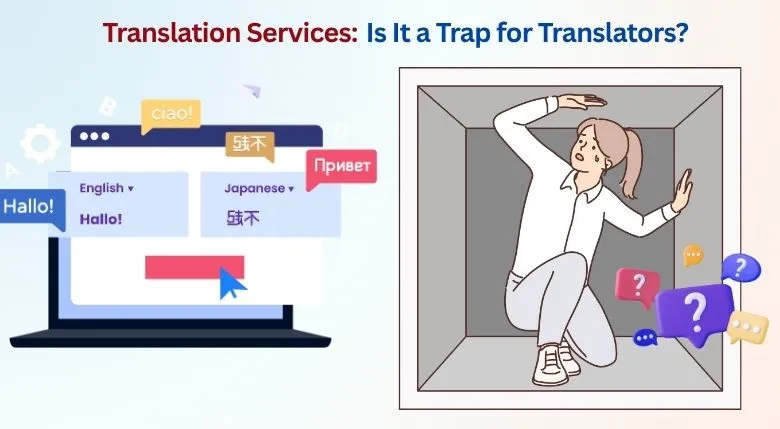
Is It a Trap for Translators?
A translator faces various problems while translating content into different languages.
Let’s discuss some language pitfalls below:
We Offer Native-Level Proficiency and High Cultural Accuracy in All Translated Content!
1. Different Structure for Different Languages
Every language has a predefined structure that contains verbs, nouns, and pronouns in a particular order. For example, in English, a sentence order will contain subject, verb, and object (SVO).
But in other languages like Arabic, subject pronouns become a part of the verb, which then determines the voice of the sentence. Additionally, the Farsi language follows the structure of subject, object, and then the verb (SOV).
These differences in language can become challenging for translators.
Translation of Compound Words
Compound words are formed by combining two words. However, the overall meaning of the word might not be similar to the individual words. While some compound words directly refer to the meaning of their original words, like treetop and afternoon. Others might only mean half of its original words. For example, a sunflower is a flower, but it is not made of the sun.
Furthermore, some compound words have nothing to do with the meaning of their original words. For example, a butterfly is neither a fly nor is it made of butter.
A translator might get confused while translating compound words.
2. Ambiguous Words
Ambiguous words have different meanings depending on the context in which they are used. For example, bark might mean the sound made by dogs or the outer layer of a tree.
Translators, who are unaware of the context while translating ambiguous words, might get confused, resulting in incorrect and poor translations.
3. Untranslatable Words
In many languages, there are certain words that are non-translatable or untranslatable. When we say untranslatable, we don’t exactly mean they cannot be converted. We mean that they don’t have an exact equivalent in other languages. For example, in Hindi, we have prasad, which is a divine offering. Although prasad can be translated into sweet in English, it doesn’t capture the exact meaning.
As direct translations of these words are not possible, translators need to find the closest meaning to ensure people understand the context.
Translating Idioms
A native speaker can easily understand phrases and idioms of their language, but translating them into another language is a whole other task.
For example, in Hindi, the idiom, “bandar kya jane adrak ka swad,” means to offer something valuable to someone who does not appreciate it. However, if directly translated into English, the phrase would mean, “What does a monkey know about the taste of ginger?”
Hence, it is necessary for translators to find contextually equivalent idioms of the target language, rather than directly translating them.
4. Expressing Slang
Slang is more culture-driven than language-driven. A slang word is similar to idioms, as they need contextual understanding for translations.
For example, in Hindi, “chugalkhor” means a person who cannot be trusted. Or in English, “couch potato” means a lazy person.
Such words need deep cultural knowledge to be translated accurately.
Do you want to explore the role of translators in multilingual content? Check out our must-read blog Know the Major Role of Translators in Delivering Successful Multilingual Scope Worldwide!
Conclusion
Translators face these problems daily, and they are not limited to a handful of languages. In such situations, translators need to focus on the meaning rather than the accuracy of words.
Furthermore, one cannot rely on AI tools, as they won’t be able to capture the intended meaning.
How can one overcome these challenges?
By following some valuable tips:
- Add footnotes to give context of slang, idioms, or untranslatable words.
- Translate using a glossary or dictionary to ensure accuracy.
- Working with certified translation services that employ a robust quality assurance process.
Now, answering our initial question, are translation services a trap for translators? No, they are not. In fact, modern translation services act like a bridge of opportunity for professional translators.
- Professional translation services constantly need support from native translators.
- They provide remote job opportunities across the globe.
- Using expert CAT tools, translators can easily improve the quality of their projects.
- Modern MTPE services combine the speed of machine tools and the expertise of human translators to ensure exceptional quality.
One such company that provides valuable opportunities to translators is Somya Translators. We cater to diverse industries across the world and have worked with several renowned companies. Aspiring translators can check out some career opportunities here: https://www.somyatrans.com/careers/.
We are also certified under ISO 17100:2015 and offer expert translation and localization services in more than 170 Indian and global languages.
Check out how our services can help you meet your language requirements: https://www.somyatrans.com/services/.
Reach out to us for a free quote!
Call: +91-9990094796
Email: info@somyatrans.com