
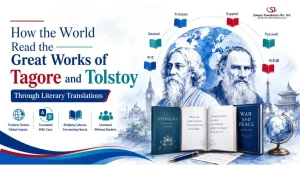
The most profound stories are often written while keeping a specific community, language, or culture in mind. Yet, over time, most of these works find their way to reach readers far beyond the place of their origin. And this wider reach is not just a coincidence. This global reach is made possible due to the thoughtful process of literary translations.
The aim of literary translations is simple: help people experience a story in their linguistic comfort zone.
Think about an avid reader in India discovering the works of the great Russian author, Leo Tolstoy. Expert literary translations make it possible for our friend in India to read the great works of Tolstoy in their preferred language.
This blog will explore how, over the years, literary translations have helped some of history’s greatest works travel across continents, influence millions of readers, and create a strong bridge between cultures.
Why Are Literary Translations Not Just About the Language?
Initially, one might think that translations are just about converting the words. However, in literature, there are many more layers.
A novel, poem, or play carries:
- Cultural traditions
- Historical context
- Emotional depth
- Symbolism and metaphors
- Diverse storytelling styles
So, while translating literary works, preserving these elements becomes just as important as translating the words themselves.
Professional literary translation services do exactly that. Rather than focusing on the words, they focus on recreating the reading experience. The goal is to help readers feel the same emotions, understand the same themes, and appreciate the writing brilliance intended by the author.
How Do Literary Translations Help to Create Global Impact?
They Turn Stories into Experiences
Most celebrated authors wrote their books in their native language. For example, Leo Tolstoy—although bilingual—always wrote his books in Russian. Yet, he is globally regarded as one of the greatest authors of all time.
Thanks to literary translations, his works and those of many others like him transcend national boundaries. As a result, famous literature becomes a universal experience rather than a regional book.
They Build Cultural Understanding
One of the most cherished strengths of literature is its ability to introduce readers to unfamiliar cultures. For example, Paulo Coelho, in his book The Alchemist, introduces us to the Andalusian shepherd culture of Southern Spain. However, he originally wrote his book in Portuguese (O Alquimista).
Through translations, readers can gain meaningful insights into:
- Different traditions
- Social values
- Historical events
- Philosophical ideas
- Everyday life in other cultures
So, in a way, literary translations act as a cultural bridge, helping people understand societies they may never visit.
Boost Your Book’s Global Reach! Contact Us for Professional Literary Translations and Get a Free Quote!
How Famous Authors Reach the World Through Translations
Leo Tolstoy: The Russian Great Who Spoke to the World
Very few have influenced the world of literature as Count Lev Nikolayevich Tolstoy did. His exemplary works, like War and Peace and Anna Karenina,were originally written in Russian. However, through in-depth literarony translatis, his powerful storytelling, moral reflections, and social commentary were passed on to readers across the world.
Rabindranath Tagore: Our Beloved Nobel Laureate
The great polymath, Rabindranath Tagore, is the epitome of literature crossing linguistic boundaries. His celebrated work, Gitanjali, gained massive global recognition after being translated into English from Bengali.
The translated work beautifully reflects Tagore’s spiritual insights, poetic style, and philosophical depth.
The success of the English-translated Gitanjali became eternal when Tagore was awarded the prestigious Nobel Prize in 1913—a feat no Asian had ever achieved before.
Gabriel Garcia Márquez: The Magic of Culture
The Colombian author Gabriel García Márquez made transformative contributions to modern fiction with his book, One Hundred Years of Solitude.
The novel combines imaginative storytelling with a distinctive narrative style that captivated readers worldwide. However, this success was only achieved when Gregory Rabassa translated the book from Spanish to English.
Haruki Murakami: The Japanese Author with Global Reach
Haruki Murakami’s novel Kafka on the Shore shows a dual narrative of contemporary life. The book was first published in 2002 and originally written in Japanese. In 2005, it was named among the “10 Best Books of 2005” by the New York Times after it was translated to English by celebrated translator Philip Gabriel.
Today, readers across Europe, Asia, North America, and beyond can enjoy his works in different languages—thanks to professional literary translation services.
Are you interested in learning more about literary translations and their influence on different cultures? Check out our must-read blog: Literary Translations: A Bond Between Cultures, Creativity, and Languages.
Why Are Literary Translations Different from General Translations?
While both revolve around translations, they require different approaches.
General translation services prioritize accuracy and clarity. Literary translations, on the other hand, need creative insight.
A literary translator must pay special attention to:
- Idioms and expressions
- Cultural references
- Humor and wordplay
- Use of literary devices
- Narrative style
For example, translating a legal document would require accuracy and compliance, whereas translating a poem would need emotional depth.
This acute distinction explains why publishers, authors, and institutions seek out professional literary translation services rather than standard translation services.
How Do Literary Translations Preserve Cultural Heritage?
It is widely believed that literature is one of humanity’s most valuable cultural assets. From ancient texts and philosophical writings to classic novels, literature spread knowledge globally.
Consider the works like:
- The Bhagavad Gita
- Don Quixote
- The Bible
- Tao Te Ching
- The Universal Declaration of Human Rights
They are revered globally, not just because of the language they were written in, but because literary translation services were able to preserve their cultural knowledge during translations.
As languages evolve and societies change, professional translation services continue to ensure that valuable literary contributions continue to educate and inspire readers around the world.
Frequently Asked Questions (FAQs)
Q1) Can a translated book become more popular than the original?
Ans. Surprisingly, yes, it can. Many translated works have achieved significant global acclaim, which perhaps would not have been possible in their native languages. However, this heavily relies on the quality of the translation.
Q2) Are translators or translation companies considered co-creators of a book?
Ans. Many experts believe that literary translation services should be given the title of co-creators, as they help to recreate the author’s tone, voice, and artistic intent in a completely different language.
Q3) Which genres are the most challenging to translate?
Ans. Genres like historical fiction, fantasy, and poetry are often considered challenging to translate because of their heavy reliance on cultural symbolism and usage of different literary devices.
Wrapping Up
In this explorative journey from Tagore to Tolstoy, we learn a very important fact: great literature does not become globally famous just because it was well-written. It becomes renowned because of expert literary translations that make it accessible to readers across languages.
Be it a Russian classic, an Indian poetic masterpiece, or a Japanese novel, professional literary translations help insights and ideas travel far beyond the local language.
Keeping this in mind, it becomes vital for authors and publishers to work with literary translations in India and beyond.
Somya Translators, a leading translation company in India, understands that literary works must not just hinge on words but maintain the original integrity of the story. By working with experienced translators, we help literary works reach audiences in the farthest corners of the world.
Is your book limited to linguistic and geographical constraints?
Trust us, and together we can take your work to the global level!
Call: +91-9990094796
Email: info@somyatrans.com