Let’s imagine the following scenarios:
- A patient walks into a hospital in Germany but only speaks Arabic.
- A Marathi-speaking patient from rural India joins a telehealth consultation in English.
- A pharmaceutical company in the United States is preparing to hold clinical trials in six countries.
What is similar in these scenarios?
Other than being directly related to the medical industry, these entities face the challenge of communicating in different languages.
A few years ago, this would have been an almost impossible challenge. But today, professional healthcare translations can easily overcome the challenge of the language gap in communication in the medical industry.
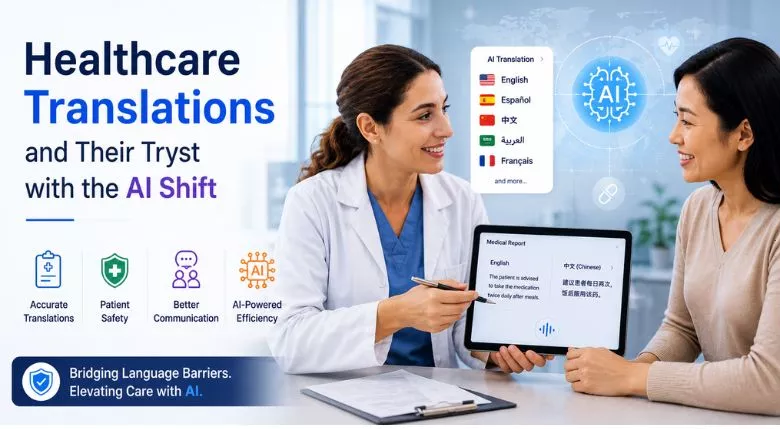
Furthermore, in 2026, artificial intelligence (AI) has completely transformed the way healthcare content is being translated. This evolution is changing how hospitals operate, how pharmaceutical companies scale globally, and patient experiences across languages.
But how much progress has AI truly brought in medical translations?
In this blog, we will explore how multilingual communication is evolving with AI healthcare translations and how much importance human expertise still holds in the industry.
Importance of Healthcare Translations in 2026
Did you know that healthcare processes today have become digital and global?
Now patients can easily access:
- Telemedicine platforms
- AI-powered health apps
- Wearable health monitoring devices
- Digital prescriptions
- Cross-border medical consultations
With this, healthcare professionals are communicating with patients in more languages than ever.
Several reports conclude that over 60% of global healthcare organizations invest in multilingual communication systems to improve patient engagement and reduce misunderstanding.
This has led to a surge in demand for medical translation services, with reports indicating that the industry’s valuation can well surpass a billion dollars by the end of 2026.
With the help of healthcare translations, organizations ensure accuracy and clarity in:
- Clinical trial documents
- Patient dossiers and discharge summaries
- Medical device manuals
- Healthcare insurance paperwork
- Telehealth consultations
- Healthcare mobile applications
We have explored the necessity of multilingual communication in the healthcare industry in 2026.
But what role does AI play here? Let’s explore further.
How Is Multilingual AI Transforming Healthcare Translations?
Real-Time AI Translation in Telemedicine
Telemedicine has expanded rapidly across India, Europe, the Middle East, and North America. Yet the persistent difference in languages still remains a challenge.
Multilingual AI tools, such as Ada Health and LivePerson AI and Aisera, are solving this challenge through:
- Live voice translation
- Real-time subtitling in multiple languages
- AI-powered multilingual chatbots
- Speech-to-text medical transcription
Let’s imagine a hospital in a multilingual country like India. The hospital partners with professional healthcare translation services in India and AI to ensure clear doctor-patient communication during video consultations.
AI-Powered Document Translations
Hospitals across the world deal with thousands of medical documents every day. Translating them manually is time-consuming.
But with modern AI translation solutions:
- Translating patient records becomes faster.
- Maintaining consistency in medical terminology across documents becomes easier.
- Repetitive manual work is reduced.
- The multilingual documentation workflow is accelerated.
While AI translation tools can boost speed, there is a catch. Relying only on AI for sensitive healthcare documents Translation is not enough.
To boost accuracy and maintain data protection, it is vital to work with expert medical translation services that implement strict privacy laws and reviews.
Smarter Localization for Healthcare Apps and Platforms
Patients expect healthcare apps to be multilingual and culturally adaptive.
They use these apps for:
- Appointment scheduling
- Remote health monitoring
- Mental health support
- Medication tracking
- Diagnostic assistance
This need for diversity has led to an increase in demand for software localization solutions.
Healthcare software localization includes:
- Regional language adaptation
- User interface adjustments
- Voice assistance localization
- Adapting the cultural tone of the software
- Optimizing accessibility
For instance, a healthcare app designed for Spanish-speaking users in Europe may require cultural adaptation when it is being curated for Latin America—even though both demographics speak the Spanish language.
Similarly, in India, healthcare platforms need different adaptations to support regional languages such as Marathi, Malayalam, Tamil, Bengali, Gujarati, and Punjabi.
Why Is There a Rise in Inclusive Medical Communication?
Healthcare organizations today don’t just expect multilingual communication but also focus on accessibility.
They have realized that providing services and content in multiple languages improves accessibility and directly impacts patient outcomes.
With multilingual medical content support, patients are more likely to:
- Follow treatment plans
- Understand prescriptions
- Trust healthcare providers
- Attend follow-up appointments
As a result, multilingual healthcare translations are getting thoroughly integrated into medical ecosystems around the world.
And now, with the help of AI tools, medical translations can also include:
- Regional dialects
- Medical terminology
- Gender-neutral healthcare communication
- Literacy-sensitive content
Are you interested in learning more about the day-to-day operations of healthcare translation companies and the challenges they face? Check out our must-read blog: POV of a Medical Translation Company in the Healthcare Industry!
Translate Your Medical Content with Complete Accuracy!
Beyond 2026: The Future of Healthcare Translations
The future of healthcare communication is bright, with heavy reliance on multilingual AI-assisted services.
Emerging innovation in healthcare includes:
- AI-powered wearables for healthcare translations.
- Augmented reality for healthcare interpreting.
- Multilingual virtual healthcare assistants.
- Predictive patient communication systems.
- AI-integrated electronic health records.
Healthcare organizations that invest in professional medical translation services will likely boost their patient trust, enhance global reach, and improve operational efficiency.
You May Also Wonder
Q1) How is AI improving healthcare translations in 2026?
Ans. AI is improving healthcare translations by enabling faster multilingual communication, real-time telehealth interpretation, automated medical transcription, and scalable document translations.
Q2) Why are healthcare translations vital for patient safety?
Ans. Patients who clearly understand diagnoses, prescriptions, and treatment instructions are less likely to face misunderstandings. Accurate healthcare translations reduce communication errors and improve patient understanding.
Q3) Why is localization important for healthcare apps?
Ans. Localization ensures healthcare apps are culturally relevant, linguistically accurate, and easy to use across different regions. Localization solutions also improve accessibility, usability, and patient engagement.
Wrapping Up
As AI continues to transform healthcare communication, the demand for accurate, culturally aware, and technologically advanced healthcare translations will grow stronger.
This is where experts like Somya Translators become useful.
We help healthcare organizations overcome the language gap by offering reliable medical translation services and certified clinical document translation services. From telemedicine interpretation and healthcare app localization to multilingual clinical trial translation, we provide expert solutions to ensure high patient trust and accessibility.
To explore how our trusted language services can support your organization, reach out to us via call or email.
Call: +91-9990094796