
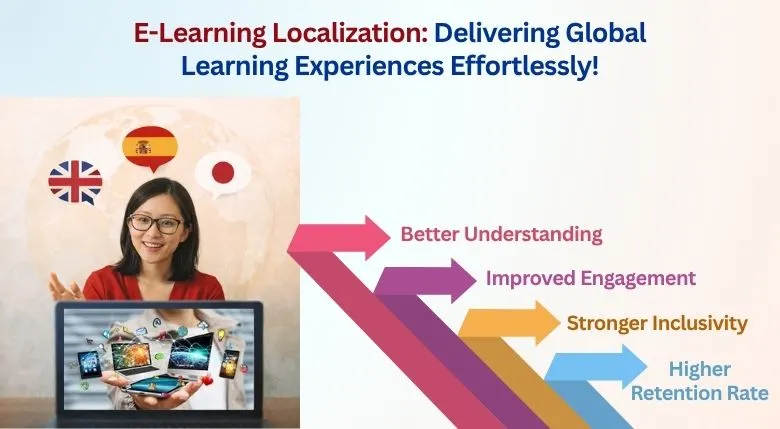
When an online course is launched in different language-speaking regions, e-learning localization becomes vital. It adapts the content in such a way that the learner (whatever language they speak) completely understands the course.
But isn’t just translating the language enough?
No, simply translating the content may often lead to low engagement, poor completion rates, and confused readers.
Learning is an experience, but sometimes, certain linguistic and cultural gaps can derail this experience, especially on a digital or online platform. E-learning localization addresses this gap by aligning both the content and the delivery platform with the expectations of multilingual learners.
This blog will explore how e-learning localization services help learning content and platforms function globally. We will also discuss how organizations can focus on delivering high-volume localized content for effective learning.
What is E-Learning Localization?
E-learning localization is the process of adapting learning content and digital platforms for different languages, cultures, and regional contexts.
Localization focuses on curating the learning experience to suit its target audience. The process of e-learning localization includes:
- Language adaptation
- Cultural relevance
- Visual and multimedia adjustments
- Platform design, usability, and performance
Digital learning translation services focus on converting the text of the content, whereas e-learning localization ensures that the learning experience resonates with the target viewer.
Why Is Multilingualism Important in E-Learning?
Language is a vital communication tool, but in e-learning, language is how learners absorb and retain information. When a course is created in a learner’s native language, comprehension improves significantly.
Multilingual content is vital for e-learning courses because:
- Improved Engagement: Learners who don’t speak English are more likely to complete an online course if it is localized to their native language.
- Better Understanding: Complex topics become easier to understand when they are translated into regional languages.
- Higher Retention Rate: Studies suggest that studying in one’s native language improves memory recall and comprehension.
- Stronger Inclusivity: Providing learning materials in different languages provides a sense of inclusivity among all learners.
Relying on English is not enough, as it cannot truly serve global audiences. Therefore, translating online courses for global learners becomes a strategic necessity.
Did you know that e-learning localization can also be used in training employees efficiently? Check out our related blog to know more: E-Learning Localization Services: A Smart Way to Reduce Worker Training Time.
Role of E-Learning Localization in Enhancing Content and Platform
Localization doesn’t just adapt the course material. It also improves how the platform delivers the content to specific regions.
We can divide the role of e-learning localization services into two avenues.
Content-Level Transformation
Localized content feels natural and relevant. And localizing this content includes:
- Integrating region-specific examples and scenarios.
- Simplifying the language to avoid misunderstanding.
- Adjusting terminology for industry-specific clarity.
For example, a vital term like “onboarding,” if not translated properly, may confuse non-English speakers.
Platform-Level Transformation
Equally important is LMS content translation, which ensures that the e-learning platform itself functions properly in different regions.
This includes:
- Navigation menus in local languages.
- Localized buttons and user interfaces.
- Date, time, and currency formatting.
- Mobile app optimization and responsiveness.
As a result, learners don’t just understand what they are reading but can also easily navigate between course materials.
Why Is Targeting a Specific Market Vital?
Although learning is a global approach, it is quite personal for the learners. Not all regions speak the English language; many follow different cultural beliefs and prefer various learning styles.
Hence, it is vital to adapt the e-learning content according to the language spoken in the particular region, and online course localization helps with that.
It assists organizations:
- Align content with cultural values and local beliefs.
- Avoid offensive phrases and confusing imagery.
- Adapt the tone and communication style to suit diverse learners.
- Match the learning content with regional learning practices.
Let’s take the following example.
A symbol, “thumbs up,” generally means “correct” or “understood.” Basically, it denotes a positive feeling. However, in countries like Japan, the symbol comes off as too casual and might end up feeling offensive. Similarly, humor, idioms, or references may not carry the intended meaning in different regions. Therefore, online course localization becomes vital, as it ensures that the content is adapted in such a way that it feels respectful in other cultures.
Best Practices for E-Learning Localization
A successful e-learning localization doesn’t just fall into someone’s lap. It needs a layered and structured approach.
1. Analyze the Requirements
It is necessary to plan properly before global expansion.
Check for:
- Which terms need to be translated?
- Which visuals need to be adjusted?
- Which cultural expressions must be adapted?
- What tone must be used for which market?
To achieve true e-learning localization, the content must also have:
- A simple language.
- Flexible layouts and formats.
- Allotted space in case of text expansion.
2. Research the Target Market
It is necessary to understand:
- Language variations and dialects.
- Cultural landscape.
- Learning expectations and preferences.
3. Always Work with Professionals
Rely on professionals for:
- Accurate elearning translation services.
- Complete cultural adaptation, which feels respectful and is acceptable.
- Seamless technical integration with different platforms.
4. Don’t Just Stop at Text
Ensure that all aspects of the course are translated and localized. This includes:
- Content, like text, manuals, and courses.
- Multimedia, like videos, recordings, and images.
- Platform interface, including navigation menus, buttons, and sometimes design.
5. Test It Before Launch
To ensure that your localized e-learning content and platform resonate with the target region, it is necessary to test it before launch for:
- Is the content clear and comprehensible?
- Is navigating across the platform easy?
- Are the visuals appropriate and understandable?
Pre-launch testing of e-learning content avoids later revisions.
Localize E-Learning Content According to the Target Market!
So, What Did We Learn from this Blog?
When e-learning content is influenced by geography, it needs to be shaped by language and culture. As digital learning grows beyond borders, localization becomes necessary. From adapting courses to optimizing delivery platforms, e-learning localization ensures that learners receive an effortless and meaningful experience.
Today, organizations that invest in localizing online courses for global learners are much better positioned to expand tomorrow.
Is it your goal to create impactful global learning experiences?
Working with experts like Somya Translators can help you achieve clarity, consistency, and cultural relevance for your e-learning content and platform!
Let’s collaborate! Contact us today for a free quote!
Call: +91-9990094796
Email: info@somyatrans.com