
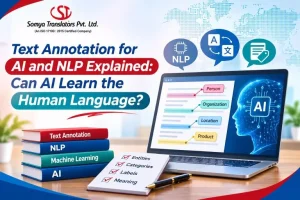
When an AI-powered platform analyzes an ambiguous customer query like “the service was sick,” what does it understand? Is the customer complaining or praising the service? It depends on how well the AI has been adapted to comprehend human language and context. This is where a fundamentally important process known as text annotation for AI and NLP comes into play. By turning ordinary text into labeled examples, it helps the machine recognize names, understand user intentions, detect opinions, and identify relationships between words.
Today, chatbots, AI, and multilingual search engines find exceptional use for text annotation to handle multiple languages more efficiently.
In this blog, we will discuss some types of text annotation, practical uses, quality challenges, and its role in translation and localization.
What Is Text Annotation in AI and NLP?
Text annotation is the process of adding labels to text so that an AI or natural language processing (NLP) system can identify patterns and perform specific tasks. These labels may describe an individual word, a sentence, a message, or an entire document.
For example, an annotated customer message might include labels that identify a product name, classify the query, and mark the sentiment as positive or negative.
How Text Annotation Works
The process typically involves four key steps:
- Collect text from suitable sources, such as customer reviews, conversations, documents, or surveys.
- Define labels that align with the AI task.
- Apply labels according to clear guidelines.
- Review the annotations before using them to train or evaluate a model.
Highly accurate labels can help models learn vital language patterns. However, inaccurate labels can lead to wrong pattern recognition and undermine user trust.
The National Institute of Standards and Technology (NIST) underscores three requirements of a trustworthy AI:
- Accuracy
- Reliability
- Testing under realistic conditions
A Simple Example of Text Annotation
Let us consider the following statement:
“Riya works at Microsoft in Delhi.”
Text annotation for a statement like this would look like:
| Text | Annotation Label |
|---|---|
| Riya | Person |
| Microsoft | Organization |
| Delhi | Location |
These labels help an AI model identify and analyze who, which, and where in the sentence.
Text Annotation vs. Text Labelling
Both of these terms are often used interchangeably because they both involve labelling words. However, some project teams use “annotation” for more detailed tasks, such as marking spans inside a sentence or linking entities. Others use “labelling” when the task is much simpler, such as giving one tag for the whole sentence. The distinction depends on the project and the industry.
It is vital for a text annotation service to clarify the terms they agree on with the client before confirming the project.
Common Types of Text Annotation
There are several types of text annotation, each designed to teach the AI or NLP model a different skill.
This table outlines some common types and where they are useful.
|
Type |
What it labels | When is it useful |
|---|---|---|
| Named entity recognition | People, organizations, places, dates | Extracting facts from text |
| Sentiment annotation | Positive, negative, neutral | Understanding customer opinion |
| Intent classification | The user’s purpose | Building chatbots and virtual assistants |
| Text classification | An entire document or messages | Routing and sorting content |
| Part-of-speech | Grammatical roles of words | Language analysis and translation projects |
| Semantic and relationship | Meaning and links between entities |
Knowledge graphs and deeper analysis |
Named Entity Recognition (NER)
NER is tasked with identifying and labelling names of people, organizations, locations, dates, amounts, and other entities. The NER process usually begins with a list of entity types, followed by written rules for special cases. For example, should the term “Mumbai University” be labelled as an organization or an organization plus location? Annotators then mark each entity in the text.
NER is quite useful when a system needs to extract facts from unstructured statements.
Sentiment Annotation
Sentiment annotation marks the opinion in a piece of text. Ideally, it marks a sentiment as positive, negative, or neutral.
Here’s an example for each category:
- Positive: The delivery was quick, and the product is excellent.
- Negative: My order arrived late and was damaged.
- Neutral: The package arrived on Wednesday.
However, sentiment annotation can be challenging when a statement expresses mixed emotions. For example, “the phone is fast, but the battery drains quickly.” This statement could either get a neutral label or separate labels for speed and battery.
Intent Classification
Intent labels are attached to the statements that describe what the person wants. A chatbot trained on these labels can respond to the purpose behind a message rather than relying on the keywords alone.
Some examples of intent classification are provided in the following table.
| Customer query | Intent |
|---|---|
| I’d like a table of two on Sunday. | Make a booking |
| I want my money back. | Request a refund |
| Do you deliver to Noida? | Ask for information |
| Where is my order? | Track an order |
Text Classification and Topic Labelling
This classifies an entire message or document into predefined classes, such as billing, technical support, or complaints. These classes are usually decided before annotation begins, and each text gets sorted into one class or more.
For example, a message about failed payment is labeled as “billing” while a message about product damage is classified as “complaint.”
Part-of-Speech and Linguistic Annotation
These labels are used to describe grammatical figures (noun, verb, or adjective) and the relationship between words in a sentence. Within the linguistic annotation process, the annotator analyzes the text word-by-word and applies fixed tags to them.
Let’s take the following example.
Universal Dependencies, an international open-source project for grammatical annotations, uses a shared set of 17 part-of-speech tags and, as of May 2026, covers 353 treebanks in 193 languages. [Source: Universal Dependencies, 2026]
These annotations are vital for multilingual projects due to language-specific grammar rules. Linguistic labels help AI tools check grammar, understand sentence structure, and translate text more accurately from one language to another.
Semantic and Relationship Annotation
Some projects want more than just facts. They want a deeper meaning, like understanding how words are related to each other. For example, in the sentence we used above, “Riya works at Microsoft,” AI can analyze that Riya is a Microsoft employee. Similarly, in “Riya is a good manager. She leads a team,” AI needs to understand that “she” refers to Riya. Semantic and relationship annotation help AI understand the meaning of sentences more accurately.
Examples of Text Annotation in Real-World Applications
Demand for text annotations for AI and NLP is growing rapidly. In 2024, the global AI annotation market was valued at $1.45 billion. The market value is projected to reach $13.11 billion by 2033. [Source: Grand View Research, 2025]
The following places frequently see the use of text annotation.
Text Annotations for Chatbots and Virtual Assistants
Intent labels help a chatbot identify a customer’s message and route it appropriately. For example, “My order never arrived” goes to the support team, while “Does this come in blue?” goes to the product team. Entity labels also add details, such as the order number or product name, so that the bot can act on the request.
Customer Feedback and Sentiment Analysis
Companies receive thousands of customer reviews and survey responses. When a statement is labelled by sentiment and by topic, a model can sort the rest automatically and analyze effectively.
For instance, a model could analyze customer feedback and identify vital metrics, such as most complaints received this month related to delivery time and not product quality.
E-Commerce and Product Review
Product descriptions and reviews contain several useful details. Annotators can mark color, material, and size in a statement like “red cotton shirt, size L.”
They can also label review topics such as fit, durability, and delivery. The results train search filters, comparisons, and review summaries.
Healthcare and Scientific Text Processing
In clinical notes and research papers, annotation marks entities such as symptoms, drug names, doses, and conditions. Being a specialized field with no room for error, this work needs annotators who have domain knowledge.
Clinical texts also contain personal information, so they must be handled securely with restricted access and ironclad privacy rules.
Search, Document Processing, and Information Extraction
Text annotation helps systems find names, dates, topics, and important details in high-volume documents. This process supports contract search, research databases, knowledge management, and automated document sorting.
In the translation and localization industry, annotation can also help identify product names, technical terms, and language-specific expressions. A translation agency working with multilingual AI datasets can draw on linguistic expertise to ensure that labels retain the same meaning across languages.
Common Text Annotation Quality Challenges
An AI model is only as good as its labels. A study of 10 widely used benchmark datasets, out of which three were text datasets, estimated that 3.3% of test labels on average were incorrect. [Source: Northcutt et al., NeurIPS 2021]
Some common quality challenges in text annotation include:
Ambiguous Words and Context-Dependent Meaning
A simple word can have more than one meaning. For example, Apple can be either a fruit or a consumer electronics company. Annotators must use context and follow clear entity-labelling rules.
Inconsistent Labels Across Annotators
Two annotators can label a sentence differently. For example, “great, another delay” can be interpreted as negative to one annotator and positive to another who missed the sarcasm.
A 2022 study found that clearer review rules helped annotators label text more consistently. In a dataset of IMDB movie reviews, the annotator’s consistency score increased from 0.131 to 0.464. For Amazon product reviews, it rose from 0.014 to 0.556. [Source: arXiv, 2022, paper 2205.12702]
This study was crucial in determining why clear guidelines and quality checks are important to create reliable text annotation datasets.
Handling Slang, Spelling Errors, and Multilingual Text
The way people talk digitally is quite informal. They use abbreviated words like “pls,” transliterated words, and a mix of languages in the same message. Such informal statements can easily confuse annotation systems.
These issues can be resolved by professional translators and reviewers when their linguistic and subject-matter expertise matches the dataset.
Annotation Bias and Missing Categories
A limited set of labels may not capture the full meaning of every message. For example, “the food was great, but the delivery was slow.” In this case, the customer is happy with the food but disappointed with the delivery. If the annotators can only label positive, negative, or neutral, they may struggle to assign a label that accurately reflects both emotions.
Review and Quality Control Methods
Expert text annotation teams solve these problems with a few steps:
- Clearly written guidelines and annotator training.
- Regular sampling and independent review of finished labels.
- Inter-annotator agreement checks, often with Cohen’s Kappa, where scores above 0.80 are generally considered a good agreement score. [Source: Landis and Koch, 1977]
- Adjudication, in which a senior reviewer settles disagreements.
- Corrections, version tracking, and final dataset validation.
While automation can suggest labels, human review matters most for uncertain or context-sensitive examples.
How to Prepare Text Data for Annotation
A good preparation saves a lot of time later. Here is how you can prepare your text for annotation:
Define the Annotation Objective
Mention what the model must do. It could be to find company names, sort tickets, initiate refunds, or address customer queries. A clearly defined objective would determine the labels, sample size, and the annotator expertise required.
Create a Clear Label Schema and Guidelines
Define every label and provide clear examples. They must also contain guidelines about edge cases like sarcasm or ambiguous statements.
Clean and Organize the Text Dataset
Remove duplicate rows, fix formatting issues, and fill missing text. Hide or mask personal details like phone numbers, names, or addresses.
Run a Pilot Annotation
Annotate a small sample first. Compare the results across annotators, identify the areas of disagreement, and revise the guidelines accordingly.
Validate Labels Before Model Training
Review a random sample of the finished labels, run consistency checks across annotators, rectify errors, and record the final dataset version. Keep training and evaluation data separate to ensure the results are accurate.
How To Choose the Right Annotation Approach
Match the Annotation Method to the AI Task
Select the labelling method that aligns with the task assigned to the model:
| AI Task | Suitable Annotation Method |
|---|---|
| Identify people and companies | Named entity recognition |
| Review customer feedback | Sentiment annotation |
| Detect requests and commands | Intent classification |
| Sort messages by subject | Text classification |
| Understand grammatical structure | Linguistic annotation |
| Identify connections between entities |
Relationship annotation |
Some projects may even need two annotation methods.
Consider Dataset Size, Language, and Domain Complexity
- A larger dataset needs more annotators and stricter reviews.
- Languages with several dialects or scripts require expert native speakers.
- Specialized fields like healthcare or law need in-depth industry knowledge.
When to Consider Professional Annotation Support
Professional annotation support becomes necessary when the project is large, uses specialized terms, and covers several languages. Professional text or data annotation services work closely at different stages of the project, so it is vital to choose a professional based on the objective.
Frequently Asked Questions (FAQs)
Q) What is text annotation in AI and NLP?
Ans. It is a process of adding labels to words, phrases, sentences, or documents, such as names, sentiment, intent, or topics, so an AI model can learn from it.
Q) What are the main types of text annotation?
Ans. The most common types are named entity recognition, sentiment annotation, intent classification, text classification, part-of-speech or linguistic annotation, and semantic or relationship annotation.
Q) Why do AI models need labeled text?
Ans. Models learn patterns from examples, and labels tell them what each example means. This further helps AI and NLP models to be accurate.
Q) How does text annotation support translation and localization?
Ans. It can help multilingual systems identify entities, technical terms, sentiment, and language patterns. Linguistic review ensures that labels account for differences in grammar, context, and cultural meaning.
Q) What makes a text annotation dataset reliable?
Ans. Several elements, such as clear guidelines, trained annotators, consistent labels, suitable privacy settings, sample reviews, and a final check before model training, can make text annotation reliable.
Conclusion: Building Reliable Text Datasets for AI and NLP
Expert text annotation for AI and NLP comes down to three fundamental objectives:
- Choose the label type that fits the task.
- Mention clear guidelines.
- Check a sample of the labels before annotation begins.
For multilingual AI, cultural context and language accuracy are as important as the labels. Somya Translators, a leading ISO 17100:2015-certified language service provider, supports multilingual datasets and language-focused AI projects with expert annotators.
Need help with text and data annotation? Check out our data annotation services!
Reach out to us today and get a free quote!