

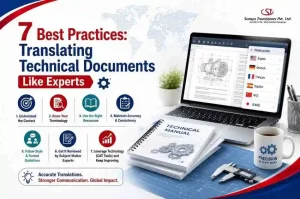
Technical document translation requires centralized knowledge bases, standardized file formats, translation memory (TM) tools, subject-matter-expert linguists, clear source writing, multi-step quality checks, and controlled version access. Unlike general translation, technical translation prioritizes safety, precision, and legal compliance over creative language.
A confusing appliance manual is annoying. A mistranslated manual for an industrial machine, a medical device, or an aviation engine can be fatal. This is why translating technical documents is not just a language task — it directly affects operator safety, machine efficiency, legal compliance, and a company’s ability to expand across international markets. Mistranslation in technical documentation can also trigger legal scrutiny and cost companies millions of dollars in liability, recalls, or delays.
Translate Complex Manuals with Ease and Efficiency! Contact Us Today for a Free Quote!
This guide explains why technical translation differs from general translation, and outlines seven internationally recognized best practices manufacturing and industrial companies use to keep translated technical documents accurate and compliant.
What Makes Technical Translation Different From General Translation?
Technical translation must be rigid, literal, and consistent, while general translation allows creative flexibility. A mistranslated marketing sentence may sound awkward; a mistranslated technical instruction can cause injury or legal liability.
| Feature | General Content | Technical Content |
|---|---|---|
| Goal | Engage, attract, and educate readers across languages | Guide and protect the safety of people operating machines or equipment |
| Word Choice | Synonyms and varied phrasing allowed | Exact, repeated terminology required |
| Impact of Mistranslation | May sound awkward | May cause safety hazards, lawsuits, or regulatory non-compliance |
| Primary Use Cases | Marketing materials, e-learning, tourism content | Manufacturing manuals, medical device instructions, software documentation |
The 7 Best Practices for Translating Technical Documents
1. Build and Implement a Centralized Knowledge Base
A centralized knowledge base is a secure, shared system that stores all reference materials a translation team needs to stay consistent across languages.
An effective technical translation knowledge base includes three core components:
- Project Briefs — documents defining the project’s purpose, turnaround time, and deliverables
- Style Guides — rules for brand tone, date formats, and numbering systems
- Glossaries — an approved list of terms, product names, and industry vocabulary that must stay consistent across every translated document
Why it matters: A centralized knowledge base prevents terminology drift when multiple translators or languages are involved, and it reduces costly revision cycles.
2. Create and Maintain Standard File Protocols and Formats
Files should be prepared for translation before the project starts, not during it. Poorly formatted source files (e.g., non-editable InDesign or XML files) slow down translation and increase error risk.
Three file-preparation standards to apply before handoff:
- Use Editable Files — separate text from images so translators can work without redesigning graphics
- Plan for Text Expansion — languages like German and Hindi can require up to 30% more space than English; layouts must stay flexible to prevent text overflow or distortion
- Protect Code Variables — isolate software tags and code snippets from translatable text in software manuals to prevent accidental translation of functional code
3. Use Advanced Translation Memory (TM) Tools
Translation Memory (TM) software is a database that stores previously translated sentences and terms, then automatically suggests them when the same or similar text reappears.
Common TM tools used in professional technical translation: SDL Trados, memoQ, and Phrase.
Three measurable benefits of TM software:
- Cost reduction — clients are not billed again for previously translated content
- Faster turnaround — linguists only translate new material
- Higher consistency — repeated terms and sentences remain identical across the entire document set
4. Work With Subject Matter Experts, Not Just Bilinguals
Fluency in two languages does not qualify someone to translate technical content. Accurate technical translation requires linguists with formal training and real-world experience in the relevant field — such as mechanical engineering, chemistry, or software development.
Professional technical translation agencies assign native-language linguists who hold relevant degrees and industry experience, ensuring terminology is not just linguistically correct but technically accurate.
5. Standardize Source Content Before Handoff
Translation quality is capped by source quality. If the original document is unclear, every translated version will inherit that confusion.
Before sending files for translation, technical writers should:
- Keep sentences short, direct, and easy to parse
- Use active voice (e.g., “Press the power button” instead of “The power button needs to be pressed”)
- Avoid regional slang, idioms, or overly complex phrasing
6. Implement Multi-Step Quality Checks
The 4-eyes framework is a quality control process used in professional technical translation, involving four distinct review stages:
- Translation — a certified translator converts the source text into the target language
- Editing — a second linguist compares the translation against the original for accuracy
- Proofreading — a specialist checks formatting, layout, unit conversions, and overall precision
- QA (Quality Assurance) — the file is finalized against client requirements; high-risk projects may also include back-translation or Linguistic Quality Assurance (LQA)
This layered review process is designed to catch errors before they reach the client.
7. Control Version Access and Keep Assets Updated
Using outdated glossaries or source files is a leading cause of translation errors. Professional teams solve this using platform-based asset management systems with role-based access control, ensuring every linguist works from the current, approved version of glossaries, style guides, and source files not an outdated copy.
Key Takeaways
- Technical translation prioritizes safety and precision over stylistic variation
- A centralized knowledge base and TM tools reduce cost and improve consistency
- Subject-matter-expert linguists not just bilingual speakers are essential for accuracy
- The 4-eyes framework (translation, editing, proofreading, QA) is the industry-standard quality process
- Version control prevents teams from working off outdated source material
Frequently Asked Questions
What types of documents need technical translation services?
Technical translation covers operational manuals, safety data sheets (SDS), engineering specifications, medical device manuals, software interfaces, patent filings, and user guides.
How does a centralized workflow save money on technical translation?
Using multiple translation agencies creates duplicated work, since each agency builds separate files and terminology lists. Centralizing the project with one translation partner allows the team to build a single, reusable translation memory — lowering costs over time.
Why shouldn’t companies rely entirely on free automated tools for technical documents?
Free AI translation tools often struggle with industry-specific terminology, context, and local regulatory requirements. A single mistranslated instruction can create a safety hazard or compliance violation. Professional workflows combine AI-assisted tools with certified human experts to ensure full accuracy.
About Somya Translators
Somya Translators is a technical translation partner working with a global network of certified subject-matter-expert linguists. We ensure technical content remains accurate, clear, and compliant across every target language.
Make your technical documents global with expert multilingual solutions.
📞 Call: +91-9990094796 📧 Email: info@somyatrans.com
Contact us today for a free quote.