

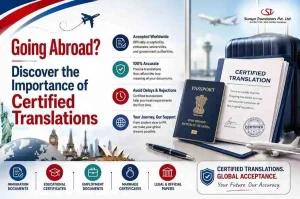
You submit a translated marksheet to an embassy for a student visa. But a few weeks later, a rejection letter comes. You are confused; a fluent speaker did the translation, so how did it get rejected? Simply because it lacked the specific certification stamp required by that specific country. When an official document is translated and sent to a foreign organization, overcoming the language barriers is just half the battle. The other half is to ensure that the translation is properly certified in accordance with the target country’s requirements.
In this blog, we will understand the importance of certified translations and why the requirements differ from one country to another.
What Is a Certified Translation?
A certified translation is not much different from a general translation, wherein a document is translated from one language to another. The only difference between the two is that a certified translation carries a signed statement of accuracy. This statement is also called a “certificate of accuracy,” and it proves that the document is translated by qualified experts and completely matches the format of the original.
The four core components of a certified translation are:
- Complete, word-for-word translated text.
- Signed certificate of accuracy from the translation agency or linguist.
- Explicit descriptions of seals, stamps, and signatures.
- Translator or translation agency’s contact details and credentials.
The key purpose of certified translation is accountability. Official bodies can rarely read the native source language. So, they rely on certified document translation to ensure that no vital details were changed, added, or omitted.
Translate All Your Official Documents with Full Accuracy and Compliance!
Why Do Certified Translation Requirements Differ by Country?
Every country relies on its versions of legal frameworks, accreditation bodies, and administrative rules to check the validity of document translations.
· Legal Framework and System Differences:
- Common Law Countries (e.g., the US and the UK): These nations do not generally have a centralized government body of translators. Any linguist with the appropriate competence can be issued a certified translation with a signed statement of accuracy.
- Civil Law Countries (e.g., Germany, Spain, and France): These systems use “sworn translators” (known as “beeidigte Übersetzer” in Germany). These professionals are court-appointed and are the only ones legally allowed to produce the signed and stamped statements with certified translations.
· Professional Accreditation Standards:
- Canada: The country requires official document translation to be performed by translators certified by the Canada Translators, Terminologists, and Interpreters Council (CTTIC) or a provincially recognized body.
- Japan: Every official submission requires verification through a public notary or specific consular officer rather than an independent agency signature alone.
· Regional and Linguistic Conventions:
Several countries speak more than one language. For instance, Switzerland speaks German, Italian, French, and Romansh, while India has 22 scheduled languages and thousands of regional dialects. Certified translations need to be done according to local rules related to dialects, legal terminology, and layout standards.
Explore more about the importance of certified translations in India in our blog: A Complete Guide to Certified Translations for Visa Applicants in India.
Which Scenarios Require Certified Translations?
Professional translation services that offer certified solutions are necessary whenever the official authority needs to verify your identity, background, or qualifications.
Some documents that commonly require certified translations are:
- Immigration and Visas: Bank statements, marriage licenses, police verification, and passports for government agencies like USCIS.
- Legal Proceedings: Court exhibits, affidavits, adoption papers, and power of attorney records requiring legal document translation.
- Higher Education: Transcripts, diplomas, and course descriptions submitted to foreign universities.
- Corporate and Finance: Certified translations are important for some cross-country contracts and filings, such as tax reports, audits, and business registry documents.
Certified, Notarized, or Apostille: Understanding the Differences
It is quite easy to mix up these three types of translations. Here are the differences between them:
| Feature | Standard Translation | Certified Translation | Notarized Translation | Apostille |
| What Is It | Simple text translation without a certificate of accuracy | Translation with a signed statement of accuracy | Certified translation signed in front of a notary public | Government authentication of a public document for international use |
| Who Provides It | Freelance translators or a professional agency | Qualified translator or a certified translation company | Qualified translator and commissioned Notary Public | State department or designated government office |
| Primary Use Case | Internal communications, marketing materials, or general documents | USCIS university admissions and legal filings | Specific state courts, adoption agencies, and some select embassies | Hague Convention country transfers |
| Verification Focus | Language accuracy and readability | Accuracy and completeness of the translated text | Identity of the person signing the document | Authenticity of the official signature or stamp on a public record |
Key Takeaway: A notary public does not verify whether the translation is accurate. They only confirm the identity of the person signing the document. Hiring a notary does not necessarily account for translation accuracy and can still lead to rejections.
Common Mistakes That Cause Document Rejections
Avoiding simple translation errors like the ones mentioned below saves time and money.
- Using Machine Translations or AI Translations: Automated tools miss out on many things, such as marginal texts, watermarks, stamps, and localized legal terminology. They cannot provide statements of accuracy or valid signatures either.
- Self-Translation or Bilingual Friends and Family Members: Bilinguals are not qualified to provide certified translations. Additionally, self-translated documents are often rejected due to conflicts of interest.
- Incomplete Content: Leaving out seals, back-page stamps, signatures, or faint marginal notes. Every element of the document must be accurately translated.
- Name Mismatches: Amateur linguists often end up translating the names in a way that doesn’t match the official passports or application forms.
- Poor Quality Scans: Translators cannot translate illegible texts, which result in unreadable notations in the final document, causing delays.
Frequently Asked Questions (FAQs)
Q1) What makes a translation “certified?”
Ans. A translation is considered certified when it includes a formal, signed statement from the translator or the agency. This statement holds the translator or the agency accountable for the accuracy, completeness, and true representation of the original document.
Q2) Can I certify my own translation for official use?
Ans. No. Most government bodies, courts, and educational institutions reject self-translation or translations performed by family members. The reason behind this high rejection rate is a conflict of interest.
Q3) Are a certified translation and an apostille the same?
Ans. No. A certified translation verifies the translated language matches the original document. An apostille is a separate government-issued certificate that authenticates the signature or seal on a public document for use in another country under the Hague Convention.
Q4) Do all countries require certified translation?
Ans. Not necessarily. Common law countries like the US and the UK accept agency-certified translations. However, in some countries like Germany, Spain, and France, translations need to be completed by court-appointed “sworn translators.”
Translating official documents into different languages requires high expertise. As a trusted provider of globally accepted translation services, Somya Translators delivers accurate, official translations that are compliant with the regulatory standards of over 100 countries.
Whether you need to translate legal filings, academic credentials, or personal records with high accuracy and exceptional quality, we can help.