

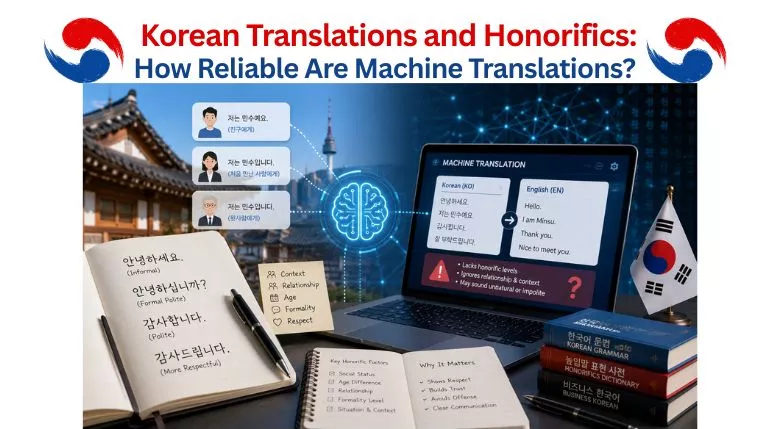
Some languages are quite straightforward. Korean is not one of them. When a business is communicating in the Korean language, people don’t judge just by what is said but also by how it’s being said. The level of politeness, choice of honorifics, tone, and way of ending a sentence—they all depend on who is speaking and who is being addressed. This makes Korean translations more complex than they already seem.
Businesses that work with Korean clients or try to engage with Korean consumers carry an extra layer of responsibility for getting the honorifics right. And then the question arises: can they trust machines for this?
In this blog, we will explore whether machine translation actually handles Korean honorifics or if human expertise is still essential for accurate and culturally relevant Korean translations.
What Are Korean Honorifics?
It’s not just using polite words.
Korean honorifics are language structures that are used to show respect, hierarchy, and social positioning during communication. They generally shape how people speak in both personal and professional settings.
Korean honorifics include:
- Speech levels
- Honorific verb forms
- Titles and suffixes
- Endings of formal sentences
For example,
- “먹다” means “to eat.”
- “드시다” is a respectful version of the same phrase, but for seniors or clients.
Similarly,
- “-아요” is a polite but casual way to agree with something.
- “-습니다” is used for a formal and highly professional setting.
These differences may not seem like much, but in Korean culture, they can dictate how a conversation will flow. One wrong usage can make communication sound careless, overly aggressive, and socially inappropriate.
Why do Korean Honorifics Matter in Business Communication?
In the Korean corporate environment, your social hierarchy influences how communication will flow.
A junior employee does not speak to a CEO the same way they speak to a coworker. Likewise, when a business communicates with its customers, they need to do so with respect. This is why honorifics are so vital in Korean translations.
Incorrect use of honorifics can result in:
- Misunderstandings
- Loss of professionalism
- Cultural discomfort
- Reduced business credibility
Let’s consider the following examples:
- Emails: A casual sentence ending in a business email may come off as disrespectful to the receiver.
- Contracts: Improper tone in legal documents can lead to the document being rejected by the authorities.
- Meetings: Using direct/straightforward phrases instead of respectful greetings might seem rude to some senior people.
In Korean business culture, respect is often communicated indirectly through language structure. Therefore, accurate Korean translation services ensure that not just the meaning is preserved but the social tone feels respectful too.
Challenges in Translating Korean Honorifics
One of the biggest challenges faced in Korean translations is that many honorifics do not have a direct translation in the English language.
So, while a sentence may technically mean the same thing in both languages, the emotional depth and the cultural respect might be missing in Korean.
Some major translation challenges include:
- Lack of direct English equivalents
- Heavy reliance on the context
- High dependency on the tone
- Formal vs. informal ambiguity
- Ensuring region-specific cultural sensitivity
For example, the Korean phrase “나는 괜찮아” can mean either of the following:
- It is okay.
- I am fine.
- No problem.
- No thanks.
The context of the phrase influences what the translation would be.
This high dependency on the context makes localization services for the Korean language absolutely essential for businesses.
Can Machine Translations Handle Korean Honorifics?
Let’s now explore the crux of our blog: Can we use machine translations to translate Korean honorifics?
“Sometimes, but not always.”
Machine translations are based on pattern prediction. So, they analyze the sentence, match it through their vast database, and then provide the closest translation. However, honorifics, which depend on social subtlety and relationships, obstruct machines from fully interpreting/analyzing the sentence.
This results in:
- Overly casual tone in professional communication.
- Mixing formal and informal speech levels.
- Ignoring or misrepresenting hierarchy between the speakers.
- Misinterpreting implied meaning.
Some Risks of Using Machine Translations for Korean Business Content
If a business completely relies on machine translations, it risks facing severe consequences.
These risks include:
- Miscommunication with clients
- Damaged brand reputation
- Being culturally offensive
- Losing the customer’s trust
- Coming off as unprofessional in messages
To avoid these, it is essential for businesses to partner with professional business translation services. These services work with expert native Korean translators to ensure proper conversion and usage of honorifics.
Do you want to explore businesses that generally need professional Korean translations? Check out our must-read web blog: Korean Translations and Why Do Some Industries Need Them?
When Can Machine Translations Be Used?
We had mentioned earlier that machine translations can be used in some cases. In fact, machines provide speed and efficiency when used properly.
Some suitable cases where machine translations can be used are:
- Internal communication
- Rough drafts
- Non-sensitive documents
Another way of using machine translations is to also apply human review to the translated content.
So, after the machine translates the initial content, native Korean linguists review it for:
- Cultural resonance
- Proper usage of honorifics
- Language accuracy
- Tone
- Terminology
- Readability
This process is also called machine translation post-editing (MTPE).
Translate Your Content Effortlessly into the Korean language!
Why Choose Accuracy Over Automation?
Machine translations have improved greatly, but they still have a long way to go before becoming completely reliable—especially when it comes to translating Korean honorifics.
As business communication in South Korea heavily depends on hierarchy, tone, and cultural respect, simply relying on machines won’t guarantee you success. Rather, it will damage professionalism and trust.
AI tools give you speed, but human expertise guarantees you accuracy. And in Korea, where business reputation matters, success is the only way forward.
At Somya Translators, we provide expert Korean translation and localization services that are specifically designed for business communication. Our Korean native linguists use honorifics precisely, ensuring correct tone, cultural relevance, and business etiquette required for the Korean market.
You May Also Wonder
Q1) Can mistakes in Korean honorifics affect business relationships?
Ans. Yes, incorrect honorific usage may appear disrespectful, overly casual, or culturally insensitive. This can damage business relationships in corporate communication.
Q2) Are AI tools reliable for Korean legal documents?
Ans. AI tools may help with drafts, but legal and contractual documents must always be translated by expert and certified human linguists.
Q3) Which industries commonly require the translation of Korean honorifics?
Ans. Industries such as tourism, healthcare, e-learning, and entertainment deal with Korean honorifics and so require assistance from Korean business translation services.
If your business is planning to communicate with Korean clients, partners, or customers, we, Somya Translators, can help you with accurate, culturally aligned, and professionally reviewed Korean translations.
Call us or email our team today to discuss your requirements.
Call: +91-9990094796
Email: info@somyatrans.com