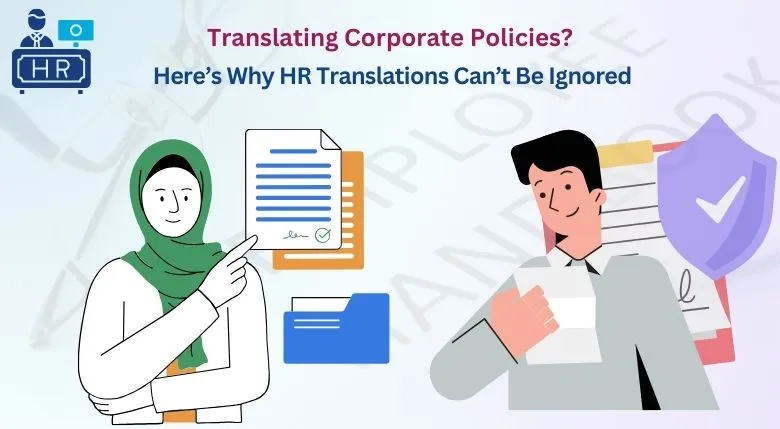
 Effective company policies mean an enriching workplace. An enriching workplace means satisfied employees, and satisfied employees surely lead to profits and growth.
But if we are being honest, the idea of flipping through an employee handbook or a lengthy list of company policies can well and truly be a snooze fest! Now imagine reading one in a language you half understand.
Confusing? Yes. Risky? Definitely.
In any company, the human resource department plays an essential part in ensuring an efficient workplace culture. Their most trusted tool? HR documents, which are vital to maintaining smooth company operations. However, when the workforce speaks multiple languages, ensuring that every employee fully grasps the information provided in company policies and employee handbooks becomes challenging.
So, what happens when a new German native employee joins an American company? Will they understand the company policy, benefits guide, and compliance rules?
This is where HR policy translation comes in. It helps employees understand workplace rules, rights, responsibilities, and procedures in a language they are comfortable with
In this blog, we will discuss why accurate linguistic services like HR translation and employee handbook translation are essential in the modern multilingual corporate world.
What Are HR Translations?
Simply put, HR translations refer to the process of converting human resources materials into different languages. They include employee manuals, workplace guidelines, contracts, and performance evaluations.
To truly understand why HR policies need translation, we must remember that professionals don’t just convert the language. They also offer other linguistic services, such as corporate policy language localization to adapt the legal content according to the cultural requirements of the region.
The Risks of Poor Translations
Google Translate can do a good enough job, right? Well, not quite!
Free online translators are not the right choice to translate complicated and legally binding HR documents.
The reason is:
- Free translators are not 100% accurate, which can lead to legal issues.
- Online translators can misinterpret technical terms and jargon, leading to compliance failures.
- Poorly translated instructions also create confusion about leave entitlements, safety precautions, or disciplinary procedures.
For example, confusing calendar days with working days in a leave policy could cause employees to miscalculate their entitlement. Similarly, ambiguous disciplinary words could prevent employees from understanding the process of responding to a complaint.
The US Occupational Safety and Health Administration emphasizes that workplace safety training must be provided in a language and vocabulary employees can understand. While requirements can vary by region, the principle remains that clarity is of the utmost importance while communicating safety procedures.
ARE YOU LOOKING FOR ACCURATE AND COMPLIANT HR TRANSLATION SERVICES?
Contact us today for a free quote!
Which HR Documents Need Accurate Translations?
In a multilingual workplace, every HR document needs to be accurately translated.
Some of them are:
- Employee Handbooks
- Onboarding and Training Manuals
- Health and Safety Instructions
- Workplace Compliance Materials
- Performance Appraisal Forms
- Employee Benefits Guides
- Conflict Resolution Policies
Some other HR documents used in multilingual workplaces include:
- Employment Contracts
- Recruitment Materials
- Payroll Information
- Leave Application Forms
- Grievance Procedures
- Anti-Harassment Policies
- Termination Notices
As these are high-stakes documents, maintaining legal compliance through HR translation is vital.
For example, the importance of translating employee handbooks lies in helping new recruits understand company expectations, workplace conduct, available benefits, leave policies, and reporting procedures.
What Are Some Benefits of HR Document Translations?
One thing is clear:
- Build deep trust and inclusivity among employees.
- Improve retention and morale in culturally diverse teams.
- Help employers implement company policies fairly across regions.
- Improve recruitment and onboarding experiences.
The benefits of multilingual employee communication are vital when employees need to understand policies that affect their rights, safety, and working conditions.
Miscommunication among the workforce can cost a company money, loss of credibility, and an unstable work environment.
Case Study: IKEA, The Swedish Powerhouse
IKEA, known for its beautiful and innovative home decor, has rapidly expanded its operations across Asia and South America, two very competitive markets. In Southeast Asia, IKEA expanded across markets such as Singapore, Malaysia, Thailand, and the Philippines, maintaining a common HR framework. However, to fully comply with the local regulations, they had to make adaptive changes to their HR policies.
So, why is regional adaptation of HR policies and documents so vital?
It helps to comply with local regulations. HR policy localization also helps with
- Smooth onboarding process
- Happier and more satisfied employees
- Fewer workplace conflicts
- Improved efficiency in the workplace
The localization approach for every country is not the same. For example, brands entering India face several difficulties while localizing. Check out our blog to learn more: 5 Localization Hurdles Brands Trip Over in India.
What’s a Good HR Translation Partner?
When evaluating a translation provider, focus on quality, subject expertise, confidentiality, and the ability to maintain consistent translations over time.
Here’s what you need to look for:
- ISO-certified translation services (preferably ISO 17100).
- Expert, native translators with legal and HR domain proficiency.
- Capable of providing multilingual corporate policy language localization.
- High priority on data privacy and confidentiality.
ISO 17100 specifies requirements for translation-service processes, resources, and quality. Organizations should verify a provider’s certification status and scope rather than relying on a general certification claim.
For more information about HR policy translations, feel free to visit our HR and company policy translation webpage.
Want to ensure a thriving global workplace? Contact Somya Translators us today for exceptional HR document translation services!