

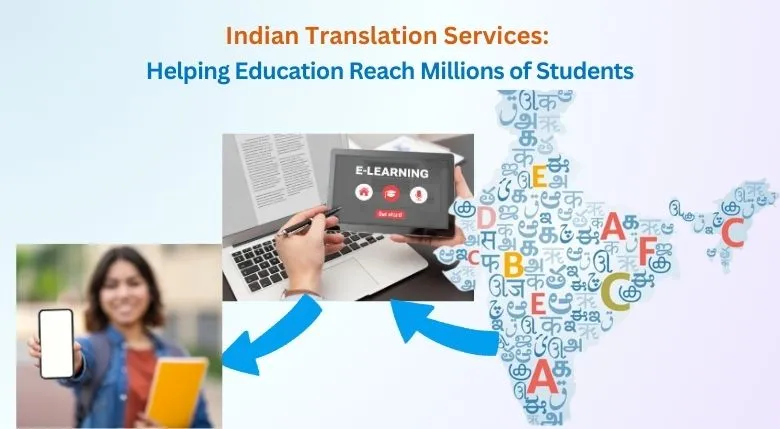
 Millions of students get enrolled across various education boards, such as the Central Board of Secondary Education (CBSE), the Indian Certificate of Secondary Education (ICSE), state boards, and international schools, with hopes to achieve quality education. These students don’t just represent India’s bright future but also the country’s vast linguistic diversity. In a metropolitan city like Mumbai, a student speaking Malayalam shares a desk with a Marathi student. Or in a rural district, students get to learn fluent English along with the regional language.
However, today, schooling in India is not limited to teaching by traditional methods only. The past fifteen years have seen the rise of e-learning platforms in India, which have also started using multiple languages to ensure broader student participation. Though English and Hindi are still majorly used in education, studies show schooling in regional languages, such as Marathi, Tamil, Odia, and Malayalam, is equally beneficial for a multilingual student’s overall development.
As languages shape a child’s learning ability, it sometimes becomes essential to express knowledge in their native language. Hence, Indian translation services are seen as a foundational support system in schooling in India.
This blog will explore how professional language services strengthen schooling, the challenges they face, and how educational institutes can find a suitable academic translation partner to support multilingual students across India.
Why Do Multiple Languages Matter in Indian Education?
The Indian constitution recognizes 22 scheduled languages, while there are hundreds of regional dialects spoken across the country. While English and Hindi are commonly used in education, many students and teachers often communicate in regional languages for clarity.
Several problems can arise when school communication is limited to one or two languages. Some of these issues are:
- Parents may not fully understand school curricula, notices, and policies.
- Multilingual students may face difficulties in grasping foundational concepts.
- Teachers themselves may face challenges while interacting with regional students.
However, by integrating Indian translation services into the education system, these challenges can be effectively addressed. Furthermore, using translation and interpretation for schools can ensure language doesn’t become a barrier to understanding, participation, and growth.
How Do Indian Translation Services Support the Education System?
Professional translation services for Indian languages help schools function efficiently. This includes administrative communication, classroom learning, and online schooling.
Some areas where academic translation services make an impact are:
- Translation and interpretation for schools can help to significantly reduce the gap in communication between teachers, students, and parents. These solutions can be used during PTMs, orientations, counseling sessions, and disciplinary discussions.
- Students can understand complex concepts better when academic materials are translated into regional languages. Similarly, translating courses in educational apps, such as Vedantu and Unacademy, helps distant learning students understand the concepts better.
- Vital documents like school policies, circulars, and notices become more accessible to parents who speak different languages.
Several studies conclude that students, especially in earlier grades, tend to learn and retain information better when taught in their first language (mother tongue).
Which Academic Content Needs Translations?
Modern Indian schools rely on a wide range of learning materials to provide comprehensive education. However, these materials need to be linguistically adapted to ensure that students understand them completely.
Some educational materials that require translation are:
- Report cards and other academic merit documents.
- Curriculum guides, worksheets, and textbooks.
- Exam instructions and assessment materials.
- Online modules, courses, and digital classrooms.
Professional academic translation services can expertly maintain subject-specific terminology while adapting the content according to the cultural elements of Indian regional languages.
The aftermath of the COVID pandemic saw a rise in digital classrooms. With this rise,
Translation And Interpretation For Schools, Document Translation Agency, Academic Translation Services, E-Learning Translation Services, Transcript Translation Services.
have also become essential. Video lessons, interactive quizzes, subtitles, and LMS content need careful localization so that students from various regions receive high-quality education, regardless of the language they speak.
Several online education institutions have also shifted their focus to micro modules and their localization. Check out our related blog to know more about them: Micro-Module E-learning Localization: A Smarter Way of Learning.
Translate All Academic Content with High Accuracy!
Contact Somya Translators Today for a Free Quote!
The Supporting Role of Document and Transcript Translations
Under the broader umbrella of academic translations, other language solutions, such as document and transcript translations, play a vital role.
- A reliable document translation agency would ensure that proper, certified steps are taken to provide accurate and culturally driven multilingual school documents, such as textbooks, course materials, and report cards.
- Transcript translation services help students who plan to go abroad for higher studies by precisely translating academic records according to the language of the target country.
Are you interested in exploring more about the role of multilingual transcription services, especially in the e-learning industry? Don’t miss out on our related blog: Multilingual Transcription Services: Turning Unknown Words into Wisdom.
Challenges in Translating Academic Content in India
Translation for the education industry comes with some unique challenges, especially in a linguistically diverse country like India.
Some challenges include:
- Lack of standard terminology for multiple regional languages.
- Some complex academic concepts and equations cannot be directly translated into different languages.
- Maintaining consistency is difficult for large volumes of eLearning material.
- Balancing speed, cost, and quality for rare Indian languages is challenging.
Academic content must be thoughtfully localized so that it aligns with cultural context and regional understanding.
A Balanced Approach: Humans and Technology
Today, Indian translation services have started to combine human expertise with technological marvels to derive better results. Machine translation post-editing (MTPE) uses AI-assisted translation and curates it with help from human linguists to improve turnaround time and maintain accuracy.
Benefits of MTPE include:
- Speedy delivery during peak academic seasons (May-July)
- Consistent use of translated terms
- Scalable solutions for schools
- Human reviews to ensure contextual accuracy
How Can Schools Choose Suitable Indian Translation Services?
Selecting a translation service is a vital step for schools and education boards.
This is what they need to look for:
- Experience with Indian languages and the academic industry.
- ISO certified quality standards.
- Ability to offer diverse services like translation, localization, interpretation, and subtitling.
- Strong data security measures to avoid any information leak.
This is where Somya Translators enters.
As a leading ISO 17100:2015-certified language service provider, we offer:
- Professional translation and interpretation services for schools.
- Expert localization for academic and educational content.
- MTPE services for cost-effective large-scale projects.
- Subtitling services for learning videos.
- Expertise across major and rare Indian languages.
The future of India’s education will be deeply influenced by its diverse linguistic identities. By investing in professional Indian translation services, schools can invest in clarity and student progress.
If your institution is looking to strengthen its communication with multilingual students, then Somya Translators can help!
Let’s Collaborate!
Call: +91-11-43061918
Email: info@somyatrans.com