

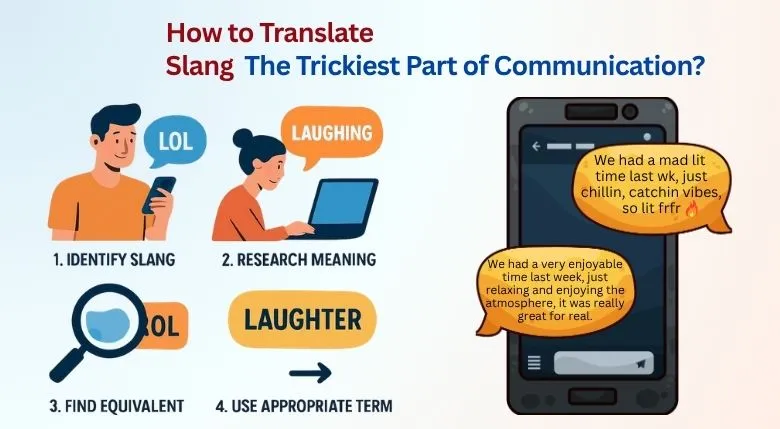
“A language not found in your textbooks but heard everywhere!”
Sometimes, the most expressive parts of communication are the hardest to translate. Slang—the informal phrases used in everyday conversations—is one of them. They sound natural, relatable, and often a bit playful. However, they are quite tricky to translate.
When you try to translate slang, things might not go as planned. Why? Because slang is more culture-driven than language-driven. It also becomes necessary to understand what slang in translation is, because experts don’t just translate the words; they translate the meaning across cultures.
In this blog, we will explore the various layers of translating slang, their importance in communication, and why they matter more than one might think.
What Is Slang in Translation?
Slang are informal words or expressions that are used in normal communication. While most people might think that slang is a new concept, it has been around for ages.
Slang is often influenced by the following:
- Pop culture
- Social trends
- Regional identity
- Age groups
- Religious communities
- Revolutionary ideas
In the translation industry, slang becomes a unique challenge, merely because it requires more than linguistic know-how. It needs knowledge of cultural nuance and contextual understanding.
Using services like informal language translation and cultural nuances in translation ensures that the emotional impact of slang remains the same in the translated language.
Why Slang Matters More Than You Think
Since the roaring twenties (1920s), slang has played a powerful role in shaping communication—not just in English but in many languages. It:
- Makes content relevant and natural
- Fosters an emotional connection with audiences
- Reflects and preserves cultural identities
Global businesses, too, take advantage of slang language, especially in their marketing materials. With professional localization, brands ensure that their marketing content contains proper slang that makes the content approachable in target regions.
Why Slang Is Difficult to Translate Across Cultures?
Slang has always been one of the most pressing language interpretation challenges.
This is why:
- No Direct Equivalents: Many slang expressions or words do not have a direct translation in other languages. For example, “spill the tea” rarely has a literal translation in other languages. However, “give me some gossip,” which is the closest meaning to the slang, can be translated into other languages.
- Constant Evolution: Slangs evolve rapidly. Words that were popular yesterday are outdated today, and words that are trendy today may be unimportant tomorrow. For example, “lit.” A few years ago, lit meant (and still means) to light something up. But now, the tech-savvy generation uses the word “lit” to describe something that is amazing.
- Cultural Sensitivity: As we mentioned earlier, slang is culture-driven. Some slang may carry unintended and even offensive terms when translated into different languages. For example, the Spanish term “mañana.” When used in an informal context, it implies doing a task at a later time. However, the direct translation of the term means tomorrow.
- Tone and Identity: Slang is used by youth, communities, and even professionals. Hence, both linguistic adaptation and cultural preservation become vital during translation.
Like slang, idioms are also quite difficult to translate into other languages. As a professional translation company, we often encounter some Kannada idioms that need to be translated into English. Want to learn some tricky Kannada language idioms? Check out our must-read blog: 7 Kannada Language Idioms That Just Can’t Be Translated into English!
Slang Translation in Different Languages
Let us discuss some examples of slang translation in different languages:
- “Cool” in English may translate to “guay” in Spanish and “chido” in Mexican Spanish.
- “LOL” becomes MDR (mort de rire) in French.
Similarly, “I’m dead” may confuse non-English speakers if not translated according to its true meaning, which is “I am laughing uncontrollably.”
These examples reflect how easily slang can distort meaning if not handled correctly.
How to Translate Slang Accurately in Global Communication?
To effectively translate slang, professionals rely on a comprehensive strategy rather than direct translation.
Some key steps of these strategies are:
- Collaborate with Native Linguists: Native linguists are culturally aware and can help to use the most appropriate translation of slang.
- Stylistic Compensation: Directly replace slang with a culturally equivalent phrase.
- Content Review: It is vital to check the content and determine translatable and untranslatable terms.
- Paraphrasing: Rewrite the slang in different words while keeping the meaning intact.
- Softening: Some slang may be strong-worded. It is better to reduce the intensity of this slang during translations.
- Linguistic Testing: Test the translated slang with a small group of the target audience and incorporate their feedback.
- Avoid Literal Translation: Even though it might denote the same meaning, literal translation often leads to confusion among speakers of other languages.
Working with professional translation company with expertise in marketing translations can help brands translate slang in a value-driven approach.
Translate Your Content with Cultural Expertise!
Slang in Business Communication: Hidden Opportunity or Obvious Risk?
We had mentioned earlier that slang is an informal phrase or word. Notice the stress on the word “informal”? So, if they are informal, are they the best choice in business content?
Some benefits are:
- Builds high relatability with target consumers.
- Enhances and aligns brand voice with the cultural preferences of the target region.
- Instantly connects the younger audience with the brand’s marketing materials.
Some risks are:
- Without professional attention, misinterpretation is easy.
- Cultural mismatches can happen occasionally.
- Brands can lose their credibility in foreign markets.
Are you a brand that wants to ensure accuracy and relevance in translating slang? Trust business translation and website localization services.
Difference Between Slang Translation and Localization
It is vital to remember that slang translation and localization serve the same purpose, but they are still different.
- Slang translation refers to the process of converting the informal expressions from one language to another. The process is generally used for marketing content.
- Localization adapts the entire content, including tone, visuals, and cultural references. The process is generally used for websites, catalogs, product descriptions, and training materials.
Both are essential for the global success of a brand.
The Bigger Picture: Slang and Global Communication
The role of slang in cross-cultural communication has become vital. It reflects how people truly think, feel, and connect.
To translate slang for global communication, brands need to understand people, not just the language they speak. This requires cultural and contextual awareness along with constant evolution.
While slang adds a new layer of personality and relatability in a brand’s marketing material, it also brings complexity. We, Somya Translators, help businesses find the right balance and success in global connections. With our expertise, experience, and approach, we help brands speak both formal and slang languages to different markets.
People Also Ask
Q1) How do translators handle slang effectively?
Ans. Professional translators use cultural equivalents, paraphrasing, and contextual adaptation when translating slang. This helps them to preserve the original meaning and tone.
Q2) Can slang be used in professional communication?
Ans. Yes, but very carefully. It works best when used in marketing, tourism, social media, and website content. However, it must be avoided in legal and medical content.
Q3) Why is slang important in marketing translation?
Ans. Using the correct slang makes brand messages more relatable and engaging, especially for the younger audience.
Q4) What are the most common mistakes in slang translation?
Ans. The most common mistakes in slang are literal translation, ignoring cultural context, and using outdated or incorrect slang.
Q5) How can Somya Translators help with slang translation?
Ans. We use expert linguists and a robust quality assurance process to ensure slang is translated accurately while maintaining tone, context, and audience connection.
With the right expertise, the approach to translate slang becomes an opportunity rather than a complexity.
Unsure whether to use slang in your marketing content? Trust us for the correct guidance!
Reach out to us today and get a free quote!
Call: +91-9990094796
Email: info@somyatrans.com