

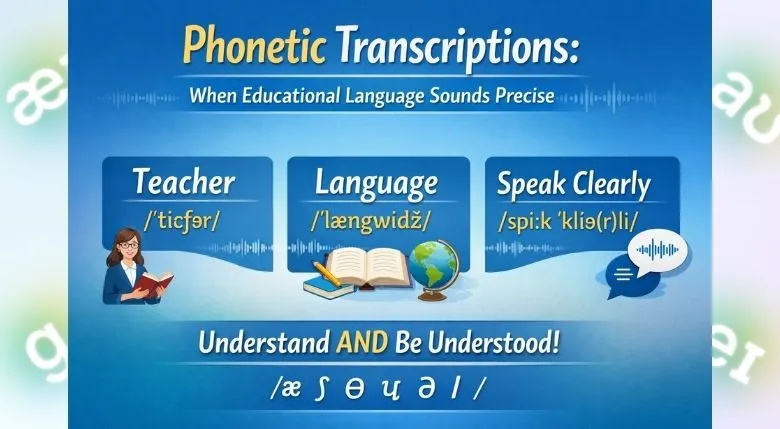
In English, “though,” “thought,” “through,” and “tough” look quite similar, yet they sound different. This language is surely tricky and inconsistent. For a student who has English as a second language, this leads to damaging learning experiences. Many students often feel confused about:
- How to pronounce a particular word?
- What spelling to use?
In multilingual classrooms and online education, these things matter. Fortunately, phonetic transcriptions help these students as a vital academic tool.
In this blog, we will explore the essential role of phonetic transcriptions and why they have become so important for modern classrooms. We will also discuss how professional transcription services can help learning institutions deliver precise and accessible content worldwide.
What Are Phonetic Transcriptions in Education?
Basically, phonetic transcriptions are the written representation of spoken words. Instead of spelling the words in the usual way, phonetic symbols show exactly the way a word should be pronounced.
Globally, the International Phonetic Alphabet (IPA) is used to assign a specific symbol to each distinct sound in human speech. By using a standard system, confusion caused by the irregular symbols is eliminated, especially in English.
For example,
- “Enough” is transcribed as /ɪˈnʌf/.
- “Through” is transcribed as /θruː/.
Although the spelling still remains tricky, the pronunciation becomes clear and distinct—boosting learning experiences for multilingual students.
Importance of Accurate Pronunciation in Education
In the education sector, precise pronunciation directly impacts:
- Listening comprehension
- Reading fluency
- Speaking confidence
- Overall academic performance
By pronouncing words accurately, students are able to recognize and use them faster. Hence, accurate pronunciation and complete comprehension go hand in hand.
Due to a rise in global classrooms, exchange programs, and multilingual digital courses, educational phonetic transcription is becoming a vital academic requirement.
Modern online education has brought about several high-impact changes. One such change is the use of micro modules in e-learning. Explore more about this in our related blog: Micro-Module E-learning Localization: A Smarter Way of Learning.
Importance of Phonetic Transcriptions in Education
Phonetic transcriptions support the education sector in more than one way:
- Improves Pronunciation Skills: Students who are not well-versed in the English language often find silent letters and unfamiliar sounds quite confusing. Accurate phonetic transcriptions offer clarity in these issues. For instance:
- “Knight” is transcribed as /naɪt/.
- “Schedule” can be transcribed as /ˈskɛdʒ.uːl/ (for American English) and /ˈʃɛd.juːl/ (for British English).
These phonetic symbols act as a guide—making pronunciation training for students more well-defined and measurable.
- Improves Listening and Reading Ability: By understanding how a symbol denotes a sound, learners improve their listening accuracy. They begin to:
- Recognize stress patterns
- Identify syllable divisions
- Distinguish similar sounds
Additionally, their reading fluency also improves as they are able to connect spoken and written language more easily.
- Supports Speech Therapy and Special Education: Phonetic transcriptions also play a vital role in speech therapy. Speech experts use them to:
- Identify diction issues
- Analyze speech patterns
- Implement corrective exercises
Clarity about how a word sounds can help students with learning differences. Expert linguistic transcription services support educational institutions with value-driven and multilingual phonetic transcriptions.
Transcribe Learning Materials with Ease and Efficiency
Which Educational Institutes Use Phonetic Transcriptions?
Phonetic transcriptions are a vital part of several educational institutions.
Schools and Language Training Institutes
Language institutions benefit heavily from phonetic training. Students learning English, French, German, or Spanish rely on consistent use of IPA references.
Even schools across the globe use phonetic guides as part of their literature programs. These guides help children to understand “sound-letter relationships” better. Additionally, they hone foundational reading skills and improve long-term language retention.
Universities and Linguistics Departments
Phonetic transcriptions are also essential for higher language education. They support:
-
- Linguistics research
- Dialect studies
- Comparative language analysis
- Teacher training programs
Moreover, universities often combine phonetic transcriptions within their international programs to ensure comprehension, pronunciation consistency, and retention in multilingual course materials.
E-Learning and EdTech Platforms
Online learning relies on multilingual clarity. While learning through remote platforms, students cannot always ask teachers for pronunciation clarity. However, to address this, e-learning platforms can integrate:
-
- Phonetic captions
- Speech-recognition assessments
- Interactive pronunciation modules
This can boost content accessibility and enhance learning engagement. Reliable transcription services in India also ensure that e-learning materials maintain high phonetic accuracy across languages.
Common Challenges in Educational Phonetic Transcriptions
Despite being highly beneficial, phonetic transcriptions come with some challenges:
- Complex IPA symbols (/ʔ/, /ʒ/, /ŋ/, /ʊ/) can confuse beginners.
- Variation in accents may require expert assistance.
- Using automated tools may misidentify speech.
- Consistency standards may get distorted (even after using IPA) in multilingual classrooms.
Addressing these challenges often requires collaboration with linguistic validation services to verify the correctness and consistency of phonetic transcripts.
How Do Professional Phonetic Transcriptions Help Educational Institutions?
Professional transcription services help by offering:
- Expert IPA-based phonetic transcriptions.
- Documents that are mindful of the accents.
- Integration with human-driven academic translation services.
- Strict quality checks through linguistic validation services.
- Support for multilingual educational content.
By investing in reliable linguistic transcription services, educational institutions can create enriching learning environments where pronunciation, comprehension, and clarity work hand in hand.
Precision in Pronunciation is Power in Learning
Global education statistics have shown a steady rise in international students opting for multilingual e-learning courses. With classrooms becoming more diverse, the demand for correct pronunciation has increased.
Hence, phonetic transcriptions are reshaping the educational sector. More importantly, they help students to speak with clarity and confidence. From developing curriculum to curating online courses in multiple languages, phonetic transcriptions support inclusive and effective learning.
At Somya Translators, we believe that expertise in transcriptions and academic translations helps educational institutions holistically develop students. Because when students learn how words truly sound, learning becomes limitless.
Are you a school, university, or edtech platform that is looking for accurate transcription services? Trust the expert linguists of Somya Translators!
Contact us today for a free quote!
Call: +91-9990094796
Email: info@somyatrans.com