

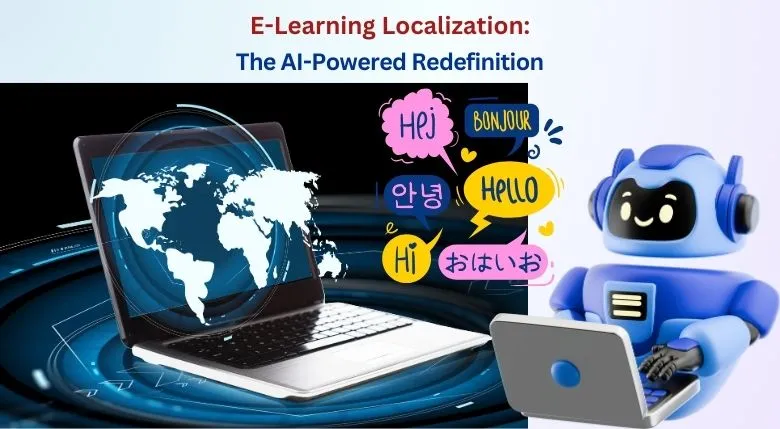
AI has changed e-learning localization, but how much has it really helped to evolve it?
As organizations and institutes have started pivoting towards digital mediums, e-learning platforms have become quite essential. Many studies show that the global e-learning industry will surpass $370 billion by the end of 2026. With such wide usage, e-learning companies that traditionally offer multiple languages have started to look at artificial intelligence. With AI-powered tools, speed, automation, and scale of language translations have become tremendous.
Yet these advancements mask a vital challenge: cultural relevance. AI-powered tools cannot guarantee whether they are also mirroring the culture of the target learners, but humans can.
Today, e-learning localization is defined by the transformative changes brought about by both AI tools and expert human linguists. In this blog, we will have a deep dive into the role of AI-powered tools in e-learning localization, where they struggle, and why human insights remain essential.
The Strategic Importance of E-Learning Localization
Providing learning content across the world can be tricky. It generally requires adapting:
- Tone and communication
- Cultural references and examples
- Visuals, symbols, and colors
- Disclaimers
- Learning preferences
For example, training for corporate compliance in India would differ significantly from training in Europe. This is mainly because the corporate law in India is different from that in Europe.
Professional e-learning localization services become vital in accommodating these changes, as they work with highly skilled linguists who are aware of the laws.
How Does AI Fit into This?
A professional localization workflow has drastically evolved with the use of neural machine translation (NMT) and large language models (LLMs).
AI-powered e-learning localization includes:
- Scalable AI pre-translation
- Automated subtitles and caption generation
- Optical character recognition (OCR) for image texts
- Automatic speech recognition (ASR) for transcription
By combining these features, AI ensures quick turnaround times and lower production costs.
However, in e-learning localization, speed doesn’t mean quality.
True Importance of Using AI in E-learning Localization
Properly using AI in e-learning localization can deliver immaculate results.
Speed and Scalability
AI can translate thousands of words in minutes. So, for high-volume content, repetitive modules, and large datasets, using AI can reduce the time to create a translation draft.
Terminology Consistency
AI gives an optimized result when its workflow is supported by accurate glossaries. E-learning content for technical sectors, such as IT, healthcare, and manufacturing, often contains a standardized vocabulary, which machines can replicate precisely. When paired with expert e-learning translation services, terminology is accurately converted into other languages.
Multimedia Content
AI tools are particularly useful for localizing:
- Automated subtitles (in SRT or WebVTT formats)
- On-screen texts
- Caption translation
- Voiceover scripting and transcription
This can be used in corporate video training, where multimedia content plays a significant role.
Cost Efficiency in Initial Drafts
Internal training content and low-risk modules can be translated and localized using AI tools, at least for the first draft. However, these drafts can be further refined by using expert human translation service. This process is known as MTPE services (machine translation post-editing).
Where Does AI Fall Short?
Machine translation processes patterns using a large database. Humans, on the other hand, interpret the meaning of the content and provide culturally driven results.
This difference matters a lot in the e-learning domain.
Cultural References and Idioms
AI translations produce results that are too direct in meaning. This is a problem for cultural phrases and references. A phrase that is relevant to one region might not have the same impact when translated through AI.
For example, an English quote like “break a leg,” which means to do your best, might be translated into other languages with incorrect context.
Similarly, AI translation tools struggle with
- Humor
- Metaphors
- Tonal shifts
These errors can have a direct impact on engagement.
Contextual Understanding
Niche terms used in learning content can be quite nuanced and layered. Terms like “scaffolding” and “assessment mapping” have deep meanings that machines can easily misinterpret.
Data Limitations
As mentioned earlier, AI translations run on datasets. However, if the data has limited information on a certain topic or culture, the output may unintentionally become incorrect. This is a significant risk for global corporations and healthcare organizations.
Compliance and Legal Sensitivity
High-stakes industries like healthcare, pharmaceuticals, manufacturing, and finance work with vital regulatory standards. A small translation error in a training module can open doors to unwanted legal scrutiny. Hence, relying solely on AI translations for the purpose of e-learning localization becomes too risky.
Why Does Human Expertise in E-learning Localization Remain Vital?
Human judgment is something that cannot be replicated by even the most advanced AI tools.
Professional human linguists bring
- Cultural Awareness
- Industry Specialization
- Audience Expectations
- Tone Sensitivity
With well-defined MTPE services, human experts refine the AI output by:
- Correcting tone and flow of content
- Ensuring high terminology accuracy
- Aligning the content with audience expectations and learning objectives
- Conducting a deep linguistic quality assurance (LQA)
Additionally, experienced linguists also understand how learners from different regions absorb knowledge and curate the modules accordingly. While some regions expect direct instructions, others prefer a collaborative or scenario-based approach.
With human involvement, a translated course can transform into a culture-specific learning experience.
Get Expert and Accurate E-Learning Localization Services
The Hybrid Approach for E-learning Localization
The future of e-learning localization is not a debate raging between AI translation tools and human linguists. In fact, the future and the present are a collaboration between them.
A hybrid localization workflow includes:
- Terminology database and glossary preparation
- AI-driven first draft
- Human post-editing
- Functional learning management system (LSM) testing
- Cultural validation
- Final quality assurance
Having a balanced and collaborative approach ensures:
- Faster deployment of learning modules
- Cost optimization, especially for high-volume projects
- Cultural accuracy across content
- Reduced risk of legal scrutiny
Global learning platforms, such as Coursera, edX, and Udemy, already rely on multimedia content, making localization essential. Even in India, with the rapid progress of the edtech industry, hybrid e-learning localization services have become vital for scalable growth.
Beyond education, e-learning platforms combined with localization services also support corporate training programs. Check out our related blog to explore how: E-Learning Localization Services: A Smart Way to Reduce Worker Training Time.
Blending AI Technology with Human Expertise
Somya Translators, one of the leading ISO-certified translation services, believes technology should enhance human expertise and not replace it.
We offer cost-effective and premium e-learning localization services that combine:
- Advanced AI tools
- Professional linguists and subject matter experts
- Rigorous QA and LQA processes
- Scalable multimedia localization
- Industry-compliant documents
Our renowned e-learning translation services and expert-driven MTPE services ensure that training content is understood and resonates with the target learners.
AI has undoubtedly transformed the e-learning industry. It improves workflow, reduces manual effort, and supports robust growth.
Yet AI technology isn’t enough to ensure engagement, clarity, compliance, and cultural relevance.
If your goal is not just translated courses but to truly localize learning experiences, the path forward is clear: blending AI with human expertise.
Contact Somya Translators today to ensure that your e-learning courses are localized the way you want them to be!
Call: +91-9990094796
Email: info@somyatrans.com