

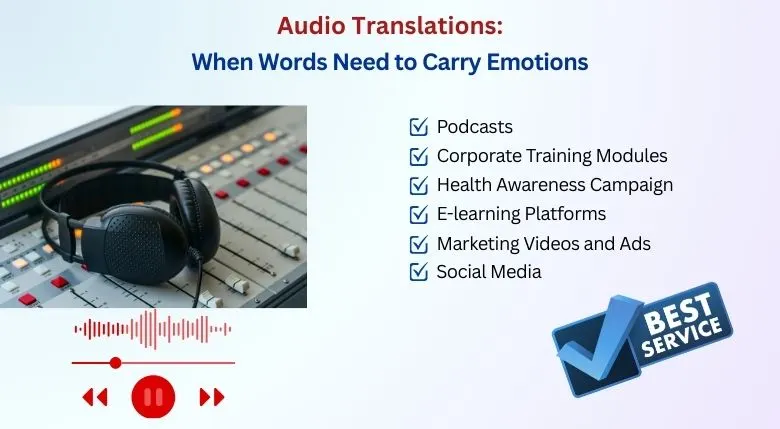
When someone listens to an audio translation, do they only hear the words that are spoken? Surely not! These audios are not just translated words; they also convey the words in the way they are spoken.
Today, audio stands as one of the most essential communication strategies for international companies. To communicate with other countries, companies often rely on translation services. However, it is not that straightforward. One can convert the words spoken in the audio file, but maintaining the emotional intent of the original content remains an unyielding challenge. Cabo conducted a study in 2016, which confirmed that emotional tone in audio shapes the listeners’ emotional engagement.
Audio has a unique power to create impact — unmatched even by the strongest words. But to match this impact, would one use automated tools like Smartcat AI Audio Translation and Murf AI Audio translator or rely on professional audio translations?
Yes, they can always rely on the latter. Audio translations are the art of translating the language and preserving the feeling.
In this blog, we will explore the importance of multilingual audio and how audio translation services ensure preservation of emotional depth.
Need for Multilingual Audio Content
Audio content is a promising avenue for global reach. And with the introduction of AI, using audio for various purposes has become simpler than ever.
- Database-driven AI tools can translate audio files using several pre-stored languages.
- Neural technology can create unmatched dubbed content.
- Real-time translation tools are very helpful in live meetings.
But, as audiences across the world demand more authentic experiences, brands are resorting to more personalized translation strategies. They are using a combination of AI tools and human voice artists in many content types, including:
- Podcasts
- Corporate Training Modules
- Health Awareness Campaign
- E-learning Platforms
- Marketing Videos and Ads
- Social Media
It is widely established that consumers love to engage with audio content when it is available in their native language. However, the psychological principle of emotion and tone also plays a significant role. So, when a brand enters a new market or a content creator engages with new audiences, they must ensure that the language is accurately translated while preserving the emotional impact.
Importance of Emotions in Audio Files
In audio files, literal translations are not enough.
Imagine a speaker is giving a motivational speech in the English language. But when this speech is telecast in Japan, the dubbed voice feels flat—although the words used are accurate. Professional audio translation services can help avoid these emotionally hollow messages.
Emotions in an audio file are categorized by:
- Tone and Pitch
- Pacing and Pauses
- Cultural Expressions
- Idioms and Metaphors
- Vocal Intensity
For audio translations, emotional equivalence or preserving emotions is just as important as language accuracy.
The Cultural Twist of Expressions
While emotions are universal and can be replicated in other languages, expressions vary from language to language and region to region.
Some feelings exist uniquely in just one culture.
For example,
- The concept of “amae,” which means an intense and unhealthy sense of affection, does not have a direct translation in English.
- Similarly, the German word “schadenfreude,” meaning the joy derived from others’ misery, has no single descriptive word in other languages.
So, when concepts or words like these occur in an audio file, translation becomes complex. Hence, multimedia localization becomes a vital part of the translation project.
This process involves:
- Rewriting scripts instead of directly translating them, which is also known as transcreation.
- Adjusting the tone to match cultural expectations.
- Replacing idioms with locally relevant expressions.
- Adapting humor and storytelling styles.
Are you interested in learning more about transcreation services? If yes, then check out our related blog post: Transcreation Services: Say It Right, Everywhere.
Translate Audio Content with High Accuracy and Cultural Sensitivity!
How to Preserve Emotions in Audio Translations?
Preserving emotions during the video to audio translation process requires both human expertise and technical knowledge.
1) Work with Native Linguists
Native voice artists understand the emotional depth needed during translations. They can identify:
-
- When a phrase feels too formal.
- When a phrase feels too casual.
- When the tone feels awkward.
Professional audio translation services always work with native voice artists and translators to deliver emotionally accurate results.
2) Focus on Emotional Intelligence
Emotionally aware translators can detect sarcasm, irony, or vulnerability from the source file. Additionally, they can also skillfully replicate these emotional cues in the target file.
3) Use Transcreation for Marketing Content
Audio used for marketing and advertising purposes often relies on creative adaptation. Rather than translating each line, transcreation recreates the message to match the emotional expectation of the target audience.
Transcreation services are vital for advertisements, brand storytelling, and promotional campaigns.
4) Using the Right Technology
Modern translation tools can be useful in audio translations.
-
- Sentiment analysis tools, such as IBM Watson Natural Language Understanding and Google Cloud Natural Language API, can identify variations in tone.
- AI-driven speech platforms, such as Murf AI and Resemble AI, match vocal characteristics.
- Neural translation engines, DeepL and Microsoft Translator, provide contextual suggestions.
However, technology must be used with human oversight.
How Can Audio Translations Become Complex?
Some challenges that arise in audio translations are:
- Cultural Emotional Differences: Some cultures are secluded with cultural restraints, while others are expressive. Audio translations must find the right balance between these cultures.
- Tone and Voice Matching: Elements, such as warmth, authority, or enthusiasm, must match the original speaker. However, this process can often become complex, which can disrupt the authenticity of the translation.
- Poor Audio Quality: The quality of audio can also result in complicated translation processes. Disturbances like noise, multiple sound overlaps, and unclear diction can hinder voice artists from comprehending the source file.
- Humor and Sarcasm: Some of the hardest elements to translate and replicate are humor and sarcasm.
- Synchronization: Accurate lip-syncing in voiceover localization services adds an extra layer of complexity.
How to Know if the Audio Translations Are Working?
Consider these tips to determine whether the translated audio file is appropriate:
- A/B testing with the native audience.
- Honest feedback from linguistic testing teams.
- Comparing engagement metrics in the target region.
- Analysis on the basis of the audience’s response.
The only key to success is to meet the audience’s cultural expectations.
Let’s Translate Feelings and Not Words
Choosing an expert partner matters in audio translations. Somya Translators offers expert audio translation services, combining skilled linguists, native voice artists, and advanced technologies to deliver emotionally accurate content.
We believe that audio translations are not just about translating words but also about establishing authentic connections.
From businesses, content creators, and educators to healthcare providers, many rely on emotionally resonating audio content. And resonating audio content can only be created by professionals.
Are you looking to translate audio files while preserving emotional intent?
Contact Somya Translators today for expert audio translations and get a free quote.
Call: +91-9990094796
Email: info@somyatrans.com