

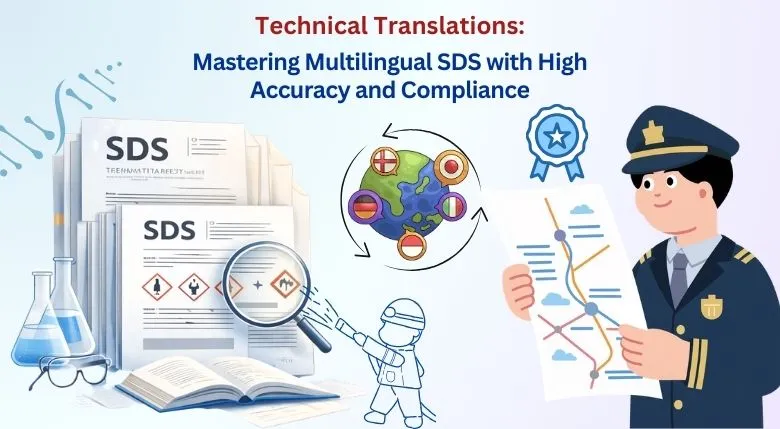
On the surface, a safety data sheet (SDS) may look like just another compliance document. However, it is one of the most tightly regulated documents in global trade. Mainly used in the chemical industry, a safety data sheet outlines how a hazardous substance is classified, how it is stored, how any exposure must be controlled, and what must be done during an emergency. And every statement in an SDS, from precautionary codes to exposure limits, carries legal and safety implications. Now imagine translating a safety data sheet so it could be understood across the world. Changing the language alone won’t be enough.
- The technical terms must be consistent and accurate.
- The format must remain intact.
- Official hazards cannot be paraphrased.
- Units of measurement need to be adapted.
- And regulatory references must adhere to local laws.
Safe to say that what appears to be a straightforward translation task quickly becomes a high-stakes exercise. Fortunately, this is exactly what technical translations offer. Not just simple linguistic services, but a vital process of regulatory compliance and formatting accuracy.
Ensure Accurate & Compliant SDS
Translations Globally!
Work with certified experts to translate safety data sheets with precision and regulatory compliance.
In this blog, we will explore how translating safety data sheets requires unmatched linguistic skill, technical expertise, global regulatory awareness, and absolute precision.
What Are Safety Data Sheets?
A safety data sheet, which was earlier known as a material safety data sheet (MSDS), is a technically complex document that lists detailed information about hazardous substances and mixtures. It follows a globally recognized 16-section structure under the Globally Harmonized System (GHS).
An SDS includes:
- Precise identification of the substance and supplier.
- Hazard classification and labelling information.
- Composition and ingredient details.
- First-aid and firefighting measures.
- Instructions for handling and storing substances.
- Exposure control and personal protective equipment.
- Toxicology reports and ecological data.
- Disposal and transport information.
- Regulatory references.
An SDS is vital for several industries, such as:
- Chemical Manufacturing
- Pharmaceuticals
- Oil and Gas
- Construction and Industrial Production
- Agriculture and Pesticides
- Cosmetics and Specialty Materials
In some regions, it is legally mandatory to provide the SDS in the native language. Therefore, technical document translation becomes essential when a product from the above-mentioned industries enters new markets.
Why Is It Vital to Translate an SDS?
SDS is basically a compliance document that carries severe implications.
It is essential to accurately translate safety data sheets because it ensures:
- Workers completely understand the risks.
- First responders act correctly during accidents.
- Companies avoid regulatory penalties.
- Products are processed smoothly through customs.
- Environmental risks are minimized.
But if an SDS is mistranslated, it may lead to:
- Workplace accidents.
- Shipment delays.
- Customs rejection.
- Legal penalties.
- Reputational damage.
In regions like the EU, the US, and India, regulatory scrutiny is so immense that authorities may block non-compliant products from the chemical and pharmaceutical industries. Hence, expert and compliant regulatory document translation becomes absolutely necessary for SDS.
Which Global Regulations Do Technical Translations of SDS Follow?
Before understanding how to translate SDS for global markets, we must understand the regulations it needs to follow.
- The United States: Occupational Safety and Health Administration (OSHA)
- The European Union (EU): European Chemicals Agency (ECHA)
- Globally Harmonized System of Classification and Labelling of Chemicals (GHS)
The Hazard Communication Standard (HCS) and OSHA mandate SDS to follow the 16-section GHS format. While English is necessary, additional languages like Spanish and French may be required depending on the workforce.
The EU requires SDS compliance under the REACH (Registration, Evaluation, Authorization, and Restriction of Chemicals) and CLP (Classification, Labelling, and Packaging) regulations. SDS components such as the hazard statements (H statements) and precautionary statements (P statements) must be available in the EU member states’ official language(s).
The regulation was developed by the United Nations, and it defines the classification and labelling of chemicals worldwide. Most countries, including India, follow the GHS standards; however, some regions require SDS to be translated into their native languages—making localization services vital.
A vital advantage of working with professional translation services is that they keep up with these evolving regulations.
Which Language Requirements Do Technical Translations Follow?
English is the lingua franca, which means the commonly used language between two speakers with different native languages. However, a global SDS cannot rely on it.
There are different language requirements in different regions:
- In the EU, SDS must be translated and provided in the official language of each member where the product is distributed.
- In the US, English is mandatory, but bilingual or even multilingual SDS may be needed for a diverse workforce.
- India, too, requires English for SDS regulations, but additional regional language support is always welcome, as it increases accessibility.
While translating the language of an SDS, it is vital to remember that official hazard statements cannot be paraphrased. So, a chemical data sheet translation must always use regulator-approved phrasing.
Technical translations are not just limited to chemicals but also help global manufacturers expand globally. Don’t miss out on our related blog to know how: Technical Translations: The Key to Efficient Manufacturing Success Globally.
Why Are SDS Translations So Challenging?
Translating an SDS is complex. Some challenges include:
- Technical Terminology: Translating complex terms like chemical names, exposure limits, toxicology references, and Chemical Abstracts Services (CAS) numbers requires complete precision.
- Units of Measurement: The US uses imperial units, but the EU and India use the metric system. Proper awareness and adaptation of these units are necessary.
- Formatting Requirements: The structure of the 16 sections must remain intact. Breaking this structure during translations can cause compliance issues.
- Standardized Hazard Statements: H and P statements must match official databases. Freely translating these is not acceptable.
- Regulatory Updates: REACH and CLP are updated systematically. Even OSHA regularly updates classifications of chemicals. Translations need to adhere to these changes at all times.
- Risks of Machine Translations: AI and automated tools risk generating technically inaccurate terms. Hence, solely relying on machine translations for regulated industries is not acceptable.
Best Practices for Translating Safety Data Sheets
Companies need to implement a strategic approach to ensure accurate and compliant technical translations of SDS.
- Use Official Regulatory Databases: Official sources provide updated and approved hazard statements, which can be used during translations.
- Implement Terminology Management: Creating precise glossaries and using translation memory tools will help with consistency across documents.
- Conduct Multiple Quality Reviews: A review process must contain:
- Bilingual editing
- Regulatory verification
- Terminology checks
- Formatting validation
- Work with ISO-Certified Translation Companies: Professional translation services, such as Somya Translators, are certified under ISO 17100:2015. This means that we follow international standards and structured workflows to ensure compliance, confidentiality, and quality control in technical translations.
Need Reliable SDS Translation for Global Compliance?
Get accurate, ISO-certified technical translations that meet international safety and regulatory standards.
Compliance Is Clarity
Safety data sheets are documents that travel across borders, languages, and legal systems. For companies operating globally, translating SDS is both a legal requirement and an ethical responsibility. Accurate technical translations for SDS help companies meet global standards and protect people and operations.
Because for hazardous materials, clarity is compliance, and compliance is safety.
Are you someone who wants to translate SDS with complete accuracy, confidentiality, and compliance? Trust the experts; trust Somya Translators!
Contact us today for a free quote!
Call: +91-9990094796
Email: info@somyatrans.com