With more than an astonishing 100 million native speakers globally, German is one of the most widely spoken languages today. The language has a history that stretches back thousands of years, shaped by regions, culture, and identities.
However, the continuous evolution of the German language has created something spectacular. It has created dialects. A dialect is a form of language that is unique to a specific region or community. German has a variety of dialects that are unique, culturally rooted, and essential for day-to-day communication. From pronunciation changes to sentence patterns, German dialects can be fascinating to explore. They also, however, pose some challenges, especially during German language translations.
In this blog, we will take a closer look at German dialects, their origins, how they differ, and finally, how a professional German translation service addresses them.
Brief History of the German Language
The German language underwent many changes over the past several years.
- Old High German: One of the earliest written forms, dating back 1500 years.
- Middle High German: A medieval language, influenced by the foreign population.
- Early New High German: Developed in the 16th century CE, when Martin Luther translated the Bible.
- New High German: A standard language that was developed during the Industrial Revolution.
- Modern German: A version spoken today, but in several regional dialects.
Hence, the foundation of standard German was laid.
Today, German is the official language of several countries, including Germany, Austria, Switzerland, Liechtenstein, and Luxembourg. Despite over 500 years of standardization, German dialects still remain relevant in the region.
You can explore more about the German language in our related blog: Explore the Top Intriguing Facts of German Language in the Current World!
High German vs. Low German: What Are They?
People who are interested in learning German often feel confused about High German and Low German. They don’t represent culture, but what they do represent is geography.
- High German: This dialect originated from the mountainous regions of South Germany. Maybe that’s why its name came to be “high.”
- Low German: This dialect was developed in the flat northern plains of Germany. Although the dialect quickly spread throughout the country.
Although they aren’t much different, the key uniqueness lies in the consonant shift of High German. The sounds used for p, t, and k are altered in High German, making the dialect surprisingly similar to Dutch and even English.
You’d be surprised to know that German and English are more common than some people assume.
Want to know how? Don’t miss out on our related blog: English and German Languages: How Are These Two Similar?
The German spoken today is mainly influenced by High German, making it an essential language in education, media, and government communication. Also, the majority of the projects received by German language translation services are based on High German.
Looking to translate your business content into accurate High German for the right audience?
Our professional linguists ensure culturally precise translations for every region of Germany.
What Are the Other Major German Dialects?
If we even include the smaller populations, German will consist of over 250 dialects.
But our focus is only on the influential ones. They involve:
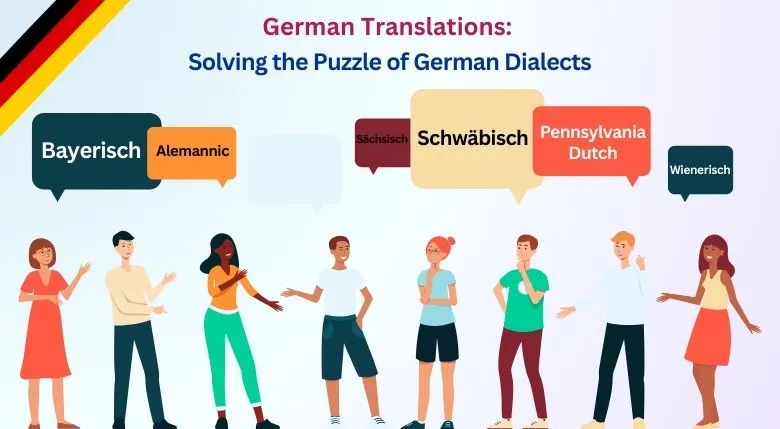
- Bavarian (Bayerisch): Spoken by around 14 million people in Bavaria and Austria. The dialect is known for its strong pronunciation shifts.
- Swabian (Schwäbisch): Commonly spoken in Baden-Württemberg. The dialect can be recognized by its use of softened consonants and unique rhythm.
- Alemannic: This includes Swiss German and Alsatian. The dialect is spoken in Switzerland and southwest Germany.
- Upper Saxon (Sächsisch): The dialect can be found in eastern Germany and can be confusing to identify.
- Berlin Dialect (Berlinerisch): This dialect is fading due to migration and globalization.
- Viennese (Wienerisch): The dialect is vital to the identity of the Austrian people and combines several cultural nuances with the German language.
- Pennsylvania Dutch: Far beyond Europe, this dialect is spoken by some immigrant communities who settled in the United States.
As each of these dialects is deeply culturally rooted, professional translators and interpreters must be careful while navigating through them.
Why Do Dialects Matter in German Translations?
An accurate translation relies on:
- Tone
- Meaning
- Intent
Dialects have the tendency to affect all three. For example, a phrase in the Berlin dialect, “ick hab keene ahnung,” meaning “I have no idea,” is completely different in the Bavarian dialect, which is “I hob koane ahnung.”
Hence, German translations become vital. Professional, native translators understand thoroughly when to use Standard German and when to use a regional dialect.
However, there is a process that they follow.
Professional German language translation services use a strategic approach.
- Analyzing the target region, audience, and requirements.
- Selecting the appropriate dialect according to the requirement.
- Ensuring cultural accuracy without being generic.
- Maintaining terminology consistency across high-volume and multi-dialect projects.
Furthermore, an accredited translation agency does not rely on AI tools alone. Human expertise is vital to address the dialect changes in a translation project.
Finding a German Translation
Not all translation agencies can handle dialects with utmost accuracy. It is essential that the translation agency contain:
- Native linguists with high regional expertise.
- Industry-specific translation services.
- Deep experience of the German-speaking regions and dialectal changes.
- Multi-step quality assurance and localization solutions.
One agency that stands out in providing expert German translations is Somya Translators, which translates more than 5 million English-to-German words annually. By combining professional steps, we offer accurate translation for various German dialects.
For communication, German dialects are not obstacles but bridges. They reflect history, identity, and local expression, which strengthens global communication rather than complicating it.
Are you a business entering Germany but worried about the differences in dialects? Somya Translators can help you speak every form of German!
Contact us for accurate German translations and get a free quote!
Expand confidently into German-speaking markets with expert dialect-aware translations.
Partner with professional linguists who understand regional nuances and deliver accurate results.
Call: +91-9990094796
Email: info@somyatrans.com