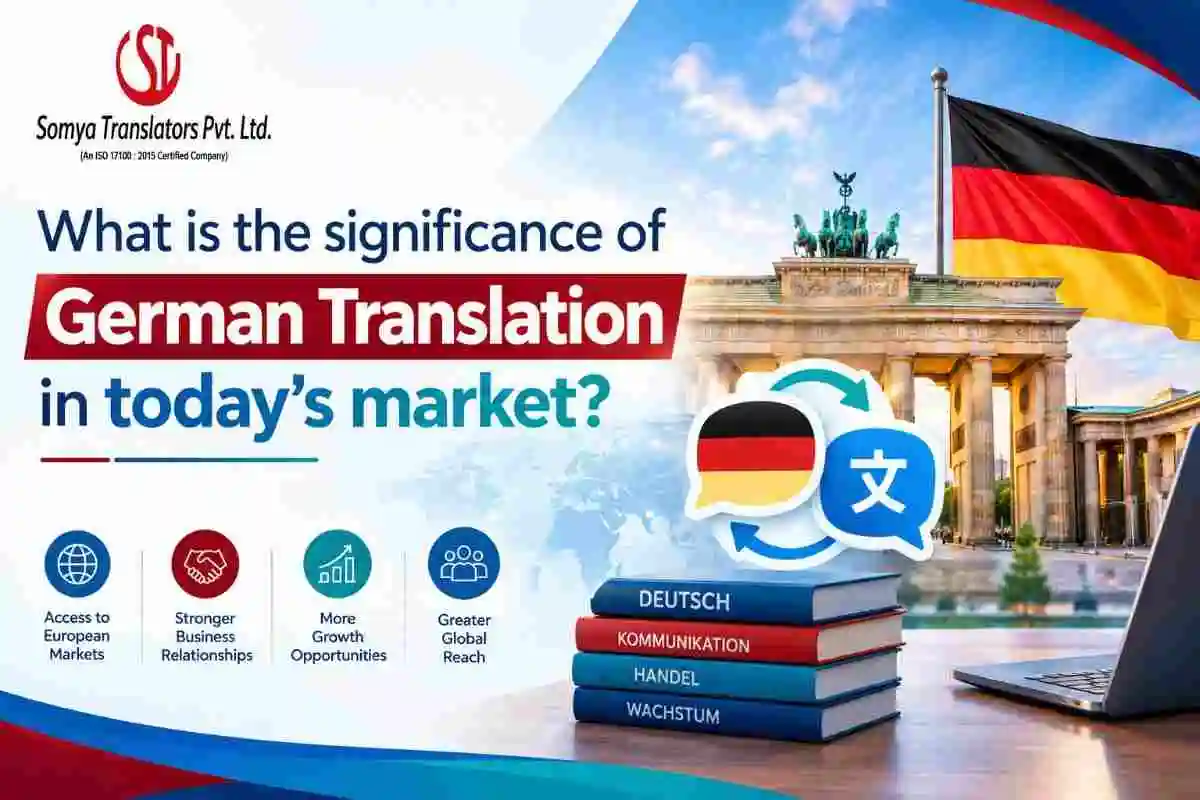
German translation matters because Germany is Europe’s largest economy, German is an official language in six countries, and buyers expect contracts, manuals and support in their own language. Accurate translation turns market access into sales and keeps products legally compliant.
As businesses grow globally, translation has become a core part of international trade. German trade has expanded steadily in recent years, and language is often the biggest barrier. Awkward exchanges with German dealers, unclear contracts or poorly translated documents can stall a deal before it starts. Written and verbal communication both need a professional translation service to close these gaps.
This guide explains why German matters now. For the step-by-step process, read how global businesses grow with German translation. To compare service types, see our full range of German translation services.
Why is the German market so important?
Germany has the largest economy in Europe and is typically ranked among the world’s three or four largest. It is also a major exporter. In 2023, Germany produced about 4.1 million passenger cars and exported roughly three-quarters of them, according to VDA, the German automotive industry association. Machinery, chemicals and pharmaceuticals are other major sectors.
For foreign companies, this means German-speaking customers, partners and regulators sit at the centre of many supply chains.
Where is German an official language?
| Country | Status |
|---|---|
| Germany | Official language |
| Austria | Official language |
| Liechtenstein | Official language |
| Switzerland | One of four national languages |
| Luxembourg | One of three official languages |
| Belgium | Official in the German-speaking Community |
Roughly 95-100 million people speak German as a first language, and about 130 million including second-language speakers. Germany, Austria and Switzerland together are often called the DACH region.
Why do buyers expect content in German?
Everyone prefers to read and do business in their mother tongue. CSA Research has repeatedly found that about three in four consumers prefer to buy products with information in their own language. In business-to-business sales the expectation is stronger for technical and legal content, because errors carry liability.
German buyers also associate precision with quality. A product with careless German documentation signals a careless product. The same applies to brochures, pamphlets and other promotional material: they must be in the buyer’s language to be understood and trusted.
Why choose a skilled translation agency?
Clear and correct communication is essential in business. A skilled agency makes the difference between a polished message and a costly mistake.
- Strong command of both languages. Translators must be fully bilingual and understand both the source and target language, whether the pair is Hindi to German, German to English or any other combination.
- Excellent English. Grammatically correct, refined English is needed for error-free German-to-English document translation.
- Subject knowledge. Legal, technical and medical content needs translators who know the terminology of that field.
- Quality checks. A review process catches errors before documents are published or signed.
Hiring a specialized German translation agency helps you enter a market with confidence and communicate your business goals accurately.
What content should you translate first?
- Legal and compliance documents: contracts, labels, safety instructions, certificates.
- Product documentation: manuals, specifications, data sheets. See user manual translation.
- Website and online store: localized, not just translated.
- Customer support and onboarding content.
- Marketing material: adapted in tone, not translated word for word.
Can machine translation do the job?
Machine translation is fast and useful for internal reading. For published, legal or safety-related content it still needs human review, because German compound nouns, formal register and industry terms are easy to get subtly wrong. Read what that looks like in the impact of German translation on communication.
Why choose Somya Translators?
Somya Translators is a dependable agency with experience in Indian and foreign language translation. Our team delivers accurate, precise and authentic translations that help you understand the German market, build trust with customers and grow your sales.
FAQs
Why is German translation important for business?
It lets you sell, contract and support customers in Germany, Austria and Switzerland in their own language, and it keeps documents compliant with local rules.
Is German still a major business language?
Yes. Germany is Europe’s largest economy and a top global exporter, and German-speaking markets are central to engineering, automotive, chemical and pharmaceutical supply chains.
Do I need German if my customers speak English?
Many do, but contracts, manuals, labels and consumer-facing content are expected in German and in some cases required by law.
Which countries need German translation?
Germany, Austria, Switzerland, Liechtenstein, Luxembourg and Belgium, plus German-speaking communities elsewhere.
How do I start?
List your highest-risk documents (legal, safety, product), then request a quote for those first.
Next step: Talk to our team about German translation services or get a free quote.
Relatable Blog: Role of German translation services