

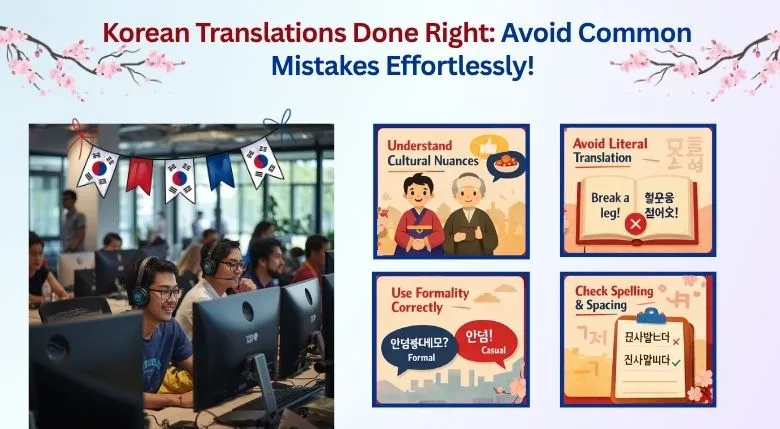
When a Korean term, “괜찮아요,” is translated into “it’s okay,” you are only getting half the story. Depending on the context, the same term can mean “I am fine,” “no thanks,” or “don’t worry about it.”
Basically, there is no single fixed meaning. This is because Korean is a context-driven language that changes depending on the intention of the speaker. This variation in context is one of the most vital reasons behind the complexity of Korean language translations.
Korea is built on implication, not directness. When a Korean person conveys something, they assume that the listener would not just interpret the word-to-word meaning but also understand the gravity of the situation. So, when Korean translations rely on direct equivalents, the result may be technically correct, but practically wrong.
In this blog, we will discuss some very common Korean translation mistakes and shed light on some valuable tips to avoid them.
But before we get on with it, we need to discuss the role of translation accuracy in Korean.
Why Does Accuracy in Korean Translations Matter So Much?
Communication in the Korean language is not just dependent on grammatical correctness but also on formality and tone.
A sentence—although grammatically precise—needs to be altered depending on:
- Who is being addressed
- The level of formality expected
- The cultural tone of the message
However, ignoring these creates poor translations in Korean and can further lead to:
- Blunt or unnatural message
- Misalignment with Korean etiquette
- Loss of trust and respect
Hence, brands rely on professional translation services that provide expert Korean translations to ensure both language and cultural accuracy.
Are you interested in learning more about how businesses benefit from Korean translation services? Check out our related blog: Korean Business Translations: The Unwritten Rule of Doing Business in South Korea.
Why Is the Korean Language Complex?
We have discussed why conversing in Korean does not just depend on grammar but also on other things.
But do you know that the language itself is complex?
The Korean language follows a subject-verb-object (SOV) structure and uses multiple honorific levels.
For example, “–아요” vs. “-습니다”
- Using “아요” at the end of sentences makes them polite but informal.
- Using “–습니다” at the end of sentences makes them formal and polite.
Korean translations adjust their results depending on the social hierarchy.
Common Korean Translation Mistakes
Let us now explore the most common Korean translation mistakes.
1. Literal or Direct Word-For-Word Translations
Direct translation doesn’t always work in Korean translations. Many commonly used Korean expressions carry nuanced meanings that direct conversions cannot interpret.
For example,
“손이크다” (son-i keuda).
- Meaning: Hands are big.
- Actual Meaning: Someone is being generous.
When a phrase like this is translated word-for-word, the sentence loses its meaning.
Why does this fail?
- Korean relies on contextual and implied meaning.
- Korean idioms and phrases are culturally rooted.
2. Ignoring Context and Tone
The tone (the way a language is spoken) in Korean directly depends on the grammar.
For example,
- “기다려”: Wait. A casual tone.
- “기다려주세요”: Please wait. A polite tone.
- “기다리시겠습니까?”: Would you mind waiting? A formal tone.
While all three terms mean “wait,” their usage is quite different. Incorrect usage can change the entire tone of the sentence.
How does this impact Korean translations?
- A casual tone in a Korean translated business report will be seen as unprofessional.
- Similarly, an overly formal tone in marketing materials may end up being too distant or rigid.
3. Misuse of Honorifics
Using honorifics in sentences is a smart way to show respect to others.
For example,
- “먹다” (meokda): To eat.
- “드시다” (deusida): A respectful way of saying “please eat.”
If you interchange these two terms, it might become subtly disrespectful to the person being addressed.
Why does this matter?
If a foreign business communicates with its Korean customers by using incorrect honorifics, it risks losing trust and brand credibility.
4. Cultural Misinterpretation
Some culturally rooted Korean words do not have the most accurate translation in English.
For example,
- “눈치” (Nunchi): The ability to read the room or understand unspoken cues.
Such a Korean term cannot be ignored when translating into English.
Why are such terms important?
If ignored in Korean translations, communication can feel:
- Too direct
- Socially unaware
- Culturally disconnected
5. Poor Handling of Technical Terminology
Complex and technical English words often become difficult to translate into Korean.
For example,
- English Phase: Rollback the transaction
- Incorrect Korean Translation: “거래를뒤로되돌리기” (Push the transaction backward).
- Correct Korean Translation: “트랜잭션롤백” (Transaction rollback)
What do we learn?
Translating technical terms requires both language and subject-matter expertise. Literal translation of technical terms can be confusing; hence, it is vital to ensure industry-standard terminology is being used.
6. Incorrect Sentence Structure
The flow in which Korean is written is fundamentally different than English.
For example,
“나는그영화를어제봤다.”
- Literal Order in English: I that movie yesterday watched.
What do we derive?
When translating from Korean to English or vice versa, it is necessary to restructure the sentences; otherwise, they sound unnatural.
Now that we have explored some common mistakes in Korean translations, we can discuss how to avoid them.
Translate Every Document into Fluent and Accurate Korean!
How to Avoid Korean Translation Mistakes?
- Hire Native Korean Translators: Qualified native Korean translators understand the nuances of tone, honorifics, and context that non-native speakers might struggle with.
- Prioritize Localization Over Direct Translations: To avoid awkward word-for-word translations, it is necessary to implement Korean localization. This would ensure that the meaning, tone, and cultural nuances are completely preserved and appropriate after conversion.
- Understand the Social Norms and Politeness Levels: Korean verbs and pronouns change according to the hierarchy. Before translations, translators must analyze who is being addressed, the setting, and the required level of formality.
- Use Subject-Matter Experts in Technical Content: Industry-specific Korean terms that do not have direct equivalents in other languages require special expertise to ensure accuracy, clarity, and compliant usability.
- Strict Review of Translations: Implement a multi-step review process to ensure high-quality translations, which can help Korean language translation services to check whether the translations are culturally fit.
- Use of MTPE: Machine translations or the use of AI can speed up the work but cannot provide the required cultural depth. The best approach that combines the efficiency of machines and ensures cultural relevance is machine translation post-editing (MTPE). In this, the machine translation tools translate the content to be reviewed by an expert human translator to rectify cultural gaps.
Key Takeaways
- A single error in Korean translation can completely alter the tone, meaning, and brand perception.
- Successful translations balance accuracy, cultural fit, and readability.
- Combining native experts, context awareness, and a structured review process ensures that Korean translations convey the message authentically to the audience.
People Also Ask
Q) Do some Korean words have multiple meanings?
Ans. Yes, this is because Korean is heavily contextual and has implied meaning rather than precise wording.
Q) What is the biggest obstacle to Korean translations?
Ans. One of the most significant challenges in Korean translation is to maintain the correct tone and formality level while preserving the original meaning.
Q) If literal translation is ineffective in Korean, then what is effective?
Ans. Focus on localization, that is, transforming the content both culturally and linguistically.
Wrapping Up
Understanding what is unsaid is as important as understanding what is written. This is the basic gist of a successful Korean translation.
For businesses communicating with Korean consumers or dealing with the country’s regulatory organizations, working with experienced and reliable agencies becomes necessary. Somya Translators, a trusted Korean language translation service, ensures clarity, cultural accuracy, and consistency in all translation projects.
We are proud to announce that we have translated over 3 lakh words into Korean in the financial year of 2025-26.
Are you looking to partner with a professional translation service that can communicate your message clearly and articulately to the Korean market?
Trust Somya Translators!
Get a free quote today!
Call: +91-9990094796
Email: info@somyatrans.com