

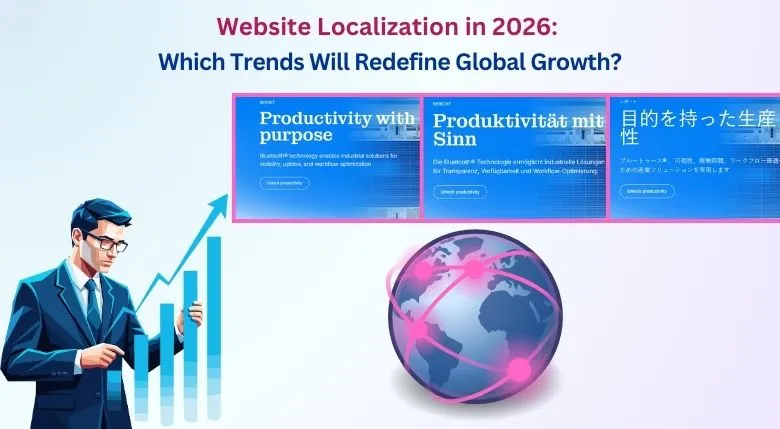
Website Localization in 2026: Which Trends Will Redefine Global Growth?
Is a website still considered a digital address for a brand? We believe that in 2026, it is more than that. It is like a digital handshake that a brand makes with its customers. And just like a physical handshake, this too needs to be firm and reassuring.
For businesses, an efficient way to ensure this is to adapt their websites according to their language, culture, habits, and values. This could be achieved by collaborating with professional website localization services.
Businesses that expand beyond borders have learned that simply translating the language of their website isn’t enough to attract a global audience. Users expect more. They expect relevance, familiarity, and a digital experience that is native.
But with content volume rising and AI tools entering the picture, the whole landscape of localization has changed. In this blog, we will explore some website localization trends that are set to dominate 2026 and how they matter for global businesses.
Planning to expand your website globally?
Get expert help from professional website localization specialists.
Trend 1: The Dominance of Human-AI Hybrid Localization
Automated tools have entered the localization industry, and they have brought some transformative changes along. However, the idea that AI can fully replace humans is a myth. The website localization strategy for 2026 will be defined by the combination of AI and humans. AI tools will increase the speed of the process significantly, while human linguists will ensure that the tone, intent, cultural elements, and brand image are protected.
Several translation companies follow this combination in their workflow:
- AI translations for speed and volume.
- In-depth human review for cultural references, accuracy, and preserved brand voice.
- Quality assurance to maintain consistency across regions.
Trend 2: Adaptation According to Language, Region, and Behavior
Website localization in 2026 aims to shape the entire user experience.
This process will involve:
- Region-specific banners, tempting offers, and testimonials.
- Local payment gateways and shipping options.
- Curated content that varies according to user purchase behavior and decision-making patterns.
For example, in some markets, trust badges and detailed specifications may work well, but in other markets, customer testimonials and marketing messages may perform better. Personalized website content that aligns with the language and culture significantly improves traffic and conversions.
Studies have even shown that localized websites can increase conversion rates by 300%.
Trend 3: Localizing Voice, Chatbots, and Customer Support
Proper website support is the backbone of a web experience. In 2026, users should expect this support to come in the form of their native language.
Some key developments would include:
- Multilingual chatbots that are trained in local languages.
- Help centers, such as customer support solutions, function in several regional languages.
- Multilingual voice search for seamless usage of the website.
Website support that has been thoroughly localized builds trust and reduces confusion. Brands that work with web content translation services to provide multilingual support outperform their competitors regularly.
Need multilingual chatbots, website content, or customer support localization?
Our experts localize websites in 100+ languages with cultural accuracy.
Trend 4: Multilingual SEO Will Become a Unique Growth Strategy
Search patterns of users vary from region to region. Keywords that perform well in one region won’t perform in the same way in a different region. So, direct translations of the keyword won’t help a website rank higher in different regions. That’s why multilingual SEO is becoming central to the planning of localization strategy in 2026.
Effective multilingual SEO includes:
- Native keyword research
- Localized metadata, URLs, and content structure
- Region-specific search intent
Search engines from different regions rank multilingual websites higher in searches.
Are you interested in learning more about the relationship between website localization and multilingual SEO? Don’t miss out on our related blog: Website Localization: Ensuring Global Reach With Multilingual SEO.
Trend 5: Localization Will Enable Legal, Compliance, and Privacy Guidelines
Digital regulations across the world are strict, and any brand entering a new region must thoroughly follow their specific laws. Poor translations of websites, especially the legal content, can result in fines, lawsuits, or reputational damage.
Websites that want to grow in 2026 must localize:
- Privacy policies and data usage notices
- Cookie content banners
- Legal disclaimers and compliance pages
- Industry-specific regulatory information
Precision is the key here. Experienced linguists with subject matter expertise ensure accurate legal phrasing and formatting. Sensitive language services like Arabic web localization also need to ensure legally accurate language and structure (right-to-left).
Trend 6: Mobile Localization Won’t Fall Behind
Global mobile users are growing at a staggering rate. In 2026, mobile localization will be essential for global companies.
This would mean:
- Shorter, clearer, localized content
- Mobile-friendly layouts for different scripts
- UX elements adapted to local reading patterns
Mobile localization will aim to create seamless experiences across devices, particularly in emerging markets where mobile is the primary access point.
Trend 7: Visual Localization Takes the Center Stage
On a website, words are just a part of the message. Visual elements can communicate just as much as words, and sometimes even more.
Visual localization includes:
- Region-appropriate image and icons
- Color choices aligned with cultural meanings
- Localized infographics and multimedia
A successful website in 2026 won’t ignore this and will localize both language and visuals together.
Trend 8: A Bridge Between Language and Accessibility
Language and accessibility have always been intertwined with each other. Websites must balance both.
This overlap includes:
- Localized content that is compatible with screen readers.
- Accessible fonts for non-Latin scripts.
- Clear language structures that provide cognitive accessibility.
Expansion will heavily rely on brands that address both accessibility and localization while meeting ethical and regulatory standards.
Expanding your website into global markets?
Our localization experts help businesses adapt websites for international audiences.
Let’s Find a Website Localization Company
Are you a brand that wants to enter global markets while following website localization trends of 2026? You would require expertise, technology, and accountability. Somya Translators provides all.
As one of the leading multi-language website translation services, we offer:
- ISO1710-Certified Processes
- Native and Experienced Linguists Across Global Languages
- AI-Supported Machine Translation Post-Editing (MTPE)
- Expertise in Diverse Languages and Complex Markets
- Fair Pricing and Timely Delivery
The future belongs to brands that stay ahead of the curve. As website localization trends evolve, companies need to invest in strategies that guarantee global trust and growth.
Do you want strategic website localization solutions across several languages?
Feel free to reach out to Somya Translators for a free quote!
Call: +91-9990094796
Email: info@somyatrans.com