

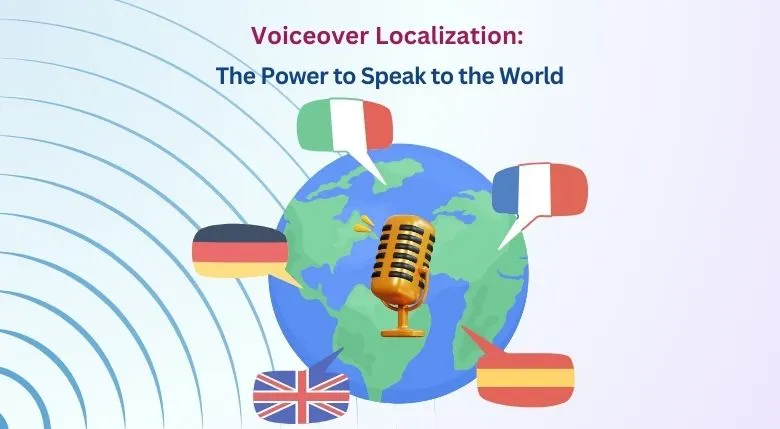
 Have you ever watched a German ad, or a Japanese game trailer, or a Spanish medical video in your native language and felt, “That was a bit odd”? Pondering back, you realized the concept of the video was amazing, the visuals were clear, and the script was good. So, what was the problem? Chances are, it was the voiceover, or rather the implementation of voiceover localization, that turned a perfectly fine video into an awkward one!
Today, when digital content flies across the world within seconds, it is critical to pay extra attention to the language! Yes, language, which is hailed as the medium of communication, can often (and ironically so) be the one that messes up communication.
On the global level, translation of the language of the video isn’t enough. Because language is only the beginning—true global engagement lies in culture, emotion, tone, and even pauses.
In this blog, we will discuss why voiceover localization is the powerful (and silent) secret to global success.
What Is Voiceover?
As the name suggests, voiceover is spoken audio that is added over a video or multimedia presentation. Voiceovers are commonly used in advertisements, e-learning courses, product demonstrations, how-to videos, documentaries, and games. Unlike dubbing, which is lip-synced audio, voiceover is often done in narration style and off-screen.
However, when a brand is trying to connect with a global audience, just recording the word-for-word voiceover in another language isn’t enough; it also needs to be localized.
Translation vs. Voiceover Localization: What’s the Difference?
To be clear, translation and localization are not the same thing.
- Translation: Converting words from one language to another, with flawless accuracy.
- Voiceover Localization: Tweaking the spoken content for a specific region. This could be done by adapting the references in the script, changing the tone, or striking the right emotions.
While translation is used to make content clearer and more understandable, voiceover localization is used to make the content more engaging for the audience. One corrects, while another connects.
So, Why Are Tone, Emotions, and Cultural Sensitivity Essential?
Will a product demonstration advertisement in English, merely translated into Korean, work in Seoul? Probably not! If the tone isn’t adjusted to the preference of the Koreans, the ad may fall flat.
This is because:
- Cultures interpret different emotions, which is essential to capture in the tone of the voiceover.
- Pacing and pauses vary from region to region. For example, Italians prefer to speak in a continuous tone with long pauses, while the Japanese speak in short pauses coupled with a high tone.
- Even laughter and sarcasm carry different interpretations in different places.
For culturally adapted voiceovers, it is essential to use the tone that is recognized and preferred by the target audience.
Just like voiceover localization, subtitles are also a great way to improve engagement across regions. Want to know more about subtitling services? Check out our blog: Subtitling Services: Fuel to Boost Engagement and Reach!
And what about emotions and cultural sensitivity?
Global voiceover services don’t just depend on the tone but also on the emotions and cultural sensitivity reflected.
- Emotion Delivery: Different regions demand different emotions in the voiceover. Scandinavian markets require subtle emotions, while Latin American markets prefer expressive emotions.
- Cultural Phrases: “Break a leg” doesn’t mean good luck in every country; sometimes it can be taken literally.
For example, an e-learning course created in the U.S. had to be entirely re-recorded for Middle Eastern countries like Saudi Arabia and Oman, as the fast-paced, upbeat delivery of the narration was perceived as disrespectful and overwhelming.
LOOKING TO ADD MULTILINGUAL VOICEOVERS TO YOUR VIDEOS?
Contact us today for exceptional voiceover localization solutions!
How to Cast the Right Voice?
Choosing the right multilingual voice talent for voiceovers is both a strategic and emotional decision. Here’s why:
- Gender: For some reason, brands prefer to make ads for their products using female voiceover artists, as they project trust and authority.
- Age: Young voiceover artists can be a great choice for playful brands, while mature voices are preferred for technical videos.
- Accent and Dialect: To gain maximum engagement from the target region, it is essential to replicate the local accent or dialect.
- Tone and Energy: A voiceover for a corporate video would require a more spirited tone, while a voiceover for a nature documentary demands a compassionate tone.
Why Can’t Brands Skip Voiceover Localization?
Here’s why expert voiceover localization is a must-have for any brand that wants to operate on a global scale:
- Significant improvement in global engagement.
- Better consumer perception of the brand.
- Increased trust and relatability.
- Higher return on investment on multimedia content.
- Strikes an emotional connection with diverse audiences.
And of course, global voiceover services are not just about translating the language; they are about making the message feel native in every language.
How Can Somya Translators Help?
At Somya Translators, we understand that a brand’s voice is more than just words; it is the embodiment of the brand. As an ISO 17100:2015-certified localization company, we bring:
- Expert linguists and multilingual voice talent who are native to the target region.
- Studio-quality production and recording.
- Customized solutions in 170+ languages.
- Unbelievable prices for fast and scalable solutions.
Launching a new product in Southeast Asia?
Introducing an e-learning course in Africa?
Localizing a marketing ad for South America?
We can make your brand’s voice heard in the right way!
Contact us today for a free quote!