

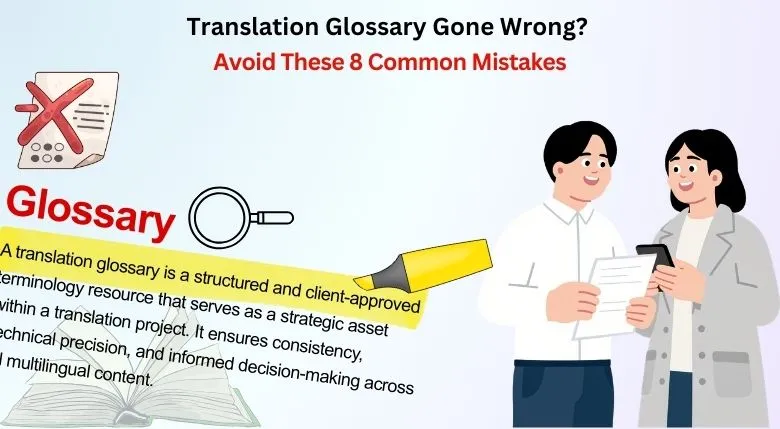
In a translation or localization project, a glossary cannot be taken for granted. Expert translation services understand the importance of a well-made translation glossary. A glossary is a vital document that lists out complex translatable terms of a source file. It also creates a viable roadmap for the translator, quality assurance team, and project managers. Without it, even the most experienced translator can risk inconsistencies and mistakes.
Imagine a technical manual being translated into five languages. Due to an incomplete glossary, the term “troubleshoot” was translated differently in each of the languages. Now multiply this mistake by dozens of documents. This is exactly how companies can face translation consistency problems in their multilingual projects.
Fortunately, this blog will explore why translation glossaries fail and what the 8 most common mistakes agencies face with an inaccurate glossary are.
Struggling with Terminology Consistency in Your Translation Projects?
Work with professional translators who create accurate and tool-integrated glossaries for multilingual projects.
Why Is a Translation Glossary Vital in Translation and Localization Projects?
As mentioned earlier, a translation glossary is a strategic asset in a project. This is because a reliable glossary stands on three pillars.
- Accuracy: Each entry consists of approved terms that align with the guidelines set by the client and are technically precise.
- Accessibility: Every glossary must be easily accessible by translators, QA specialists, and proofreaders.
- Actionability: A translation glossary helps the translator make informed decisions rather than relying on guesses.
A precise glossary includes:
- Key terms that include acronyms, product names, titles, technical phrases, and high-frequency words.
- Clear definitions of each term to remove misunderstandings.
- Approved terms in the target language that are validated by the linguist and the client.
- Examples that show the usage of the term in the context of the document.
Using tools like Smartcat, Phrase, and Lokalise can help professional translation services create and manage specialized glossaries according to the target language.
Why Is Creating a Translation Glossary So Difficult?
Building a glossary for a translation project may sound simple: extract translatable terms, convert them, and distribute the list to the team. However, in real-world conditions, this process is often complicated.
The reason being:
- Manual extraction of terms is tedious. The project team ends up spending hours just to extract terms from the source file. Manual extraction also risks missing terms and including unnecessary words.
- Distributing the glossary may not be an easy task. It is vital to ensure that the format in which the glossary has been created can be integrated into the CAT tools used by the translator.
- Glossaries need approval from several parties, including the client. Constant rejection can lead to delayed projects.
These reasons lead to glossary issues in translation that slow the project workflow and risk quality.
Translation agencies don’t just rely on glossaries but also on a checklist to ensure perfect results. Check out our related blog to know more about the translation checklist: Professional Translation Services: This is Why You Need a Checklist!
8 Common Mistakes in Your Translation Glossary
1. Not Creating a Glossary Beforehand
Many project teams wait until the eleventh hour before creating a translation glossary. This gives the translators less time to go through the glossary and risks the quality and timeline of the project.
The Solution:
- Build the glossary during the content analysis.
- Extract the key terms as you prepare the source file.
- Consult the translators while creating the glossary.
2. Giving Equal Importance to Every Term
Not all terms in a glossary are of the same value. Some are important, while others are not. This creates some hindrances while making the glossary.
The Solution:
- Vital information, such as product features, safety measures, and labels, must be prioritized.
- Focus on legal, regulated, and technical terms specific to the industry.
3. Ignoring the Context of the Terms
Some common words like “capital” and “charge” can have more than one meaning depending on the context. A translation glossary often fails to represent every meaning along with the context in which the term must be used.
The Solution:
- Sentence examples and term usage must be mentioned in the glossary.
- Explain the nuances between similar terms.
- Put a reference to real content to clarify intent.
4. Not Taking Regional Language Differences into Account
Several languages, such as English, Portuguese, and French, have regional dialects and variations. Using the same glossary for each dialect won’t yield precise results.
The Solution:
- Maintain different glossaries for different variants. For example, en-US and en-UK will have different glossaries.
- Consult native linguists before creating a region-specific glossary.
5. Ignoring Glossary Integration with Translation Tools
Glossaries that are created in Excel or Word need manual referencing and integration with translation tools. Without this, translation inconsistencies are created, and the quality assurance process slows down.
The Solution:
- Import glossaries into CAT tools like Smartling, memoQ, or SDL Trados.
- Enable automatic highlighting and warnings for unapproved alternatives.
- Implement real-time QA checks to identify terminology errors.
6. Creating Glossaries without Aligning them with Everyone
A translation glossary must be understood by every party related to the project. Often, translators work with unapproved terms, which leads to revisions and delays.
The Solution:
- Share draft glossaries with clients and translators to get them approved as early as possible.
- Align translators, proofreaders, and QA teams on glossary usage.
- Only use client-approved terms in the glossary.
7. Manual Extraction of Terms
Creating glossaries for long and high-volume documents can be time-consuming, especially if the terms are identified manually. This process also makes the glossary error-prone.
The Solution:
- Use automated tools for extraction, but review them using humans.
- Focus more on validating terms of the glossary.
- Use translation memory tools for suggestions.
8. Not Having Proper Updates
Without constant updates, the glossary can soon become outdated. While old terms remain in the glossary, the scope of adding new terms will always be missing.
The Solution:
- Assign glossary ownership for continuous updates.
- Implement regular glossary audits to ensure that they remain updated.
Following these translation glossary best practices won’t just ensure accurate translationn but also maintain high-quality and timely delivery of multilingual projects.
Find the Experts
A translation glossary is a tool that saves time, improves quality, and boosts localization workflows. However, without professional translation services, creating and using a glossary is impossible.
Somya Translators helps clients with actionable, accurate, and tool-integrated glossaries. Be it for technical translation services or legal localization services, we ensure that your terminology remains consistent, culturally accurate, and ready for any region.
With the right planning, automated tools, and complete clarity among all involved, your translation glossary becomes a powerful asset for multilingual projects.
Need Expert Help Creating a Translation Glossary?
Partner with experienced linguists to build accurate terminology databases for multilingual projects.
Contact us today and create the perfect translation glossary for tomorrow!
Call: +91-9990094796
Email: info@somyatrans.com