

 Punjabi isn’t just a language spoken by 100 million people; it is a cultural phenomenon with a rich heritage. While being one of the top ten most spoken languages in the world, it has some unique elements that are a must-know for every Punjabi translator!
When someone contacts us, Somya Translators, for Punjabi translation services, the big question we ask is, “Which Punjabi, Indian Punjabi, or Pakistani Punjabi?” Yes, the Punjabi we know and hear—especially in those party songs—is not the only Punjabi spoken.
The differences between Indian Punjabi and Pakistani Punjabi do not just lie in the location but also in scripts, dialect, tone, and cultural context.
In this blog, we will discuss these subtle yet significant differences. We will also learn how professional Punjabi translation services can help brands navigate and understand these nuances with ease.
The Importance of Understanding the Script
When we say “script” here, we do not mean a film script, but rather the one used to write in a language!
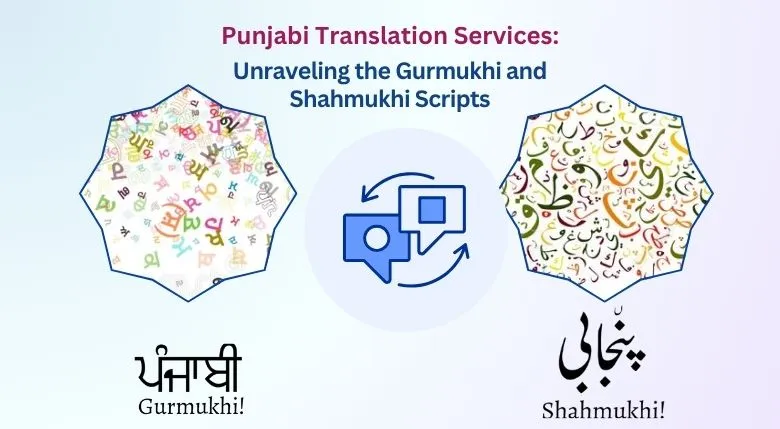
Punjabi, being a unique language, is one of the rare languages that is written in two distinct scripts: Gurmukhi and Shahmukhi.
During an English-to-Punjabi translation project, it is vital for the translator to correctly identify the required script.
For native Punjabi speakers, the script is not just a visual but a symbol of cultural heritage.
Gurmukhi Script
- It is primarily used to write Indian Punjabi and has originated from the ancient Brahmi script.
- The script was developed in the 16th century CE by Guru Angad Dev Ji, the second Sikh Guru.
- The literal meaning of Gurmukhi is “from the mouth of the Guru.”
- It is the official script of Punjabi spoken in India.
- The script has 35 original letters and some additional vowel signs.
- Gurmukhi is heavily influenced by Devanagari.
- Guru Granth Sahib, the central religious scripture of Sikhism, was originally written in the Gurmukhi script.
Shahmukhi Script
- As a variant of the Arabic-Persian script, it is mainly used in Pakistani Punjabi.
- The script was derived from the Nasta‘liq style of Persian writing in the 17th century CE.
- The literal meaning of Shahmukhi is “from the mouth of the king.”
- The script is widely used in Pakistani literature and media.
- Unlike Gurmukhi, which is written from left to right, Shahmukhi is written from right to left.
- The script is influenced by Persian, Arabic, and Urdu.
- The famous romance-tragedy, Heer Waris Shah (the story of Heer and Ranjha), was popularized when it was translated into the Shahmukhi script.
Apart from these two distinct writing scripts, Punjabi is also used in several dialects, making Punjabi document translation far more complex.
Some of these dialects are:
- Majhi: Spoken in both Amritsar (India) and Lahore (Pakistan).
- Malwai: Mainly spoken in southern Punjab, India.
- Doabi: Native speakers are found in the region between the Beas and Sutlej rivers (Bist Doab).
- Pothohari: Native speakers are mainly settled in the northern Punjabi province of Pakistan.
- Multani (Saraiki): Majorly spoken in the southern Punjab province of Pakistan.
Gurmukhi vs. Shahmukhi: What Every Translator Must Know
As we have explored earlier, both writing systems have their own tightly knit cultural and historical identities. However, the differences don’t end there.
Lexical and Pronunciation Differences
- Gurmukhi speakers often pronounce words with clearer vowel sounds.
- Shahmukhi speakers use nasalization or softer sounds like we hear in Urdu.
Vocabulary
Both scripts use loanwords borrowed from different languages.
- Indian Punjabi borrows words from Sanskrit and Hindi. For example, mitr (ਮਿਤ੍ਰ) or friend.
- Pakistani Punjabi borrows words from Urdu and Persian. For example, Adalat (عدالت), or court.
Cultural and Contextual Differences
Both Indian Punjabi and Pakistani Punjabi also differ in religious identity.
- Indian Punjabi culture closely aligns with Sikhism.
- Pakistani Punjabi culture follows Islamic traditions.
The knowledge of these differences is a must for a Punjabi translation company.
Get Expert Punjabi Translation Services With Somya Translators!
Contact us today and get impeccable Punjabi Translations!
Best Practices in Punjabi Translation
Here are some expert tips to help deliver accurate and culturally relevant Punjabi translations.
- Know Your Audience: It is essential to identify the target audience before translation to know the language and script preferences.
- Use Native Linguists: Native linguists—like a Punjabi voice translator—can offer a cultural edge that a bilingual cannot.
- Create and Maintain Glossaries: For technical and complex translations, it is important to create a glossary of terms beforehand. This ensures both accuracy and consistency during the translation.
- Review and Proofread: Punjabi linguistic testing is an effective way to test your translated content in the real world. This helps you understand how well your content will be received by the native consumers.
- Balance AI and Human Translation: AI translations can provide speed, but human translators can provide cultural accuracy. It is best to use Punjabi machine translation post-editing (MTPE) services to get the perfect balance and high-quality results.
How Professional Punjabi Translation Helped a Retail Company
Today, professional Punjabi translation services are in high demand across several industries, like healthcare, e-learning, entertainment, and legal. What keeps these translation services in demand is not just the accuracy but the cultural understanding they possess.
Let’s take the following example.
A retail company wants to engage better with their Indian Punjabi audience and so decides to translate their website into the native language.
After consultation from a Punjabi translation company, the retail brand understands that the best way to engage efficiently with natives is through Punjabi website localization.
- The company translated the language of the website into Indian Punjabi and changed the script into Gurmukhi.
- They add some cultural nuances and references to gain more visitors.
The Result?
- The company experienced a boost in native Punjabi visitors.
- They received a lot of positive feedback from native customers.
- Eventually, the retail brand increased regional sales in Punjab, India.
Like Punjabi translations, Tulu translations are also necessary for accuracy and cultural relevance. Don’t miss out on our related blog to know more: Why Tulu Translation Services Matter Today More Than Ever.
How to Find a Punjabi Translation Service?
Are you looking for emotional depth, linguistic accuracy, and cultural relevance in your Punjabi document translation?
Somya Translators, India’s leading translation and localization company, is globally reputed for its Punjabi translation services!
- We provide native linguists, be it for Indian Punjabi or Pakistani Punjabi.
- We are ISO 17100:2015-certified.
- We offer a comprehensive range of solutions, like Punjabi website localization and Punjabi subtitling.
- Our MTPE services for the Punjabi language find the right balance between AI and human translations.
Looking for a Punjabi translation company? Look no further than us!
Contact us today for a free quote!
Visit our website for more details: https://www.somyatrans.com/languages/punjabi-translation-services/