

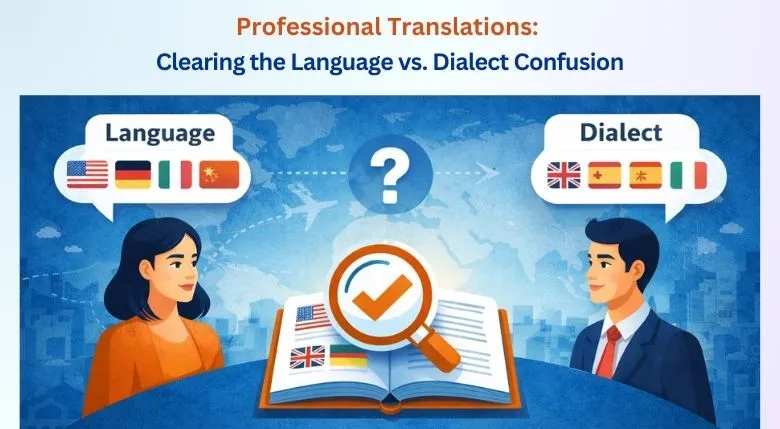
Have you ever wondered why, sometimes, two people who speak the same language may not understand each other properly? A person from London would have better chances of understanding a New Yorker than a Scottish person, although all three would be speaking English. This case is not unnatural but a reminder that language is not uniform.
This all comes down to dialects. While a language is a structured system that connects different people, dialects add unique twists in pronunciation, words, and grammar, which are shaped by history, geography, and culture. The whole gist of professional translations relies on understanding these subtle differences.
For translators, businesses, and anyone who is working across languages, these differences are not just entertaining tidbits but vital for accuracy.
In this blog, we will settle the long debate of language vs. dialects and why this distinction matters for professional translation services.
Have you ever wondered why, sometimes, two people who speak the same language may not understand each other properly? A person from London would have better chances of understanding a New Yorker than a Scottish person, although all three would be speaking English. This case is not unnatural but a reminder that language is not uniform.
This all comes down to dialects. While a language is a structured system that connects different people, dialects add unique twists in pronunciation, words, and grammar, which are shaped by history, geography, and culture. The whole gist of professional translations relies on understanding these subtle differences.
For translators, businesses, and anyone who is working across languages, these differences are not just entertaining tidbits but vital for accuracy.
In this blog, we will settle the long debate of language vs. dialects and why this distinction matters for professional translation services.
Defining Languages
Languages are a well-defined system of communication that is heavily influenced by grammar, vocabulary, and syntax. Renowned Swiss linguist Ferdinand de Saussure had described language as a complex and emotional system of signs. Additionally, American linguist Edward Sapir defined language as humanity’s effort to express ideas and emotions using systematic symbols.
A language:
- Has standardized grammar rules.
- Is often legally and officially recognized.
- Is used for education, administration, and formal communication.
- Represents a community’s identity and heritage.
Some examples of languages include English, Spanish, Arabic, Mandarin, and Hindi. Modern linguists estimate that between 6500 and 7000 languages are spoken worldwide.
However, within a language, dialects exist. And this significantly influences the way people speak a language.
Defining Dialects
A dialect is a language’s variation that depends on the region and community. Within a language, different dialects can exist, and they differ in:
- Vocabulary: Uses unique words and phrases.
- Pronunciation: Contains distinct accents and sound patterns.
- Grammar: Has variations in sentence or verb forms.
For example, English that is spoken in London is quite different from the one spoken in Scotland and the US.
Such dialects are shaped by geography, migration, history, and communities. Over hundreds of years, communities that were separated by mountains, oceans, or geographical borders developed a speech of their own. This phenomenon explains much of today’s high global language variation.
Not to be Confused with Accents
People generally confuse dialects with accents. An accent only refers to the manner in which words are pronounced in a language. Dialects, on the other hand, include vocabulary, phrases, grammar, and even sentence structure.
So, an accent affects how something sounds, while a dialect influences what is said and how it is said.
When the Line Gets Blurry
Complexities arise when we try to define the exact linguistic difference between a language and a dialect.
One way to differentiate between language and dialect is to check whether two people or groups understand each other. If they do, then they are likely speaking the same language and the same dialect. However, such an approach doesn’t work all the time.
For example:
- Swedish speakers and Norwegian speakers usually understand each other due to minute language variations between the two.
- Mandarin and Cantonese are two widely spoken dialects of Chinese, yet they closely resemble each other, especially while speaking.
- Hindi and Urdu are also quite similar in conversation, yet they are treated as different languages and are also written in different scripts.
These confusions can arise during professional translations, and so, expert language translators need to be mindful of these subtle variations.
Did you know that Brazil and Portugal speak Portuguese, but in their own way? Check out our related blog to explore the differences: Portuguese Language: Exploring Differences Between Brazilian and European Versions.
Some Popular Languages and Their Dialects
Some popular languages that have multiple dialects include:
English
- British English
- American English
- Australian English
- Jamaican English
- Indian English (Closely Related to British English)
Vocabulary differences across the different dialects of English can cause some confusion during professional translations. For example, “boot” in British English means the trunk of a car, while in American English it refers to a type of footwear.
Spanish
- Mexican Spanish
- Argentine Spanish
- Castilian Spanish
Certain pronunciations, phrases, and tones vary greatly in Spain and Latin America.
Arabic
- Egyptian Arabic
- Levantine Arabic
- Gulf Arabic
Modern Standard Arabic is widely used for writing and formal communication. However, spoken Arabic differs from region to region, making communication difficult.
Hindi
- Khari Boli
- Awadhi
- Bhojpuri
- Braj Bhasha
Common Hindi is largely based on Khari Boli. However, in North and Central India, regional dialects like Awadhi, Bhojpuri, and Braj are more common.
These examples highlight why understanding dialect vs. language is vital for effective global communication.
Are You Looking for Accurate Language Translation Services?
Why Do Dialects Matter in Professional Translations?
Simply translating content into Spanish or Arabic may seem right, but professional translation services cannot ignore dialects.
Or else, it could lead to:
- Misinterpretation of Meaning
- Loss of Emotional Tone
- Cultural Insensitivity
- Damage to Audience Trust
This is especially true in India, the US, Europe, and Africa, as these regions represent significant linguistic diversity.
Consider this:
A marketing campaign that is translated into Standard Hindi may not resonate the same way in Bihar as it would in Delhi.
So, for businesses and translation agencies, choosing the right dialect doesn’t just boost accuracy but also credibility.
How Do Translation Agencies Handle Dialect Differences?
Experienced translation services implement several strategies to accommodate dialectal diversity:
- Employ native linguists from specific regions.
- Conduct audience research before localization.
- Adapt idioms, metaphors, and cultural references.
- Maintain accurate glossaries for regional consistency.
- Use technology tools alongside human expertise.
For example, marketing translations for the US market differ from those for the UK market, even though both use English.
Find the Experts for Professional Translations
Identifying the fine line between language and dialect can be complex, especially in translations. It needs experience, research, and cultural insight, something that can only be provided by professional translation services.
With expert linguists, industry knowledge, and vast language tools, Somya Translators ensures that every translation project reflects high accuracy, cultural awareness, and contextual precision—regardless of the dialect.
Rather than asking whether something is a language or a dialect, always ask: Who is your audience, how do they speak, and how would you want to speak to them?
When the distinction between language and dialect is not clear-cut, the best an expanding business can do is rely on professional translations.
If you have plans to translate your content but are unsure about the language or dialect of your target regions, then we, Somya Translators, can surely help you!
Contact us today for a free quote!
Call: +91-9990094796
Email: info@somyatrans.com