

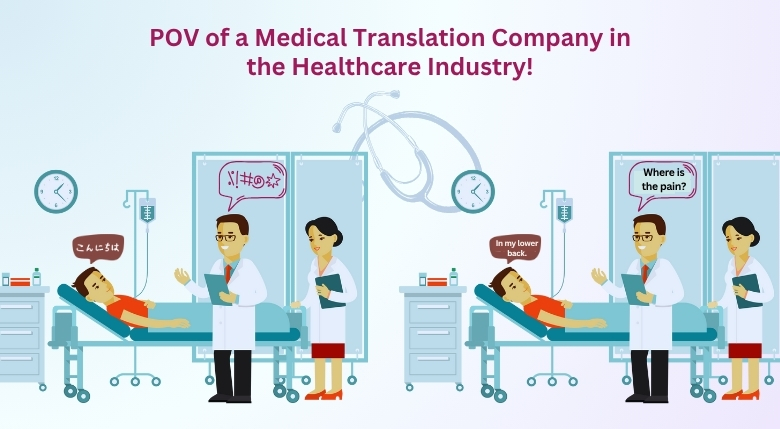
 We don’t wear a lab coat or carry a stethoscope, yet we help to enhance and improve the healthcare industry using our trusted tool, languages.
While working with renowned healthcare brands for the past 16 years, we have learned one thing: “Words can either heal or harm.” From medical research, clinical trials, vaccine rollouts, and hospital corridors, the art of getting it right is essential and complex.
However, amidst our professional journey as a medical translation company, we have learned that our duty is not just to improve multilingual communication but also to enhance trust, clarity, and compliance.
This blog isn’t just another theory but a glimpse of our medical translation journey, molded by challenges, learnings, and ultimately experiences.
What’s a Medical Translator’s View?
If you felt that language may not hold as high value as it seems, let’s check some facts. Almost 65% of clinical trial data used in global research originates from non-English-speaking regions. Yet, a large amount of clinical research is reviewed by English reviewers. This just shows how important it is to provide accurate, culturally relevant, and compliant medical document translation.
Here’s what we have learned as a leading certified translation company in India.
• Expertise Trumps Fluency
You can’t use Google for professional medical translation. The gamble of mistranslation is too high on free platforms like this. For instance, the word “hypertension” in a patient’s medical report can be translated into “high stress” by a machine translator. Although this seems harmless, it is essential to remember that such medical documents are used for life-altering procedures.
What we learn from it: Subject matter expertise is more essential than word-for-word translation. Medical linguists need to be proficient in both the language and the domain.
• Every Country Has Its Own Medical Dialect
Imagine you get a medical document translation project for a hospital in Madrid, Spain. The target language is Spanish. In this scenario, as a professional, you would need to use a linguist native to Spain and not Mexico. Though both countries speak the same language, there are some cultural differences. For example, blood pressure is translated into “tensión arterial” in Spain and “presión arterial” in Mexico.
LOOKING TO CONVERT YOUR MEDICAL DOCUMENTS ACCURATELY?
Contact us today to get exceptional life sciences translation company!
What we learn from it: It is vital to provide native linguists and create medical glossaries for every medical translation project.
• Regulatory Compliance is a Moving Target
In India, the Drugs and Cosmetics Act requires medical information to be translated into regional languages. In Europe, the EMA guidelines state only specific terminologies to be used in clinical trial documents. In the U.S., the FDA requires all translated documents to have the highest possible readability. As we move from one region to another, medical rules and regulations change. Hence it is important to stay aware of the changing regulations in the medical domain.
What we learn from it: In high-stakes medical translations, collaborate closely with regional regulatory teams and update translation memory systems regularly.
• Technology Helps, but Humans Enhance
We use CAT tools to boost the speed and accuracy of translations. However, we can’t rely entirely on machine translations in the medical domain, especially with documents like medicinal guides, awareness posters, and clinical trial brochures, which contain idioms and region-specific phrases. For example, in the vaccine rollout during COVID-19, pharma companies had to rely on human translations to convert phrases like “You may experience mild symptoms like fever.”
What we learn from it: Machine translation post-editing, or MTPE, is the way forward. By combining the speed of machines with the expertise of humans, any medical translation company can provide region-accurate, high-quality solutions.
Want to learn more about why machine translations must not be solely relied upon in the medical industry? Check out this blog: Why are Machine Translations not HIPAA-Compliant?
Final Words
We don’t just work with words; we work with the meaning. And in medical translation, the proper meaning can make the difference between trust and confusion.
At Somya Translators, we bring expertise, innovation, passion, precision, and cultural fluency to every translation service for healthcare professionals. As an ISO 17100:2015 certified translation company, we offer:
- Native medical linguists in 170+ languages.
- Certified translations that are tailored to different regional regulations.
- End-to-end comprehensive life sciences translation solutions, like forward translation, double review, reconciliation, back translation, and interpretation services.
Whether you are a hospital, pharma company, or healthcare NGO looking to translate your medical content, we are ready to collaborate.
Contact Somya Translators today to get a free quote!