

 What makes a food brand truly global?
It could be their worldwide presence, the quality of ingredients they use, or maybe their competitive prices and product variety. These factors can make a food brand global; however, the most vital ones are trust among its consumers and clarity about the ingredients used in the product.
Long before a consumer tastes what is inside a box, they judge a product by what is written on it. In global markets, the judgment begins with how effectively the brand has translated the product information into different languages.
And how to ensure that? Simply with assistance from professional agencies that offer packaging translations.
However, this service is not a simple language translation solution but one that is compliance-driven, trust-building, and shapes the global image of a food brand.
This blog breaks down how accurate food packaging translation supports global compliance, safeguards consumer health, and boosts brand credibility across global markets.
What Are Food Packaging Translations?
Let’s imagine a Korean cup noodle manufacturing company expands its operations in Thailand. Will local consumers understand what ingredients the noodles contain or their expiration date if the brand does not translate its packaging information into the Thai language? Unlikely.
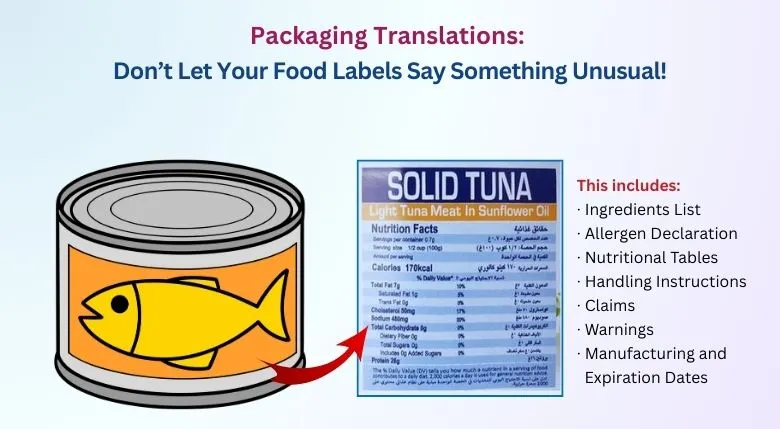
Expert food packaging translation services are vital in such situations. They involve converting all customer-facing and regulatory information on a food product’s packaging into the language of the target market.
This includes:
- Ingredients List
- Allergen Declaration
- Nutritional Tables
- Handling Instructions
- Claims
- Warnings
- Manufacturing and Expiration Dates
And more.
Furthermore, the importance of a multilingually accurate food packaging label is based on two factors:
- Consumers rely on food labels to feel safe and informed. A global study by Nielsen concluded that 73% of buyers are more likely to trust a product clearly labeled in their native language.
- Governments enforce strict labeling laws. Several regulations, like the European Union’s Regulation No. 1169/2011, China’s mandatory Chinese language labeling rules, and the US FDA’s disclosure requirement, strictly monitor the packaging accuracy.
So basically, accurate product label translation for multilingual markets is essential to communicate a product’s identity, provide safety assurance, and comply with regulatory bodies.
The Role of Multilingual Accuracy in Packaging Translations
When we mention accuracy in food packaging translation, we don’t just mean the simple word-for-word translation. Complete accuracy in translation also means complying with local regulations, cultural understanding, and the ability to clearly communicate vital health information to the consumers.
Every effective food packaging translation must:
- Convey measurements, ingredients, and allergens consistently.
- Use terminology that matches the target region’s legal definitions.
- Stay consistent with brand messaging across different markets.
The following example will explore what happens when a brand decides not to translate product information into the target region’s language.
In 2014, Calbee, a popular Japanese snack brand, exported its potato chips to New Zealand. However, the brand made a huge error. According to New Zealand’s export food regulations, all allergen information must be converted and declared in the English language. Calbee did not translate its ingredient list, which contained allergens like scallop and bonito, and as a result, kept it in the Japanese language.
The company subsequently faced some hefty consequences, such as:
- The product was recalled from stores to prevent allergic reactions.
- The importer, Japan Mart Company Limited, was fined NZ$7,000 by the authorities.
- New Zealand’s regulators classified this as a translation error, stating that the product itself was safe, but the missing translation posed a serious public health risk.
How Accurate Translation Ensures Compliance and Trust
Regulatory Compliance Across Markets
Countries differ widely in packaging and food labeling requirements.
For instance:
- The UK requires a declaration of 14 major allergens, while the US requires 8.
- For Asian countries like China, South Korea, and Japan, it is mandatory to convert the label language into the official language of the country. Furthermore, these countries also conduct pre-market verification for all labels.
- Some South American countries require transparency in packaging information in case of bioengineered ingredients.
By partnering with region-specific packaging translations, brands also avoid:
- Custom Delays
- Market-Entry Rejection
- Cost of Relabeling
- Fines or Product Recalls
According to the World Trade Organization, the global food and agricultural trade in 2023 exceeded $2 trillion. With such enormous movement of packaged goods across borders, region-based regulatory compliance has never been more essential.
Consumer Trust and Loyalty
Trust and loyalty are the two pillars that set a brand’s reputation across different markets. A clear food packaging translation service helps a brand achieve this sense of security.
A consumer always wants to understand:
- What are they eating?
- Whether allergens are present or which allergens are present.
- How to store the product?
- What are the manufacturing and expiration dates?
An accurate product label translation helps to remove any doubts and uncertainty that might be present in the consumer’s mind.
Basically, culturally aligned and legally compliant packaging translations help global brands avoid unnecessary consequences and image damage in foreign markets.
It’s surely not an easy task for a brand to enter a foreign market, especially a market as diverse and vibrant as India. Check out this blog to learn about some localization challenges global brands face while entering the Indian market. Please click on this link here: 5 Localization Hurdles Brands Trip Over in India.
Looking for Accurate Packaging Translation Services?
Contact Us Today for a Free Quote!
Challenges in Food Packaging Translations
Some common challenges in translating food packaging include:
- Unclear or Technical Terminology: Some scientific terms in the food industry, such as emulsifiers, stabilizers, and preservatives, often lack direct equivalents in other languages. A skilled linguist must then look for terms that match both the language accuracy and legal requirements of the region.
- Inconsistent Brand Message: While entering different markets, brands must keep their identity and message intact. The same applies to packaging translations. Terminology guides, glossaries, and standardization tools help maintain the brand voice in different languages.
- Regulatory Complexity: Complying with the regional laws is not just limited to food but also applies to FMCG, cosmetics, beverages, and nutritional supplements. Translators must be well educated in these regional laws and must ensure that the translations follow them according to the country.
- Space and Layout Limitations: What happens when a product package is translated into the Arabic language? The right-to-left language format often raises challenges for translators. Similarly, for English-to-German translations, the text expands, making it difficult to fit the content in the limited space. These translations require creativity without compromising essential information.
Best Practices for Effective Packaging Translations
Certified translation services that specialize in food packaging follow these tips for the best results:
- Conduct thorough research of the language, culture, and regulations of the target country.
- Use experienced and certified linguists for translating allergen information and other technical terms.
- Use translation memory tools like SDL Trados and memoQ, and specialized glossaries to maintain the brand voice across languages.
- Perform a thorough linguistic QA and back translation for vital content.
- Manage label designs and layout using expert DTP tools.
- Ensure translation compliance with legal organizations and local food authorities.
How Does Somya Translators Offer Expert Packaging Translations?
For packaging translation, a brand must find a compliance partner and not just a translation partner. Somya Translators, a leading translation agency in India, can be the perfect solution in this situation.
Here’s how we ensure excellent results:
- Native linguists with multidomain expertise.
- Translation workflows that are regulatory aligned.
- ISO 17100:2015-certified translation processes for high-quality results.
- Strict quality checks to avoid any errors.
- Effective utilization of translation memory tools and DTP tools to ensure consistent translations and layout designs.
- A deep experience in providing multifaceted services like legal and medical translations to clients in India and abroad.
In an interconnected marketplace, transparency, cultural respect, and regulatory compliance are the tools that influence buying decisions. Brands that invest in high-quality translation and localization services not only meet legal requirements but also earn trust and credibility in foreign markets.
If your brand is planning to enter a foreign market, don’t be too unsure of food packaging translations. We, Somya Translators, can help you enter different markets with confidence, trust, and accuracy.
Let’s Collaborate!
Call: +91-11-43061918
Email: info@somyatrans.com