

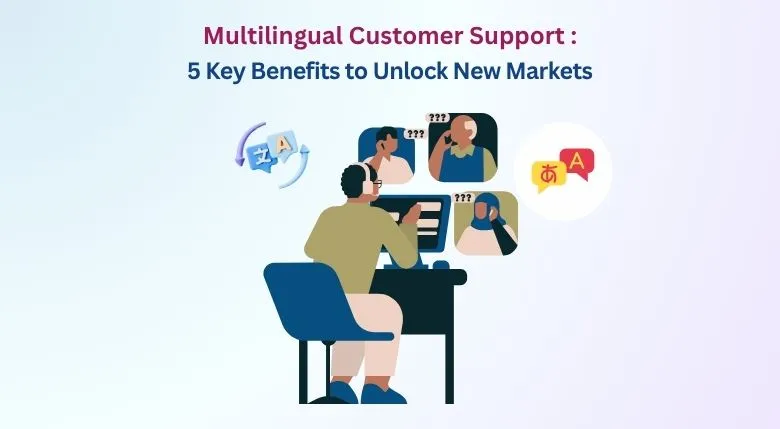
 Imagine the elation a customer halfway across the world might have upon reaching out to your support team and being greeted in their native language. For global businesses, this can be a turning moment in securing a long-term customer. However, this can also turn into a lost opportunity if the provided customer support is not multilingual, accurate, or culturally attuned. Multilingual customer support is thereby a strategic differentiator and can enable smooth global operations and market expansion.
This blog will list the five vital benefits of having multilingual customer support for global businesses.
We will also explore how to build a robust customer support strategy and the necessity of localization in it.
How Can Multilingual Customer Support Give You a Competitive Edge?
Today, businesses fear the risk of providing support in just one language and put substantial weight on CX localization (customer experience localization). Why? Simply to ensure a satisfactory global customer experience.
According to industry figures, the global language services market was estimated at $60 billion in 2022, a figure that has significantly risen over the years. Meanwhile, the multilingual customer support platform market alone is projected to grow from $6.47 billion in 2024 to $20.66 billion in 2033.
What does this mean?
That offering multilingual support in chats, emails, phones, websites, and social media is no longer a flexibility but a necessity.
Businesses can collaborate with a multilingual translation service and gain several advantages, such as:
- Positioning themselves as a global brand.
- Building trust with customers from different language backgrounds.
- Reducing delays and friction in customer interaction.
However, this demand for multilingual support was not initially seen as a business strategy; rather, it emerged from a shift in customer expectations.
The Global Change in Customer Perspective
The past few years have seen a rising trend: customers have started to engage more with brands that truly understand them, which includes communicating in the native language and respecting their culture.
To capitalize on this trend, businesses have started providing live chat, help-desk email, voice calls, and social media content in diverse languages. Hence, integrating both multilingual engagement and global customer experience into their business strategy.
With rapid globalization, various industries have increasingly started to seek out expert language solutions, such as translation services for healthcare, subtitle translation services, and multilingual DTP services.
Leveraging these services doesn’t just help businesses tackle the global language barrier but also offers a comprehensive suite of support to their customers.
Let us now explore the crux of this blog: the five key benefits of using multilingual customer support in a global business.
Benefits of Implementing Multilingual Customer Support
Improved Customer Experience and Trust
When a customer receives support in their own language, three things are established:
- Smooth communication
- Lesser misunderstanding
- Stronger emotional connection
For example, in the medical industry, translation services for healthcare are essential to ensure patient documents, instructions, leaflets, and communications are accurate and culturally sensitive.
By providing support in multiple languages, businesses reflect respect for customer preferences and cultures, thereby creating an enriching environment of trust. This trust leads to brand loyalty and higher engagement.
Faster Problem Resolution
Language barriers tend to slow down support processes, be it through calls, chats, or emails. Businesses end up spending more time understanding the problem and coming up with a solution. However, by integrating multilingual support, companies can reduce time spent on workflows and reduce resolution time.
In a world where customers expect quick replies, the capacity to resolve problems in native languages becomes a key operational strategy.
Access to New Global Markets
A professional multilingual translation service can help a business enter and operate in a new market. Entering new markets does not just depend on a robust marketing and sales strategy; it also hinges on high-quality post-sale customer service.
For example, if a company’s user base grows significantly in Latin America, it becomes necessary to provide customer support in accurate Spanish and Portuguese.
Similarly, to enter India’s diverse market, brands need to partner with an expert language translation company in India to build a foundation of multilingual support and translate documents in a culturally aligned manner.
Strengthened Brand Image and Global Compliance
In many industries, like healthcare, legal, finance, and manufacturing, having legally compliant translations is a must. A certified language service provider helps businesses align their customer support with global standards, improve brand image, and build credibility in new markets.
Let’s consider the following example.
A company decides to enter Thailand and so starts offering customer support in the Thai language. However, it failed to comply with Thailand’s digital protection laws, which led to hefty fines and reputational damage.
This unfortunate situation could have been avoided if the business had collaborated with a professional translation company. Certified translations ensure that brand communication is trusted, compliant, and professional.
Data-Driven Insights and Better Feedback
Engaging with customers in their native language helps the brand gain quality feedback. With multilingual support, customers can communicate their problems clearly, use idioms and cultural nuances, and give in-depth insights. This data, in return, will help brands solve the problem with a more effective approach and avoid any future recurrence of the same issue.
Furthermore, brands can also analyze culture- or language-specific trends to improve their services in that particular region.
In short, apart from marketing, there are three other solutions to market expansion.
- Tailoring global customer experience.
- Aligning localization services with region requirements.
- Refining the support system by implementing multilingual and cultural elements in it.
However, before reaping the benefits, a company must first set up a robust multilingual support strategy.
Let’s explore how.
How to Set Up an Efficient Multilingual Support Strategy?
Effective multilingual support that is ready for global markets needs careful planning, advanced tools, and quality partners.
The following are some key steps:
- Centralized Knowledge Base Localization: Build one comprehensive language knowledge base in English and then convert or localize it into different languages. This reduces complications and increases consistency.
- Use Multilingual DTP for Consistency in Help Documents: A multilingual DTP service helps to convert all support documents, like user guides and FAQs, into print-ready format, while aligning to tone and layout preferences across various languages.
- Use Certified Translation Services: As we discussed earlier, it is vital to partner with certified translation services, especially when catering to regulated industries like healthcare, legal, finance, and manufacturing. This helps the business to maintain language accuracy while being compliant with region-based laws.
- Integrate Diverse Channels for Multilingual Engagement: Ensure that chat, email, social media, and phone support are available in every target language.
- Prioritize the Language Based on the Market: Do not try to cover all the languages at once. Start with the languages spoken in key markets, monitor results, and then expand into other languages.
- Carefully Analyze Multilingual Feedback: Feedback is the best way of knowing what the customer wants. By using data received from different markets, businesses can improve their localization efforts, product features, and overall operations.
- Maintain High Cultural Sensitivity: Localization is not just the language; it includes cultural adaptation, tone, references, idioms, and context. By maintaining region-based sensitivity, a brand can ensure a satisfactory global customer engagement.
Food for Thought: Have you ever encountered video explainers of a product or service with multilingual subtitles? It is a commonly used, highly beneficial process that easily integrates into a customer support system. However, a subtitle translation service is not just limited to that. The legal industry, too, finds some interesting use of subtitles. Don’t miss out on our related blog to know more: Legal Subtitling Explained: What Every Courtroom Must Know.
Want Your Business to Have Expert Multilingual Customer Support System?
Contact us today and get impeccable Multilingual Translation Services!
Choosing the Right Translation Partner
When selecting a partner that supports a business’s multilingual customer support requirements, always consider the following:
- The provider must be experienced in various multilingual customer support channels, like help desks, chat, and email.
- The translation company must be adept at handling DTP, subtitling, and localization projects. They must also be able to localize the documentation suite, support glossaries, and support tone preferences.
- A provider with diverse industry expertise, ranging from healthcare, manufacturing, legal, and finance.
- Credible certification like ISO 17100:2015 to ensure the highest translation standards.
That’s where Somya Translators comes in. As the leading language translation company in India, we offer expert translators and linguists across 170+ languages.
If your business is seeking to scale new markets or operate efficiently in the existing ones, multilingual customer support would become necessary, and Somya Translators can be your dynamic solution.
Reach out to us today to give your business a global voice!
Call: +91-11-43061918
Email: info@somyatrans.com
Also check out our other language solutions: https://www.somyatrans.com/services/.