

Can one wrong word really shut down the whole factory?
Or can a mistranslated clause invite a lawsuit?
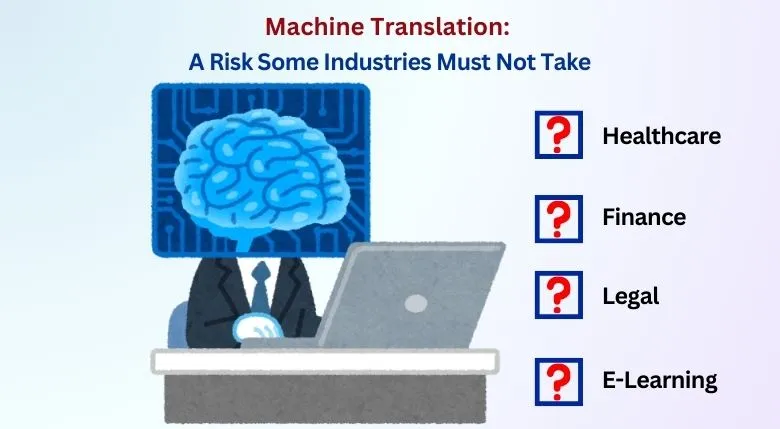
There are some uncomfortable truths that global businesses discover. AI-powered solutions are continuously evolving; they promise instant results and reduced costs. However, they also put content in some serious risks, especially if it is from a high-stakes industry. As a result, businesses have discovered that they cannot entirely rely on machine translation for multilingual content.
In this blog, we will discuss why AI is not suitable for translation in high-risk industries and why human translations are often the smartest choice.
Worried About Translation Errors in High-Risk Industries?
Get expert help from professional translators to ensure complete accuracy and compliance for your critical documents.
Why Is Accuracy Not Optional?
AI tools predict and analyze language patterns during translations. This enables them to correctly identify the words but not the sentences. This distinction matters significantly in sectors where mistranslations carry high costs.
Some of these costs include:
- Regulator Violations and Penalties
- Financial Fines
- Safety Incidents
- Legal Disputes
- Reputation Damage
For translation in high-risk industries, such as legal, medical, and manufacturing, the margin of error is zero. The translated language needs to be complete, consistent, culturally precise, and compliant.
Why Can’t Machine Translations Provide Complete Accuracy?
AI translations refer to translations that are purely done by machines, with no human expertise included. The AI processes rely on huge sets of databases collected across languages.
However, what they lack is:
- Contextual awareness
- Legal and medical reasoning
- Industry-specific accountability and certification
- Cultural relevance
In high-risk environments, such as when one needs to translate a legal contract or a medical fitness certificate, machine translation is completely unacceptable.
Need Accurate Translation for Legal, Medical, or Technical Documents?
Our expert linguists ensure industry-specific accuracy and compliance for high-stakes translations.
Industries Where Machine Translations Create Serious Risk
Healthcare: Where Accuracy Impacts Patient Safety
Translation accuracy is vital in healthcare documents. A small language error can directly have an impact on a patient’s well-being.
Some documents that need 100% accuracy are:
- Medical labels and dosage instructions
- Clinical trial translation and patient information leaflet or dossier
- Consent forms
- Medical device manuals
- Discharge summaries
Medical translation accuracy also requires complete clarity. Using an AI translation tool can lead to:
- Complexities in translating medical terminology.
- Misidentification of abbreviations with multiple meanings. For example, “administer MS 2 mg IV q4h PRN pain.” In this, “MS” can mean either morphine sulphate or magnesium sulphate.
- Context-sensitive dosage instructions.
A mistranslation of “once daily” and “once weekly” is not a lapse of language but a vital health risk.
Finance: Strict Regulations That AI Can’t Follow
Financial translations need to comply with strict regulations set across India, the U.S., and the EU. For example, SEBI, SEC, FCA, GDPR, and IFRS.
Some financial documents that need to follow these regulations are:
- Investment disclosures
- Risk statement and disclaimers
- Annual reports and audit notes
- Insurance policy wording
- Compliance filings
However, machine translation tools struggle with these because they are not trained to:
- Validate regulatory language
- Detect compliance inconsistencies
- Adapt disclosures for region-specific rules
These financial translation challenges can lead to fines, external audits, or blocked market entry.
Do you want to explore more about how financial mistranslations can cost a company? Don’t miss out on our related blog: Financial Translations: How a Tiny Error Can Cause Massive Losses.
Legal: Where Meaning Cannot Rely on Guesses
In legal language, every word carries a meaning, and one cannot simply guess the meaning.
Essential legal documents where accuracy is most required are:
- Contracts and agreements
- Terms and conditions
- Privacy policies
- Court filings
- Intellectual property documents
Legal translation mistakes often arise because AI is unable to:
- Recognize jurisdiction-specific requirements and adapt to them.
- Convert legal concepts that have no direct translations.
- Preserve clause structure and protect integrity.
Interpreting the law and translating it into multiple languages is a skill human linguists take pride in. And this skill cannot be replicated by machine translation tools.
Ensure Legal and Financial Translation Accuracy
Avoid compliance risks and translation mistakes with certified professional translators.
Manufacturing: Where Technical Precision Means Safety
Manufacturing documents oversee smooth operations across different regions. They also comply with regulations and enable workplace safety.
Some of these documents include:
- Safety warnings and labels
- Assembly and installation manuals
- Maintenance instructions
- Technical specifications
- Regulatory compliance documents
With AI translation tools, mistakes can occur. And these mistakes can cause:
- Equipment damage
- Manufacturing delays
- Workplace hazards and accidents
- Costly repairs and recalls
One major domain where machine translation tools fail to maintain consistency.
E-Learning: Where Clarity Boosts Comprehension
E-learning content translation must be clear, consistent, and precise to the point. The aim is to transfer effective knowledge to multilingual learners. Translated learning materials, if done right, support learner engagement, knowledge retention, and course completion.
Some of these materials include:
- Course modules and lessons
- Training videos and subtitles
- Assessment, quizzes, and exams
- Instructional guides and handbooks
- Learning management system (LMS) interface text
Using AI translations for these materials can cause several mistakes, which further leads to:
- Learner confusion and misinterpretation
- Reduced engagement and low course completion rate
- Incorrect assessment results
- Inconsistent terminology in lessons
- Compliance issues in regulated training programs
These risks can ultimately lead to learning hindrances.
The Solution: Human-in-the-Loop
While AI translations cannot be used for many industries, they also cannot be completely discarded.
Human-in-the-loop workflows can be used for machine translation.
This would include:
- AI speed and scalability
- Expert human translators
- Industry-specific reviewers
- Multi-stage quality checks
The combination of machine translation and humans is called machine translation post-editing, or MTPE services.
They provide:
- Terminology consistency and glossary management
- Contextual accuracy
- Compliance with local regulations
- Region-specific cultural precision
- Multi-step review to ensure quality assurance
Protect Your Business from Costly Translation Errors
Work with experienced translators who understand compliance, terminology, and industry-specific accuracy.
Let’s Go for a Safer Choice
Somya Translators treats translation projects as a quality-controlled process.
As an expert ISO 17100-certified translation company, we offer:
- Native human translators for high-risk documents
- Well-defined MTPE processes for scalability
- Industry professionals for reviews
- Structured quality assurance that is aligned with global standards
- Deep experience in legal, finance, medical, manufacturing, and e-learning sectors
“If your document cannot afford errors, it cannot afford AI-only translation.”
Partner with Somya Translators today to protect your business from translation errors.
Reach out to us for a free quote!
Call: +91-9990094796
Email: info@somyatrans.com