 “Everyone wants language to be a close ally in the wrath of a natural disaster!”
Whether it’s a desperate refugee family seeking medical aid, a free education policy introduced in rural Kurdistan, or emergency aid workers providing on-ground relief, the need, ability, and possibility of clear communication in the Kurdish language cannot be underestimated.
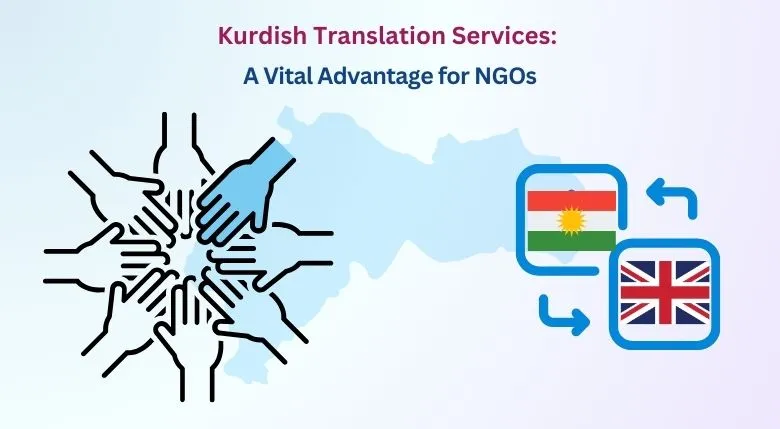
But how do global NGOs and relief programs prevent the Kurdish language from becoming a barrier during these critical situations? The answer is with Kurdish translation services!
In this blog, we will explore the vital role of Kurdish translation companies in determining the success of government and NGO projects.
The Rise in Demand for Kurdish Translation Services
Did you know that the Kurdish language is spoken by 20-40 million people in the sensitive regions of Iraq, Syria, Turkey, and Iran, yet the language and its native speakers are often overlooked during public communication strategies?
One reason behind this: Kurdish is not the primary language of the region.
In fact, a report by Amnesty International states that during the heart-wrenching 2023 Turkey-Syria earthquake, several Kurdish speakers were not able to receive quality medical treatment due to the lack of native medical translation services.
But with the emergence of English-to-Kurdish certified translation companies, this dynamic is changing.
Because millions of Kurdish speakers often need medical support, resettlement policies, and legal communication, NGOs, humanitarian organizations, and governments have started to partner with professional Kurdish translation services. This ensures that the language is not a hindrance but a vital ally to humanitarian efforts in the region.
Why Do Government and NGO Projects Need Accurate Kurdish Translations?
From region-based vaccination drives to refugee resettlement policies and legal handbooks, relying on government document translation in the Kurdish language becomes essential. Several global agencies, like the UNHCR, the Red Cross, and numerous NGOs, often need accurate and culture-sensitive translation for:
- Legal assistance and asylum documentation for refugees.
- Medical outreach during disasters or pandemics.
- Crisis communication and policy implementation.
- Educational and vocational training for natives.
And for governments, whether local or central, connecting with native Kurdish speakers builds trust, encourages participation, and ensures a clear understanding of policies.
Want to know the deeper impact of administrative translation services for different governments? Check out our related blog: Administrative Translation Services: The Key to Effective Cross-Border Governance.
The Linguistic Diversity of the Kurdish Communities
Earlier, we discussed how Kurdish natives are often overlooked during public communication strategies. But it is not just because it’s a minority language; there is another layer to it: which Kurdish dialect should be used?
Kurdish isn’t just one language but a macrolanguage, which means it contains multiple dialects.
This includes:
- Sorani Kurdish: This is a central dialect, mainly spoken in parts of Iran and Iraq.
- Kurmanji Kurdish: A vital northern dialect, with speakers based in Turkey and some parts of Syria.
- Badini: A very unique regional language spoken by communities in Northern Iraq.
These dialects vary in several aspects.
- They use different writing scripts. Some use Latin, while others use Arabic.
- They differ in vocabulary, sentence structure, and grammar, making translations more complex.
- The cultural references of these dialects widely differ from each other. A phrase or idiom in Sorani Kurdish won’t be understood by someone who speaks Kurmanji Kurdish.
A professional and reliable Sorani Kurdish translation company understands these elements and helps NGOs and governments with targeted and region-specific communication with utmost clarity.
GET EXCEPTIONAL ENGLISH-TO-KURDISH CERTIFIED TRANSLATION SERVICES
Contact us today for exceptional translation solutions!
When Clear Kurdish Communication Saves Lives
What’s the downside of not having support from Kurdish translation services?
Let us understand with a real-life example.
During the tragic 2017 earthquake in Kermanshah, Iran, several Kurdish-speaking people were left confused and were denied timely help. Why? Because all the rescue materials were provided in the Persian language, leaving thousands of people unable to receive proper aid.
This instance sparked a global advocacy for language-inclusive disaster management by an international group of language translators.
During the above-mentioned humanitarian crises or natural disasters, responders need to deliver urgent instructions like evacuation protocols, hazard warnings, and aid distribution points. If this information is not adapted according to Kurdish natives with the help of localization services, people won’t fully comprehend the information, as happened in Kermanshah in 2017.
Importance of Human Translators in High-Stakes Projects
While AI tools and machine translations are slowly making strides in the language industry, relying on human translators is still the preferred option. This is especially important for translating culture-driven content.
So, why is human translation the preferred method? Because they can:
- Easily differentiate between the Kurdish dialects.
- Localize tone and intent and tweak the cultural messaging to ensure appropriate resonance.
- They are vital for the translation of confidential medical and legal documents, thanks to NDAs and encrypted processes.
While dealing with sensitive government document translation, medical reports, and refugee case files, it is essential to be accurate, culturally sensitive, and discreet in translations. Failing to do so by using AI rather than human translators may lead to legal disputes and mistreatment.
How Can Somya Translators Be Your Trusted Partner?
When we talk about professional Kurdish translation services, one of the most dependable names is Somya Translators. As an ISO 17100:2015-certified translation agency, we go beyond translated words and try to establish an organic connection between NGOs, governments, and native Kurdish communities.
Here’s why we are the preferred destination for Kurdish-to-English certified translation services:
- We offer fast turnaround and accurate translations. This is essential for emergency response and NGO campaigns.
- Our 100% confidentiality guarantee ensures that all government and NGO documents are handled with care and security.
- We only work with native linguists who are proficient in dialects such as Sorani, Kurmanji, and Badini.
- We also offer end-to-end localization services for legal, medical, educational, and policy content.
Some NGO and government documents we translate into or from Kurdish are:
- Public health campaign materials: Brochures, vaccination guides, and mental health handbooks.
- Educational and training materials: Curriculum, refugee education kits, and NGO training material for field personnel.
- Legal and Policy Documents: Government policies, human rights reports, and asylum forms.
- Humanitarian aid communication: Emergency response guides, relief instructions, and evacuation manuals.
- International collaboration and grant proposals: UN/NGO funding proposals, intergovernmental agreements, and mission statements.
Explore more about our government translation services here: https://www.somyatrans.com/translation-services-for-government-and-public/.
So, if you are someone who needs to translate documents into the Kurdish language, let Somya Translators help you with reliable and accurate solutions.
Contact us today via phone [+91-11-43061918] or email [info@somyatrans.com] and get a free quote!