

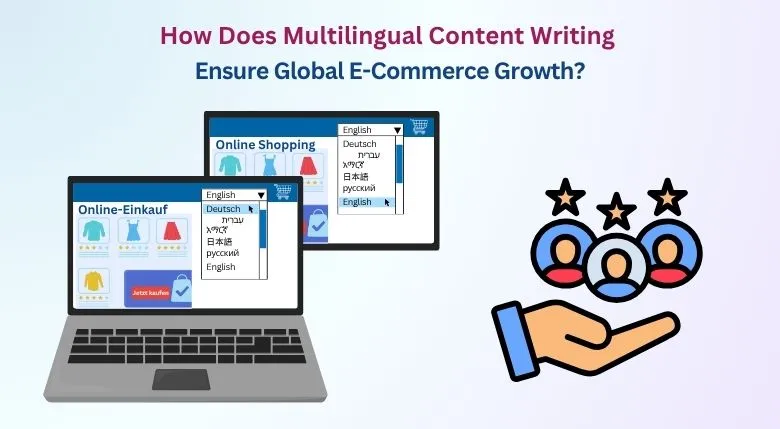
 A customer from Finland lands on an e-commerce website looking for a watch. Intrigued by the design and confidence in the brand, the customer decides to buy the product. But then, the customer hesitates. While giving a second glance at the product description (written in English), he becomes unsure whether the watch is quartz or automatic. The customer moves on to a different website to continue his shopping!
Due to the product description written in just one language, the customer got confused and left for a different site—it’s not just the loss of a customer but also the loss of a sale.
E-commerce stores are not just selling products; they are also building a connection with visitors. And to connect with shoppers worldwide, multilingual content writing services have come up as effective solutions.
In this blog, we will discuss the importance of a content writing service in different languages for the success of a global e-commerce store!
The Rise of Multilingual Content in E-commerce Stores
Did you know that 40% of online customers are confident about a purchase if they are familiar with the language of the website?
As e-commerce networks have grown tremendously and crossed geographical boundaries, businesses are realizing the importance of multilingual content writing services. However, to cater to online customers efficiently, it is not just vital to translate the content but also to make it relevant—as mentioned earlier, it is all about making a connection.
So, how does an e-commerce store ensure that a visitor becomes a customer?
What Is the Right Language Strategy?
It’s simple: When a website speaks the customer’s language fluently—across product descriptions, pages, customer support, and checkout pages¬—they tend to stay longer, engage more, and make purchases repeatedly.
E-commerce translation services with specialization in content writing help a website by:
- Adapting the tone and terminology to the cultural expectations of a region.
- Ensuring a consistent brand voice across different languages.
- Crafting compelling write-ups that resonate with customers.
- Including an accurate product description translation to avoid confusion.
However, integrating multilingual content with e-commerce content is not an easy task.
Common Challenges in Multilingual E-commerce Content
Here are some challenges that often get in the way of creating a truly global and multilingual e-commerce store:
- By-the-book or literal translation makes intended communication challenging.
- Specialized terms across pages may result in inconsistent translations.
- Local SEO guidelines are difficult to implement for different regions.
- Special focus on cultural relevance to make a brand feel native to the customer.
These challenges affect an e-commerce brand’s credibility, presence, and sales.
Get Exceptional Multilingual Content Writing Services with Somya Translators
Contact us today and get impeccable content writing services!
Best Practices for E-commerce Multilingual Content Writing Services
To overcome the above-discussed challenges and expand into global markets, follow these professional tips:
Transcreation Over Direct Translation
Transcreation involves adapting the cultural side of content while retaining the original message. It also makes the content more emotionally relevant in the target market.
Multilingual SEO Integration
SEO integration varies according to the region. A particular word that ranks high in a region won’t have the same impact in a different region. E-commerce translation services offer localized SEO, which includes:
- Using local keywords.
- Adapting meta descriptions.
- Optimizing URLs and alt text in each language.
This boosts organic reach and search results in local search engines like Baidu and Yandex.
Consistency in Tone and Terminology
Whether an online store is catering to Gen Z in the U.S. or an elderly customer in Japan, it is necessary to use the correct tone in all write-ups. This creates consistency, strengthens brand identity, and boosts customer satisfaction. Using a professional content writing service ensures:
- Proper glossaries and style guides are followed across all languages.
- Consistent terminology in all content.
- Multilingual content writers capture relevant brand messages.
Human Workflows Over Full Automation
AI tools can help with multilingual content writing, sure. But is it really time to trust AI chats completely? Without a human-driven proofreading service, AI-written content can miss:
- Cultural relevance
- Idiomatic phrases
- Clarity in readability
For any online store, providing content in the local language is essential. Don’t miss out on our related blog to explore how e-commerce translation services can help: E-commerce Translation Services: Your Online Store Can Speak the Local Language.
How Somya Translators Can Help Your Online Store
In e-commerce, where every word counts, the difference between an abandoned cart and a purchase lies in using relevant, multilingual language. Somya Translators, an ISO 17100:2015-certified leading retail translation and content writing service, helps e-commerce brands convey their story in over 170 languages.
We employ native linguists, industry-proficient writers, and market insights to ensure that e-commerce brands communicate with clarity and cultural relevance.
Some multilingual content writing services we offer for e-commerce businesses are:
- Product description writing and translation.
- Category page content.
- Landing page copy.
- Multilingual blog writing.
- UX microcopy and CTAs.
- FAQs and help center content.
- Legal page writing (terms and conditions).
Whether your brand is operating on Shopify or Magento, our content writing solutions help you scale across different marketplaces.
Want to cater to visitors across geographical borders?
Contact Somya Translators today!
Reach out to us via phone (+91-9990094796, +91-8452949431, +91-8422894974) or email (info@somyatrans.com).
Or visit our website: https://www.somyatrans.com/content-writing-services/.