

 Have you read a translated text, and mid-sentence, you feel like something is off? Maybe the words made sense, but the meaning didn’t. For instance, while reading a user manual, you come across the instruction, “Turn off the light before plugging in,” and wonder, was it supposed to say, “Plug in before turning off the light?”
This sense of disconnect in translated content is quite common, and it just cannot be ignored. What some people fail to understand is that translation isn’t just a word-for-word conversion but a more context-driven technique. They might think that the translated text should be crystal clear in the target language—but what if it’s not?
Imagine a marketing slogan translated into Japanese does not resonate with the consumers. Or a patient information document translated into Mexican Spanish contains a mistake. In such a high-stakes scenario, back translation becomes necessary.
In this blog, we will explore what back translation really means, and most importantly, whether the process is worth investing in.
What is Back Translation?
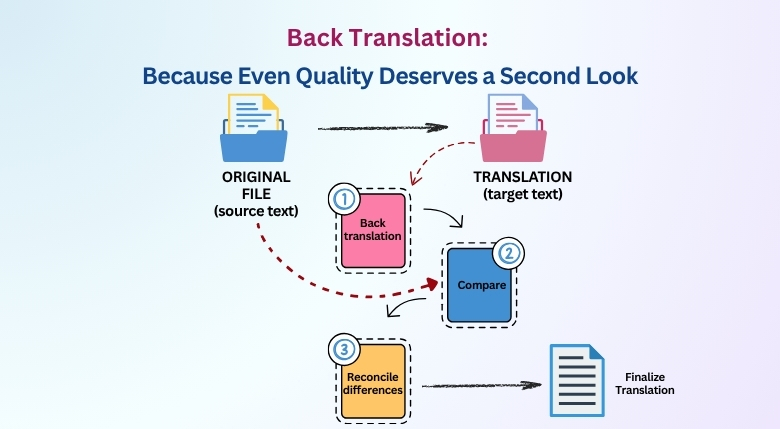
In simple words, back translation, also known as reverse translation, is a process of converting a document back to its original language, but by a different linguist. By doing so, it becomes easier to spot errors, ambiguities, and changes in meaning between the new version and the original version.
For example, let’s say you have translated a patient consent form from English to Japanese. A second translator, who is unaware of the original English version, translates the Japanese version back into English. Then you can compare the original English form with the newly re-translated version to check for errors.
The goal? To ensure that the translated message was contextually accurate and didn’t lose any meaning during the translation process.
When Does One Need Back Translation?
While back translation is an effective tool to check the quality of the content, it might not be required in every field. However, in legal and medical translation projects, where accuracy cannot be compromised, back translations become necessary.
• Medical Translations
In domains like pharmaceuticals, biotechnology, and clinical research, accuracy is non-negotiable. A small mistranslation could have life-altering results.
Hence, companies often prefer to choose back translation services for the following documents:
- Informed consent forms
- Clinical trial procedures
- Patient-reported outcome measures (PROMs)
- Medical device manuals
- Drug labels and packaging
Did you know that in clinical trials, getting flawless accuracy isn’t as easy as some might think? Check out this blog to know more: Clinical Trial Translations: How to Ensure Flawless Accuracy?
• Legal Translations
The language of law demands clarity. From affidavits and patents to compliance documents and contracts, every translation must be linguistically accurate and follow the norms of the target region.
Hence, legal firms can trust professional linguistic services to conduct back translation to:
- Avoid legal disputes caused by inaccurate terms.
- Ensure clarity among all parties involved.
- Meet the regulatory standards set by the court.
• Market Research and Surveys
During market research, it is essential to gather accurate data from foreign regions. Back translation helps research firms ensure that their survey questions carry the same essence in different markets.
Back translations are generally used for:
- Multilingual surveys and questionnaires
- Polls and customer feedback forms
- Research studies with linguistically diverse participants
• Creative or Brand-Sensitive Content
This is where things start to get tricky. Creative content, mainly used for advertising purposes, often contains puns, idioms, and region-specific cultural references. Translating such creative content isn’t as straightforward as it seems. In this scenario, meaning and fluency are more important than linguistic accuracy.
Case in point:
Nike’s popular tagline, “Just Do It,” can be translated in several ways:
- In Spanish, it is translated into Solo hazlo.
- In German, it is translated into Mach es einfach.
- In Italian, it is translated into Fallo e basta.
Hence, a professional translation company needs to ensure that these varying translations have the same impact as the original one.
LOOKING TO CHECK THE QUALITY OF YOUR TRANSLATED MEDICAL CONTENT?
Contact us today for exceptional back translations and ensure flawless quality!
Trust the Professionals
If you are operating in an industry in which slight mistranslation can have serious consequences, back translation is necessary for you. At Somya Translators, we don’t just translate the language but preserve the meaning.
As an ISO 17100:2015 certified professional translation company in India, we bring unmatched experience and diverse linguistic services to the table. From linguistic testing to forward translation, we ensure all projects are culturally precise and contextually relevant.
Some other services we offer are:
- Translation
- Localization
- Machine Translation Post-Editing (MTPE)
- Subtitling
- Voiceover and Dubbing
- And many more.
So, if you need back translation, forward translation, or full-scale localization, Somya Translators is your go-to solution.
Contact us today to get high-quality translations that never miss the mark—no matter what the industry.