

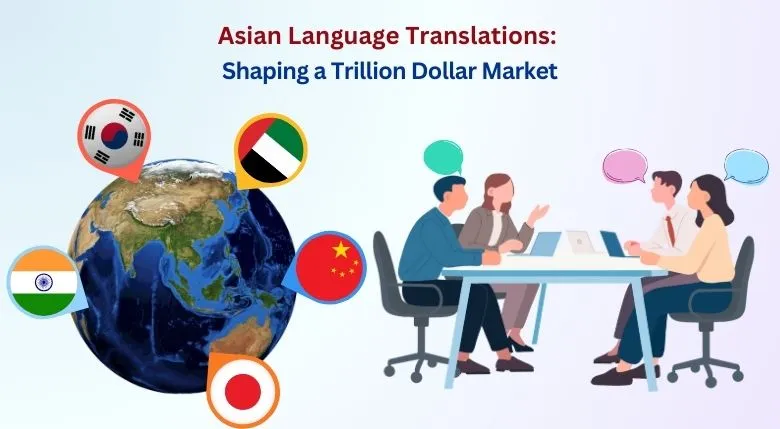
Is Asia still the “next big opportunity”? No, it already is the opportunity! In 2026, Asia is influencing global growth, adapting to digitalization, and meeting high consumer demand. From China’s futuristic, tech-driven economy to India’s rapid digitalization, the various markets of the continent are shaping up to be one of the most enticing business-friendly regions in the world. However, many global companies still assume that speaking English would be sufficient to enter and dominate these markets.
Asia is not built on one language, one culture, and one heritage. It is a culmination of hundreds of languages and cultures—each one as unique as the other. Hence, any business that wants to function effectively in Asia’s rich market would need to partner with agencies that offer Asian language translations.
This blog will explore why Asian markets are rising rapidly, and business expansion in Asia is directly influenced by languages.
Asia: The Growth Engine
Asia contributes over 50% of the world’s population. Furthermore, it also drives a significant share of global GDP growth. China, India, Japan, South Korea, and some emerging Southeast Asian markets, such as Thailand, Indonesia, and Malaysia, are trailblazers in various sectors, including technology, finance, healthcare, education, and entertainment.
Alas, Asia is not a unified market. Rather, it is a mix of several languages, scripts, and consumers coming from different cultures. For instance, an Indian consumer would have different behavioral choices as compared to a Chinese consumer. So, if a business is to cater to both consumers, it would need to quickly figure out how to ignite relatability. This could be done by providing products or services in different languages and adapted to region-specific cultures. Basically, businesses need to make their customer communication native, natural, and trustworthy.
This is why Asian language translations are becoming significant to global business strategies in 2026.
How Do Languages Help Businesses in Asia?
For many Asian consumers, languages are more than words—they are their identity. Speaking the native language invokes trust, credibility, and brand perception. Furthermore, consumers often relate to their native language with trust and relatability. A foreign business can benefit from all this if it translates its communication into various Asian languages.
Unlike many Western economies, Asia is also influenced by context. So, businesses must also adapt tone, politeness, and cultural references to avoid misunderstandings.
One infamous example of the 1960s would be when Pepsi, a global beverage brand, used literal translations rather than culturally adapted localization. This involved changing their slogan “come alive with the Pepsi generation” into “Pepsi brings your ancestors back from the grave” in Chinese. The result: a culturally insensitive and creepy brand message, which Pepsi had to apologize for.
The example of Pepsi highlights the importance of being culturally and contextually accurate in translations, especially in Asia.
So, for any company planning business expansion in Asia, it is important to:
- Translate the language of communication content.
- Adapt the tone according to the target region.
- Add local cultural references to invoke trust.
- Be contextually accurate.
Studies consistently prove that consumers—regardless of their geographical location—are far more likely to engage with brands if information is provided in native/known languages.
For consumers, speaking local languages equals higher trust.
But for businesses, speaking local languages equals higher sales, engagement, and conversions.
Looking to Translate Your Content into Various Asian Languages?
Contact Us Today for a Free Quote!
Which Asian Languages Are the Most in Demand?
Several languages can be beneficial as gateways to Asian markets.
1. Chinese (Mandarin)
Mandarin is one of the most spoken languages in the world, which naturally makes it a dominant language for businesses, digital platforms, and government operations in Asia. Spoken mainly in mainland China—a $17.8 trillion market—Mandarin has multiple regional dialects and linguistic complexities, which makes Mandarin translation and Chinese localization services a difficult task.
However, professionally translated Chinese content helps several industries, such as:
- E-Commerce
- Fintech
- Healthcare
- Manufacturing
- Gaming
Why Translation Matters: Success in the competitive Chinese market depends a lot on how global brands interact with local consumers. Interactions must not just be in Mandarin but also must be culturally respectful and contextually appropriate. Professional Chinese localization services offer culturally precise Mandarin translations that align with local platforms, consumer choices, and regulations.
Want to know more about Chinese translations? Don’t miss our related blog: Chinese Document Translations: Scale Your Business Across China.
2. Japanese
The Japanese language places a very high value on social hierarchy, politeness, and context. This heavily influences how brands structure their corporate communication strategy. Also, written Japanese and spoken Japanese vary significantly when directed towards a local customer.
To sidestep all challenges and ensure smooth brand communication, several industries partner with Japanese translation companies. Some industries are:
- Technology and IT
- Automotive
- Healthcare
- Banking
- Gaming
Why Translation Matters: The precision demanded by the Japanese language is very high. Using the right script (hiragana, katakana, or kanji), correct honorifics, and implementing cultural sensitivity in translations can only be done by a professional Japanese translation company.
Are you interested in learning more about Japanese translations? Check out our related blog: Japanese Translation Services: The Talk of the Town.
3. Korean
Korea is a highly digitally advanced and tech-driven consumer base, which also has a strong domestic market and global cultural influence. The population is trend-savvy, and hence, foreign businesses need to adapt both their multilingual content strategy and brand positioning to operate efficiently.
Korean translation services can benefit several industries, such as:
- Entertainment
- Beauty and Skincare
- Technology
- Gaming
- E-Commerce
Why Translation Matters: Culture is vital in the Korean market, and so is appropriate brand messaging that resonates with the local population. Businesses that aim to expand into the Korean market need expert Asian language translations to gain trust among the Korean consumers and high engagement in fast-moving industries, such as e-commerce and beauty and skincare.
4. Arabic
Not just East Asia but also West Asia, especially the Middle East region, is also an enticing and growing market for business and commerce. Arabic stands as an important language in the Middle East that ensures clear and accurate communication between businesses and consumers.
Some industries that benefit from Arabic translation services are:
- Oil and Gas
- E-Commerce
- Medical
- Legal
- Tourism
Why Translation Matters: Professional Arabic translation services adapt content according to the consumer’s expectations. Some complexities in Arabic translation arise due to the language being a right-to-left language. Only expert, native Arabic or Asian language translations can address these challenges efficiently.
Do you want to know more about how foreign language translation services translate right-to-left languages? Check out our related blog post: Localization Services: How Do They Translate Right-to-Left Languages?
5. Hindi
Hindi is spoken by over 500 million people in India, making it a vital link for business communication. As one of the official languages of India (the other one being English), Hindi enables communication on a large scale. While it coexists with other regional languages, such as Marathi, Tamil, Bengali, and Punjabi, professional Hindi translation services can accommodate various demands of global businesses.
Some primary industries that benefit from Hindi translations are:
- E-Learning
- Fintech
- Medical
- E-Commerce
- Tourism
Why Translation Matters: Businesses that work with Hindi translation services can reach mass audiences with clarity, cultural relevance, and confidence. Translation services can also support a brand’s local adoption and growth across digital and physical platforms.
Did you know that Hindi translations also help to preserve the rich Indian culture? Check out our related blog to know how: Hindi Translation Services Explained: A Language That Connects India.
How to Enter Asian Language Markets? A Practical Roadmap
Entering the Asian language market can be difficult if not planned and strategized carefully.
This is how a simple, yet effective roadmap would look:
- Identify the market priority, spoken language, dialects needed, and consumer behavior.
- Choose the right language to expand without any cultural and legal roadblocks.
- Partner with a professional Asian language translation service.
- Identify the content that needs translation and localization. It is beneficial to localize high-impact content, such as websites, apps, marketing materials, onboarding documents, legal contracts, and other documents.
- Don’t just stop at translation. Implement a scalable multilingual content strategy that includes different dialects and solutions, such as interpretation, transcreation, voiceovers, subtitling, and DTP.
- Several Asian translation services, like Somya Translators, offer multi-step review processes along with linguistic testing services to refine and test translated and localized content in the target market.
Asia has been on the rise over the past few years. In 2026, the Asian market is expected to rise at 4.3%, bringing exceptional trade opportunities for businesses. However, entering the Asian market will heavily depend on how businesses interact with the local consumers. Somya Translators, a leading translation company based in India, helps brands, organizations, and individuals communicate with clarity, cultural respect, and accuracy.
“When a business speaks in Asia’s languages, Asia tends to listen!”
From Chinese localization and Arabic translation to unmatched Hindi translation services—we are the experts in all!
Want to enter, operate, and grow across the enticing Asian markets in 2026? Check out our incredible Asian language translations and other solutions!
Reach out to us today!
Call: +91-9990094796
Email: info@somyatrans.com