

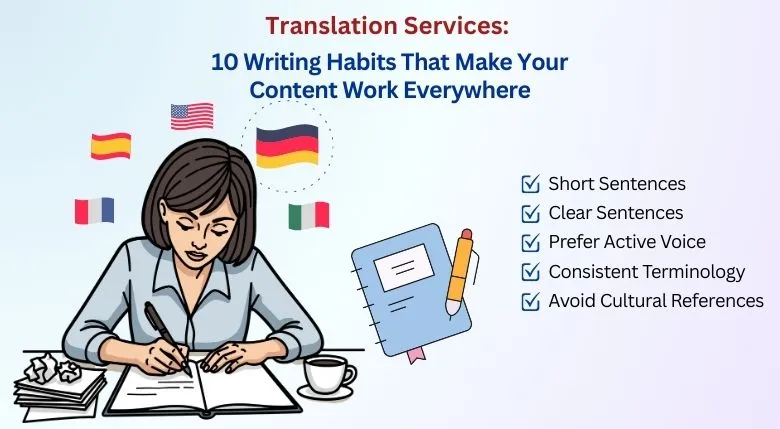
When businesses invest in translation services, they mostly focus on the result. It could be a multilingual translated manual, a localized website, or a subtitled video. However, only a few realize that the success of a translation relies a lot on the original text, also known as the source text. If the source content happens to be unclear, inconsistent, or culturally dense, even the most experienced translation company would struggle to deliver perfectly translated results.
So, expert tips on writing for translation become vital. It is not just about simplifying the source text but also about sharpening it. A carefully crafted piece of content would be easier to translate and hence would be easily understood across cultures and regions. So, how do you ensure that your source content is fully fit for a perfect translation?
Let’s explore ten essential tips that can help make your content translation-ready and maximize the impact of professional translation services.
Why Does Precise Source Text Matter for Translation Services?
Before we discuss the tips, it is vital to understand the connection between writing and translation.
A well-crafted source text:
- Reduces translation errors
- Cuts rework costs
- Speeds up the translation process
- Protects message integrity during translation
A clean and consistent source file helps businesses to eliminate confusion when collaborating with a professional translation company.
Tips to Write Expertly for Translations
1. Keep the Sentences Short and Focused
Long sentences tend to create confusion, ambiguity, and ultimately slow down translation. A sentence in the source text must aim for less than 20 words. Shorter sentences generally:
-
- Improve readability
- Support machine translations
- Reduce the scope of misinterpretation
Food for thought: If you run out of breath while reading the sentence aloud, it is probably too long!
2. Use a Clear and Standard Sentence Structure
Translations for sentences with complex constructions become prone to errors. However, creating a simple sentence with subject-verb-object order can help to improve translation accuracy drastically. Clear grammar and a predictable sentence structure help both human translators and AI translation tools.
This is especially important for translating marketing materials. Professional content writing services help businesses create consistent materials for multiple markets.
3. Eliminate Long Noun Strings
A noun string is a cluster of nouns placed together without any connectors. For example, “localization workflow optimization strategy document.” A confusing phrase like this with long noun strings can force translators to guess during the translation process. It is better to break them into a simpler sentence with connectors like “this document outlines the optimization strategy of a localization workflow.”
1. Maintain Consistent Terminology
In creative writing, when we use different terms to explain the same concept, it is considered genius. But if we do the same in translation, it creates chaos.
It is vital to choose one term and stick to it for the whole document. For example, if the term “client portal” is used in one place in the source document, it needs to be consistent. Switching to “customer dashboard” later can create confusion during the translation process.
Using a translation memory tool is perhaps the best course of action in this situation. They store previously translated segments to make the process more efficient and accurate. A structured content writing strategy includes terminology management from the start.
5. Avoid Idioms, Slang, and Cultural References if Possible
Catchy expressions like “hit the ground running” or “knock it out of the park” may sound engaging in English. But for translation services, these expressions become a nightmare.
Such phrases:
-
- Lack of a direct equivalent
- Confuse international audiences
- Delay translation with clarification queries
If humor cannot be avoided, consider using transcreation services. Doing so will adapt the message creatively while preserving its original meaning.
6. Clarity with Dates, Numbers, and Units
The writing style of dates and numbers can vary from region to region. This variation causes confusion for translation services.
For example, 05/03/2026 can be read as both 5th March 2026 and 3rd May 2026—depending on the region.
To avoid confusion of this sort
-
- Spell out the month (5th March 2026)
- Include time indicators wherever necessary (AM/PM)
- Add metric equivalents for measurements (kilometers or miles, kilograms or pounds)
7. Prefer Active Voice Over Passive Voice
-
- Passive Voice: The report was approved by the manager.
- Active Voice: The manager approved the report.
Active voice sentences are precise, clearer, and shorter. As a result, translators are able to process them faster with higher accuracy and complete clarity.
8. Remove Phrasal Verbs
Phrasal verbs are a type of expression that consists of a verb and an adverb. For example, carry out, figure out, or set up.
Unfortunately, these phrases often have multiple meanings.
For example,
-
- Carry out the job with complete precision.
- Carry out the ladder to help the person.
Replace these phrasal verbs with single-word alternatives for accurate translations:
-
- Carry out becomes perform.
- Set up becomes establish.
This would reduce ambiguity and enhance professionalism, especially for legal and technical documents.
9. Plan for Text Expansion
Translations for some languages take up more space than English. Sometimes even 30-35% more.
Languages, such as German, Hindi, and Japanese, frequently expand in length when they are translated from English.
Therefore:
-
- Leave some extra space in the source documents’ design
- Avoid tight text boxes
- Plan to accommodate flexible layouts
Not accounting for text expansion could lead to additional design adjustments and rising costs.
10. Provide Additional Resources to the Translators
For high-quality results, it is essential to provide translation services with:
-
- Style guides
- Glossaries
- Brand tone guidelines
- SEO keyword lists
- Reference visuals
Beyond these resources, translation services also create a checklist to ensure complete accuracy and high quality. Don’t miss out on our related blog to know more about the translation checklist: Professional Translation Services: This is Why You Need a Checklist!
Build Translation-Ready Content Today
An accurate source text is the foundation of a robust content writing strategy that leads to high-quality translation work. But even the most skilled writing benefits from professional support from translation services. Somya Translators, one of the leading translation services in India, understands that exceptional service begins with exemplary source content.
Content writing support from us helps businesses to:
- Reduce localization costs
- Improve go-to-market time
- Strengthen brand presence
- Grow global consumer trust
We believe that writing for translation does not limit creativity but structures the content smartly.
Whether you are a growing enterprise, a marketing team with global ambitions, or a brand refining its presence, investing in our expert translation services can be an intelligent decision.
Contact us today for professional translation services and get a free quote!
Call: +91-9990094796
Email: info@somyatrans.com
–