

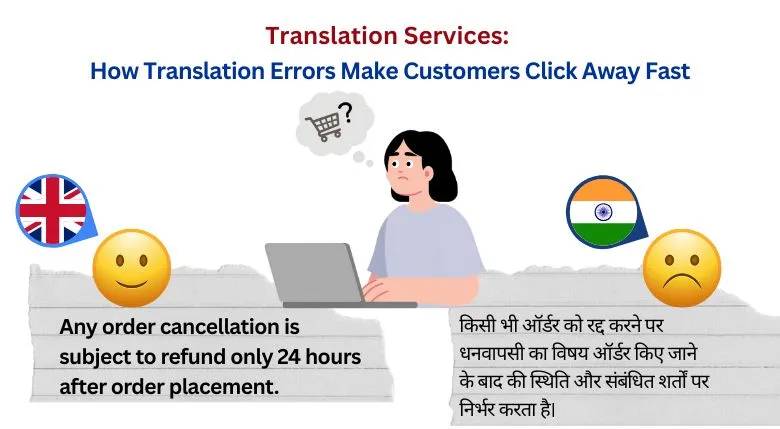
 You can spend months trying to perfect your website’s design, investing money into ads, implementing SEO, and polishing product pages, and everything might look flawless. You also see that the traffic is coming from different countries, but there is a problem. The incoming traffic does not reflect the conversions.
So, what went wrong?
As one of the leading translation services, we encounter this query a lot. And often it is not the product or the pricing, but the language. More specifically, it’s how the language of the website was translated to attract global visitors.
Online buyers can be a bit judgmental. Some may even like to scan the product description rather than looking at the product itself.
Imagine a Nigerian customer visiting a website that has been “poorly translated” into Yoruba. Chances are, the product description may not sound truly native, checkout instructions might feel confusing, or the policies may not be transparent enough. A situation like this will lead to two definite things:
- The Nigerian consumer will leave the website, never to return.
- The consumer will buy from a website that is perfectly translated into Yoruba.
Half-hearted translations can be damaging, especially in a competitive e-commerce industry. That’s why professional translation services have become the key difference between global growth and global failure.
In this blog, we will break down how translation mistakes can damage your online sales and how expert translation services can help you avoid them.
What Translation Mistakes Can Be Avoided?
Literal Translations
One of the most common translation mistakes is assuming that translating words is the same as translating meaning. It isn’t.
In a language, idioms, expressions, and emotional weight play a vital role. Some brands make the wrong choice and opt for literal translations for their e-commerce content.
The result:
- Products may lose emotional appeal.
- The call to action of the website sounds unnatural.
- Marketing messages may feel confusing.
For example, a simple CTA in English like “reach out today” may sound rude or forceful in other languages. So, what was meant to persuade ends up pushing visitors away.
However, professional website localization services can make a significant difference. By adapting to the region’s cultural and contextual expectations, a localized website ends up sounding more native than a word-for-word translated website.
Ignoring Culture, Tone, and Buyer Behavior
Language is heavily influenced by culture. Ignoring this fact is a shortcut to losing multilingual customers.
Visitors from different cultures have different expectations from the website:
- Formal vs. informal tone
- Use of humor
- Color symbolism and images used
- Guarantees, return policies, and certifications
For example, Indian buyers often look for clear return policies before finalizing a purchase, while French buyers rely on on-point product descriptions to make up their minds. This change of cultural expectation is important for global brands to follow. Ignoring this may create a cultural disconnect, resulting in loss of sales from both markets.
Poorly Translated Product Descriptions
On a website, product descriptions are one of the most vital pieces of content to persuade a buyer. Weakly translated product descriptions may significantly impact the buyer’s intentions.
Common issues in translated product descriptions include:
- Missing or unclear technical details
- Over-promising language that feels suspicious
- Confusing size charts, measurements, or specifications
- Other key features that may get lost in translation
In an international e-commerce translation project, these small misses can result in big consequences. When customers feel that the information presented is not relevant or clear, they tend to move on to a competitor who explains it better.
Are You Looking for Unmatched Translations?
Contact Us Today for a Free Quote!
Misleading Pricing, Currency, and Shipping Terms
The one thing that might scare an online buyer the most is the uncertainty about the price of the product.
Typical mistakes related to pricing, currency, and shipping terms include:
- Incorrect currency symbols or placements
- Unclear taxes, duties, or GST (for Indian markets)
- Incorrect shipping timelines
- Confusing refund policies or cancellation charges
Though these may seem like insignificant errors, they tend to raise several concerns at the checkout page. Expert multilingual professionals understand the currency of the target region and change the pricing of the products accordingly.
SEO Translation Mistakes
Translating websites without proper SEO is like opening a store without a signboard.
Some businesses make the mistake of assuming that simply translating the keywords is enough to get a higher rank in regional searches. Unfortunately, it doesn’t work that way. Keywords are calculated according to the search pattern of a region, and the search pattern varies from market to market.
Common SEO-related translation mistakes include:
- Using literal translation of keywords instead of local search phrases.
- Ignoring regional slang and buyer intent.
- Missing region-specific multilingual meta title and description.
- Missing proper hreflang tags.
Without local keywords, even properly translated websites won’t rank, resulting in no visibility, no traffic, and no conversions.
Do you want to explore more about how multilingual SEO boosts website localization? Check out our related blog: Website Localization: Ensuring Global Reach With Multilingual SEO.
No Region-Specific Customer Support and Emails
A brand shows its loyalty by offering appropriate customer support. However, some brands choose to rely on automated messages instead of personalized messages for their customers.
This usually leads to:
- Confusing email responses and promotions.
- Articles that do not truly help customers.
- Basic chatbots that misunderstand basic customer requests.
Without clear communication, customers get frustrated quickly. The result is poor reviews of the brand, leading to losses. High-quality translation services for multilingual customer support ensure that post-purchase communication is just as strong as pre-purchase messages.
Check out our related blog to learn more about the importance of multilingual customer support for foreign markets: Multilingual Customer Support: 5 Key Benefits to Unlock New Markets.
No Localization for Checkout and Legal Pages
Localized checkout and legal pages are vital on a website, as they often influence a visitor’s decision.
The following sections must be localized carefully according to the region:
- Terms and conditions
- Data privacy policies
- Warranty and guarantee information
Poor translation leads to unclear information, which damages the trust between the visitor and the brand. Also, it can expose the website to legal risks. Clear, localized language reassures buyers about the legality and credibility of the business.
How to Avoid These Mistakes?
A few simple steps can help brands avoid these translation mistakes and turn every website visit into a sale.
Here’s the trick:
- Always work with professional website and app localization services.
- Combine AI tools with human expertise to increase the speed and efficiency of translations.
- Prefer to localize the keywords rather than the whole sentences.
- Build a specialized brand glossary and style guide.
- Some translation services offer linguistic testing services to test content with real users.
- Employ native linguists with high legal expertise to translate the website’s legal pages.
- Translation and website localization services are an ongoing process and not a one-time task. So, it is to keep the localization process flexible to accommodate updates and revisions.
For multilingual brand websites, reliable partners matter. Somya Translators supports global brands with expert resources, linguists, and workflows.
Most customers abandon a website not because they dislike it, but because they feel something is off. And most of the time, that “off” feeling comes from poor translations.
If you want your website to attract visitors from global regions, then let’s go past these translation mistakes together!
Reach out to Somya Translators for expert translation services and get a free quote!
Call: +91-9990094796
Email: info@somyatrans.com