

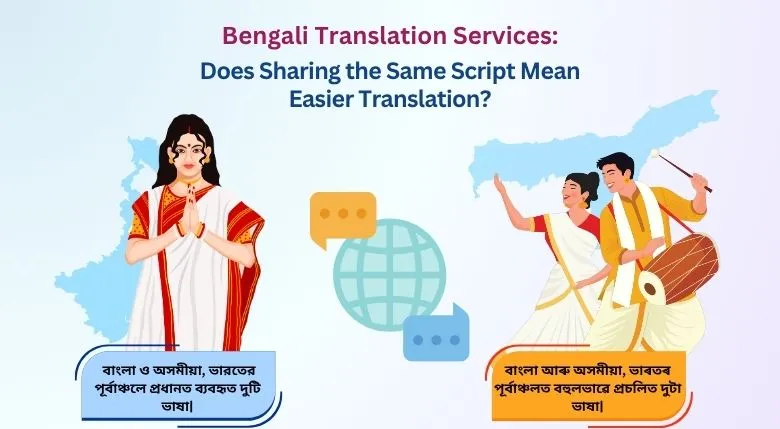
 Is it fair to assume that translation could be easier if both languages share the same script?
Bengali and Assamese, two majorly spoken eastern Indian languages, use a nearly identical writing script, the Eastern Nagari script. However, beneath the surface of writing strokes, there lie complex linguistic differences, grammatical exceptions, and cultural elements that make accurate translation between them far from straightforward. Some would even say that the conversion of Bengali into Assamese or vice versa isn’t possible without assistance from professional Bengali translation services.
But why is language translation so important for eastern and northeastern Indian languages?
Although Hindi and English are predominantly spoken in India, they are not the only languages spoken in the Northeast.
Northeastern and eastern language translation services are vital for:
- Cultural promotion and preservation.
- Inclusivity in global education.
- Efficient government and administration communication.
- Business expansion without cultural and linguistic limitations.
- Effective healthcare and NGO services.
However, English-to-Bengali translation or any other language translation services won’t be enough for clear communication.
In this blog, we will discuss the linguistic differences between the two culturally rich East Indian languages and understand the vital role of Bengali-to-Assamese translation services in them.
Contact Somya Translators for Expert Bengali-to-Assamese Translation Services!
Contact us today and get impeccable Translation Services!
What Makes Bengali and Assamese Unique?
Answering the question asked at the beginning, sharing the script does not mean easy translations; in fact, assuming that could be a dangerous decision.
Although to an amateur, these two languages might sound quite similar, they differ in several ways, such as:
Lexical Differences:
In both languages, some words look identical but mean a bit differently.
- “Dhora” in Bengali means “to catch.” However, in Assamese, the same word means “to hold” or “to meet.”
- “Jibon” is a beautiful word that signifies “life” in Bengali. It has the same meaning in Assamese but with a completely different emotional weight. This difference is essential during Bangla-to-Assamese translation of literary works.
These words—if used without help from Bengali translation services—can completely distort the meaning of the document or content.
Grammar and Sentence Structure:
Grammar is the most vital element of any language. In Bengali and Assamese, word order, tense, and honorifics differ significantly. So, literal Bengali-to-Assamese language translation may risk sounding incorrect, awkward, and, in some cases, disrespectful.
Cultural Idioms:
Both languages have strong cultural identities and hence use several phrases or idioms to enhance their appeal. However, one must be careful while translating these from Bengali into Assamese, as they might end up sounding odd or meaningless. For example, “কি মিষ্টি!” (Ki Mishti! or How Sweet!) in Bangla means to compliment the nature of a person. But, in Assamese, the direct translation results in “কি মিঠা!” (Ki Mitha!), which is used to describe the sweet taste of a food. A professional Bangla-to-Assamese translation service will be mindful of these cultural differences and use the correct, natural-sounding term.
Differences in Dialects:
Both Assamese and Bengali have several dialects that change from region to region. This diversity affects the vocabulary, pronunciation, and use of idioms, especially during translations. For example, a film that is being dubbed in both Bengali and Assamese languages must provide special attention to phrases that change according to dialects. This is possible only with the help of Bangla and Assamese subtitling services that can offer accurate subtitles according to the dialect spoken in a region.
How Do These Differences Affect Literary and Creative Translations?
Literature plays a vital role in both languages—whether it is the magical work of Rabindranath Tagore or the modern novels of Rajanikanta Bordoloi. Literary translation provided by professional Bengali translation services must capture the poetic and rhythmic lines that are used in Bangla and Assamese.
To ensure accurate Bengali-to-Assamese translation of literature, translators must preserve:
- Style and Tone
- Rhythm and Flow
- Cultural References and Metaphors
Consider this: One of Rabindranath Tagore’s sangeet (poems) has been translated into Assamese, but it does not carry the original charm and meaning. This would be a failed translation, perhaps occurring due to the use of machine translation tools.
Machine Translation vs. Human Translation: What Works Best for Bangla and Assamese?
A great translation is not just about converting the words, but rather it is about preserving the tone, voice, and emotion. This is something AI or machine translators are incapable of offering.
Advantages of machine translation:
- AI translations are fast and cost-effective. Some tools are even free to use.
- These translations can be easily applied to casual translations.
Disadvantages of machine translation:
- AI often mistranslates cultural elements—something that is essential in Bengali-to-Assamese translation.
- These translations must not be used for important documents.
- AI is not advanced enough to interpret different dialects and slang.
If dealing with an English-to-Bengali translation, machine tools may perform decently to provide accurate translations.
So, what’s the best practice?
Use machine translation for the first draft, and let professional human translators, preferably native speakers, refine the text for precise tone, voice, and phrases.
How to Ensure High-Quality Assamese-to-Bengali Projects?
Reputed Bengali translation services like Somya Translators use a consistent, layered, and efficient workflow to ensure high-quality Bangla-to-Assamese translation.
This includes:
- Source Text Analysis: A process that analyzes the original document. This includes identifying the dialect, complexity, and domain of the document.
- Term Base and Glossary Alignment: A specialized glossary of the target languages (Bengali or Assamese) is created to ensure consistent use of translation terms across the content.
- Initial Translation: A native human translator with subject-matter expertise translates the source document by referring to the glossary.
- Editing and Review: After initial translation, separate linguists are selected to edit and proofread the document. They rectify the tone, accuracy, and style of the translation to make it more relevant for the target audience.
- QA Tools: Advanced CAT tools like SDL Trados and memoQ are used to identify any translation errors or inconsistencies.
- Client Feedback and Delivery: The client provides some valuable feedback to finalize the translated document.
An efficient and professional workflow for Bengali-to-Assamese language translation provides a fine balance between speed, cost, and quantity.
How Do Somya Translators Help with Bengali-to-Assamese Translation?
As the future of India is driven by the growth of digital content, regional communication, and rapid business expansion, the necessity of Indian language translations, especially Bengali translation services, will grow. Furthermore, professional translations will keep playing a key role in preserving the linguistic identity and culture of the Bengali and Assamese people.
Somya Translators thoroughly understands this vital role of culture in Bangla-to-Assamese translations.
We aim to offer high-quality translations by:
- Implementing ISO 2015:17100-certified processes.
- Offering native-speaking linguists with regional expertise.
- Providing diverse processes like Assamese subtitling services, voiceover services, desktop publishing (DTP), and transcreation.
- Providing a complete suite of translation and localization solutions in 170+ languages.
Although Assamese and Bengali may look similar, they need a strikingly different translation approach to ensure quality and relevant results. In such situations, professional Bengali translation services are not just helpful but essential.
So, when it comes to your next Bengali-to-Assamese translation project, Somya Translators has got you covered.
Contact us today for tailored Bengali translation services!
Reach out to us via call (+91-11-43061918) or email (info@somyatrans.com).