 Let’s imagine:
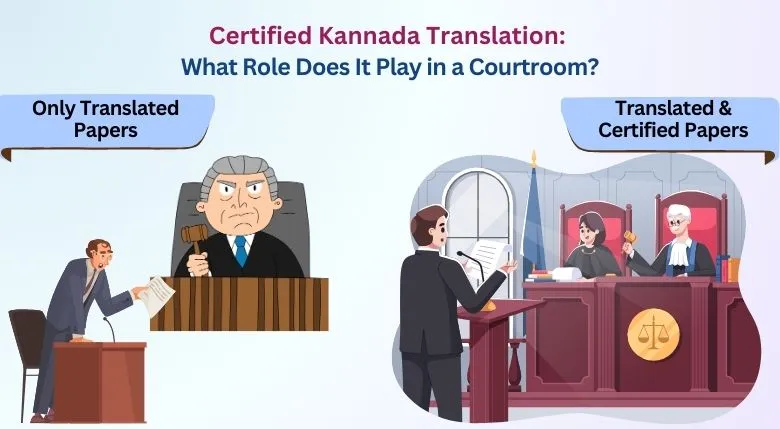
A legal dispute regarding the division of a property in the state of Karnataka is ongoing. As the case hearing and the appointed court are both in Karnataka, it becomes mandatory to translate all vital legal documents into the Kannada language. However, one of the participants in the case submitted translated and certified documents. The other one didn’t.
The result?
The only translated documents of the participant were immediately rejected by the court. Since it was not a certified translation, the submission held no legal value. One missed detail and the whole case collapsed like a stack of cards.
Sounds harsh, right? But practically, it is not. This condition is the real-world consequence of not using certified Kannada translation for legal and official documents.
A certified Kannada translation service helps to accurately convert immigration papers, academic transcripts, business agreements, licenses, wills, affidavits, and much more. Furthermore, professional government-approved translation in the Kannada language also ensures that all converted documents are culturally appropriate, legally sound, and accepted without any hiccups.
In this blog, we will explore what makes certified Kannada document translation so critical in courtrooms, offices, and immigration centers.
What is the Role of a Certified Kannada-to-English Translator?
With over 38 million native speakers, Kannada is a language rich in culture and regional diversity. However, in translations for official matters, such as courts and embassies, simply knowing the language is not enough. A certified translation in the Kannada language focuses more on preserving the meaning, regional accuracy, and legality of the content.
So, who should you trust for certified Kannada translation?
- A native Kannada translator who is certified, meaning they are officially recognized for their language proficiency and can produce translations that meet the government standards.
- Or a sworn translator in the Kannada language, who is additionally qualified to provide notarized document translation, as required by the law.
Where Are Certified Kannada Translations Used?
Some of the most common scenarios where certified Kannada translation is essential are:
- Court Documents: Contracts, wills, affidavits, judgements, and depositions.
- Immigration Papers: Birth and death certificates, marriage licenses, passport applications, and visa forms.
- Academic Certificates: Marksheets, degrees, diplomas, and letters of recommendation.
- Business Agreements: Memorandum of understanding (MoU), non-disclosure agreements (NDAs), and trade contracts.
- Medical Documents: Clinical trial reports and patient records (Demand for Kannada translation in healthcare is growing significantly).
Furthermore, these documents often require government-approved translation to be accepted.
Why Are Official Stamps and Sworn Translators So Important?
In many regions in Karnataka, the court or the embassy might ask for certified translations that are signed, sealed, and notarized by a sworn translator in Kannada. The reason? To confirm its accuracy and authenticity.
Furthermore, a certified translation with a signed stamp shows that the document can be a trusted representation of the original.
Are you trying to translate a legal document into Kannada? Here’s what you need to remember:
- Sworn translators are often mandatory to handle legal and immigration documents.
- These translations include a certificate of accuracy, the translator’s credentials (if asked), and sometimes notarization.
Legal Consequences of Incorrect Translations
All translations are not equal, and in a courtroom or an embassy, a “close enough” translation can rather be “far off!”
A mistranslated legal or official document can have some serious consequences, like:
- Penalty due to misrepresentation of facts or terms.
- Visa denial or deportation during the immigration process.
- Delay in legal proceedings and hefty fines for presenting incorrect information.
However, linguistic agencies with proper legal certifications for translations ensure that all converted documents are accepted in such high-stakes scenarios—be it in Karnataka or worldwide.
Are you or someone you know immigrating to a new country but facing confusing language requirements? Worry not; check out our related blog to know more about certified translation during the immigration process: Certified Translations: A Helping Hand in Immigration Processes!
Common Mistakes in Kannada Document Translation
Every translation that is done by unqualified and uncertified translators can be useless and inaccurate.
Some errors that are commonly found in Kannada translations are:
- Wrong use of tense and tone mismatch.
- Incorrectly translated places and numbers.
- Missing and incorrect translation of official and legal terms.
- Overuse of transliteration instead of actual translation.
Fun Fact: Nirina Mele Baryuvudu (ನೀರಿನ ಮೇಲೆ ಬರೆಯುವುದು) is a very common idiom in the Kannada language. But it isn’t easy to translate this.
By hiring a native Kannada translator who has deep cultural as well as legal and administrative knowledge, the above mentioned errors could be avoided while ensuring accurate translation of idioms.
Want to know more such Kannada idioms that aren’t easy to translate? Check out our related blog: 7 Kannada Language Idioms That Just Can’t Be Translated into English!
GET EXPERT AND CERTIFIED KANNADA TRANSLATIONS FROM SOMYA TRANSLATORS!
Contact us today for exceptional translation solutions!
The Challenge of Kannada’s Several Dialects
The Kannada language has over 20 spoken dialects.
Here are the top 5 dialect-related challenges in local dialect document translation:
- Mysore Kannada: Although this is the most standardized version of Kannada, it is often misunderstood in rural areas.
- Dharwad Kannada: The dialect is mostly spoken in North Karnataka; however, it follows a different set of vocabulary.
- Coastal Kannada (Mangalore Dialect): Although this is a dialect of Kannada, it has heavy influence from Tulu and Konkani.
- Havyaka Kannada: This is a complex dialect that is sometimes even misunderstood by the natives.
- Arebhashe: This dialect is spoken in the Coorg district and is rarely understood outside the region.
How Can a Translation Company Solve These Challenges?
Collaborating with a certified and reliable translation agency brings clarity, authenticity, consistency, and compliance.
Here is how:
- Professional translation companies employ certified, native translators who are trained in the legal and administrative domains.
- They put special care into providing region-specific translation with the correct dialect.
- Several translation companies also offer notarized document translation for official needs.
- They ensure timely delivery with multi-step quality checks and ISO (preferably 17100:2015) standards.
Looking for translations that won’t get rejected by embassies or courts? Trust Somya Translators.
At Somya Translators, we offer exceptional Kannada language solutions that are certified and accepted by all authorities.
In today’s high-stakes environment, errors in translation can be very costly. Hence, choosing a certified Kannada translation is not just smart but essential. If you are someone who needs to translate official documents expertly and in a certified manner, Somya Translators can be your trusted partners.
Need an expert and certified Kannada translation?
Reach out to Somya Translators today!