

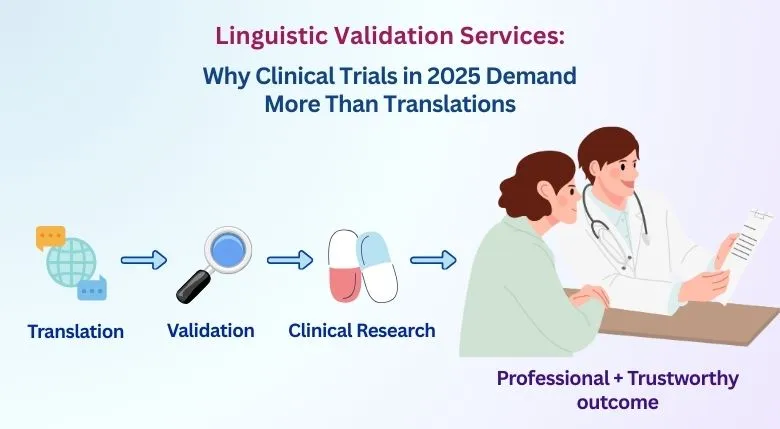
 Every year, massive pharmaceutical companies and medical research facilities pour billions into developing new drugs, creating new treatments, and manufacturing more effective medical devices. However, the process is widely complicated, as it involves years of clinical trials. And what if, after all the hard work, the drug or device fails? Not because the product was not effective, but because the language translation was not accurate.
But how does language translation come into all this?
In 2025, clinical trials became more global than they ever were. In fact, only 20% of international clinical trials are conducted in the U.S., and the remaining 80%? They are conducted in non-English-speaking countries like China, France, Germany, and Japan.
With this global reach, stretching across continents, languages, and cultures, comes a risk of miscommunication in languages.
Miscommunication in trial documents can cause:
- Delay in approval timelines
- Risk patient safety
- Questions about data reliability
- Hamper the company’s global credibility
That is why global companies are pivoting towards partnering with linguistic validation services to ensure the language translation in clinical trial documents is accurate and acceptable to the target region.
In this blog, we will discuss how linguistic validation has become paramount for global clinical trials in 2025.
What is Linguistic Validation in Clinical Trials?
In global medical research, linguistic validation is a scientific process of ensuring that all patient-facing clinical trial materials retain their originally intended meaning and cultural relevance after translations. The service is especially vital for high-stakes clinical outcome assessments (COAs) like volunteer questionnaires.
In simple words, having public-facing documents linguistically validated would mean that a question about fatigue or weakness—when translated—would mean the same in diverse regions like Tokyo, Rio de Janeiro, and Addis Ababa.
However, medical linguistic validation doesn’t just ensure that patients understand the words but also understand the clinical trial experience.
Why Is Linguistic Validation a Step Beyond Medical Translation?
While a professional clinical trial translation can get your documents translated from one language into another, it doesn’t guarantee that the translated version carries the intended meaning.
So basically,
- Clinical trial translation means converting the words of documents.
- Linguistic validation ensures that the converted words work as intended.
Let’s take the following illustrative example:
In 2018, a clinical trial was held in Colombia. As the trial was held by an American company, all documents had to be translated from English to Spanish. As a result, in the trial procedure document, which is distributed among the patients, the translation of the phrase “once daily” became “once al día.” This seems like the correct translation until one realizes that in the Spanish spoken in Latin America, once means eleven. So, patients could easily be confused by the dosage and could consume the medication eleven times a day, resulting in some devastating consequences.
This could be the cost of skipping linguistic validation in clinical trials.
UNSURE WHETHER YOUR CLINICIAL TRIAL DOCUMENT FITS THE NORMS OF A REGION?
Contact us for exceptional linguistic validation services and get a free quote!
Why Is Medical Linguistic Accuracy So Vital in 2025?
With legal regulations for clinical trials getting stricter globally, linguistic errors carry higher consequences. Linguistic validation experts ensure that all translated clinical trials adhere to these strict laws, regardless of the region.
Flawless linguistic accuracy in clinical trial documents is vital because:
- Regional Compliance: Global agencies like the FDA and the EMA always require validated translations. The EU Clinical Trial Regulation 536/2014 demands compulsory proof of complete linguistic accuracy in every translated document.
- Patient Safety: As we discussed in the above example, a simple mistranslation of dosage can result in serious harm to the patient and lead to legal consequences.
- Data Integrity: Global collaborators to the trial would need to compare the findings with their own data, and linguistic validation is essential for this.
Can an organization that has invested huge funds and time in conducting a clinical trial really afford a delay or legal case that can happen without linguistic validation?
Do you want to explore more about the importance of precision in clinical trial translations? Check out this blog: Clinical Trial Translations: How to Ensure Flawless Accuracy?
A Step-by-Step Guide to the Linguistic Validation Process
So, how is linguistic validation carried out?
A standard process followed by linguistic validation experts looks like this:
- Forward Translation: Two separate medical translators convert the material independently.
- Reconciliation: Both the translated versions are compared and combined into a single optimized version.
- Back Translation and Harmonization: This step includes a separate linguist (third) who translates the version back into the source language. This step is conducted to ensure that no vital information is lost during the first stage of translation.
- Cognitive Debriefing: Next, a small sample of patients from the target population is selected to test the translation for clarity and cultural accuracy.
- Finalization: Any issue that is found is readily resolved, and the validated document is finalized and delivered to be used.
Industries That Rely on Linguistic Validation
While the pharmaceutical industry is the most obvious candidate, there are some other related industries that often rely on linguistic validation services.
- Biotechnology and Biomechanics
- Medical Device Manufacturers
- Healthcare Research Organizations and Medical Think Tanks
- Diagnostic Centers and Imaging Providers
- Regulatory Agencies and Clinical Research Organizations
Apart from these sectors, any organization that collects global patient data and behavior patterns for further research also needs to partner with a PRO translation (patient-reported outcome) company.
Make Your Trials Safer, Smarter, and Global-Ready
As one of India’s leading ISO 17100:2015-certified translation agencies, Somya Translators has all the resources required to support your clinical research needs.
We offer:
- Over 170 languages are supported, both Indian and global.
- A specialized team of translators and linguistic validation experts.
- Acute specialization in back translation and harmonization, PRO translation, and cognitive debriefing.
- Deep experience and expertise in clinical trial translation for global markets.
- Quick and scalable translation solutions to satisfy a global clientele.
With the global healthcare landscape shifting rapidly due to emerging and evolving diseases, global clinical trials for drugs and medical devices have become paramount. And as these trials target linguistically and culturally diverse patients, translation and medical linguistic validation are a must.
Trust Somya Translators to handle the words of your clinical trial documents so you can focus on science.
Feel free to reach out to us today for a free quote!