

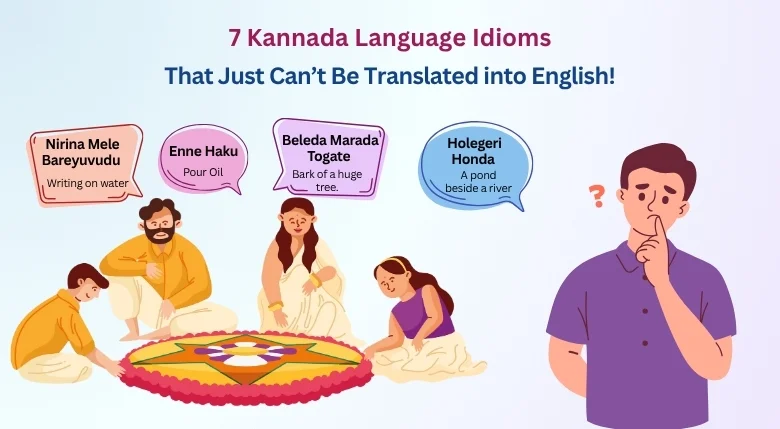
Idioms are interesting phrases that are a culmination of humorous wit, language, and culture. In India—a land of several languages—idioms in regional languages are quite common. In the Kannada language, too, idioms are steeped in traditional culture, humor, and local flavor. But have you ever tried to translate Kannada phrases into English? The idioms of the Kannada language, whether a sharp punchline, poetic observation, or biting insult, are not just difficult to translate but borderline impossible.
These phrases, which are culminated with wits, turn into bland sentences during English translations—leaving both non-Kannada speakers and linguists scratching their heads!
In this blog, we will discuss seven such phrases that make no sense during Kannada-to-English idiom translation!
Why Is There a Need to Translate Kannada Language Idioms?
Idioms are not just decorative expressions that sound cool—they carry emotions, context, and cultural subtexts. And this is what makes Kannada-to-English idiom translation a challenging task. From marketing and e-commerce to the education domain, idioms are an essential way to connect with audiences. Translating native Kannada expressions into different languages becomes necessary for Karnataka-based businesses that aim to expand their services worldwide.
However, in such cases, it is essential to remember that literal translations won’t make the cut—the original essence of the phrase must also be captured.
Let’s explore seven such Kannada idioms that lose their charm when translated into English.
1) Kaasige Biddante (ಕಾಸಿಗೆ ಬಿದ್ದಂತೆ)
- Literal Translation: Like something that fell for a coin.
- Intended Meaning: Appear unexpectedly.
The coin analogy can only be understood by Kannada natives and won’t be effective in English. Whereas a professional translator would capture the original intent and translate this phrase as “out of the blue.”
2) Nirina Mele Bareyuvudu (ನೀರಿನ ಮೇಲೆ ಬರೆಯುವುದು)
- Literal Translation: Writing on water.
- Intended Meaning: Doing something pointless or meaningless.
In English, you might have heard the phrase “a lost cause.” However, when its Kannada counterpart is converted into English, it fails to capture the true meaning. This highlights some major regional language challenges in translation.
LOOKING FOR ACCURATE KANNADA-TO-ENGLISH TRANSLATIONS?
Contact us today for a free quote!
3) Enne Haku (ಎಣ್ಣೆ ಹಾಕು)
- Literal Meaning: Pour Oil.
- Intended Meaning: Escalating matters beyond repair.
This native Kannada expression is generally used to depict a fight that rages on unnecessarily. However, its literal English translation doesn’t even come close to resembling the original idea. A more suitable English phrase for this idiom would be “adding fuel to the fire.”
4) Beleda Marada Togate (ಬೆಳೆದ ಮರದ ತೊಗಟೆ)
- Literal Meaning: Bark of a huge tree.
- Intended Meaning: An experienced or mature person.
This is an elegant Kannada idiom that equates a big tree with the experience of a person. English, however, lacks this stylized imagery and cultural layer. The closest English phrase that can get to describing this idiom would be “a seasoned pro.”
5) Holegeri Honda (ಹೊಳೆಗೇರಿ ಹೊಂಡ)
- Literal Translation: A pond beside a river.
- Intended Meaning: Something insignificant.
This Kannada idiom is far from the geographic relatability it displays in English. The closest translation we can think of to accurately describe this phrase is “a drop in the ocean.”
6) Mullu Mullige Araisu (ಮುಳ್ಳು ಮುಳ್ಳಿಗೆ ಆರೈಸು)
- Literal Translation: Remove a thorn with a thorn.
- Intended Meaning: Fight fire with fire.
This is a more culturally charged idiom. Rather than confrontation, this idiom often refers to quick problem-solving approaches. Professional Kannada expression translation services must equate this idiom with being clever and not just with retaliation.
7) Galiya Bayige Bidda (ಗಾಳಿಯ ಬಾಯಿಗೆ ಬಿದ್ದ)
- Literal Translation: Fallen into the mouth of the wind.
- Intended Meaning: Disappeared without a trace.
A more haunting yet poetic version, in English, the more suitable translation for this would be “vanished into thin air.” However, the Kannada phrase gives more cultural depth.
Translating Kannada sayings’ meaning in English is difficult—but did you know that there is another language that’s much easier to translate into English? In fact, they are quite similar. The language is none other than German. If you are curious to know more, do check out this blog: English and German Languages: How Are These Two Similar?
Get Trusted Kannada Language Translations
Idioms are proof that word-for-word translations are not enough. One needs to partner with a professional linguistic agency like Somya Translators to ensure accurate cultural translation from Kannada to English. As one of India’s leading linguistic companies, we specialize in providing culturally and contextually accurate translations.
ISO 17100:2015-certified, with a global team of linguistic experts, we offer services in 170+ languages, including Kannada.
So, if you are looking to translate Kannada phrases into English, trust the experts who understand the cultural subtleties of the language.
Contact Somya Translators today and let your words travel in the right way!