

Imagine a brand with an ambitious dream of expanding its presence to the widest corners of India. A country where, in every few hundred kilometers, everything changes—people, language, tradition, beliefs, and values! However, this massive diversity is both a goldmine and a landmine for global brands!
Why? Although it presents an opportunity for brands to engage with a dynamic consumer base, it also invites cultural risks and pitfalls. So, to avoid the pitfalls and embrace the opportunities, brands rely on localization services. It is a process of adapting content to fit the cultural and linguistic expectations of the target region.
However, it is easier said than done!
In the words of Dr. Shashi Tharoor, “India isn’t a country. It’s a continent masquerading as one.” Localization in India brings forth several challenges for a brand that aims to win hearts in Punjab while being popular in Kerala.
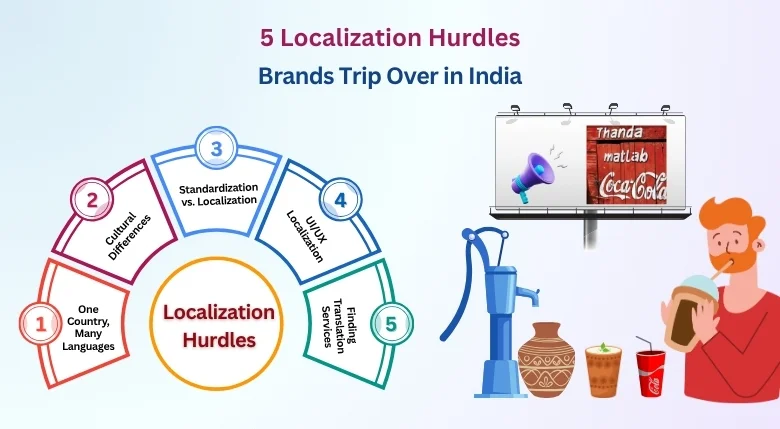
In this blog, we will explore five localization challenges faced while adapting brands for Indian regions without losing their identity and offending anyone!
1. One India, Many Languages
While this may be the obvious one, it is also the most pressing challenge. India has 22 scheduled languages, hundreds of regional languages, and thousands of local dialects. With such vast diversity, it becomes difficult for brands to adapt their content according to every language.
You might think translating into Hindi might be the solution, but it’s not!
- Hindi is a lot more popular in the northern belt of India than the southern belt!
- Direct Hindi translations do not consider the tone and dialect shift happening in different regions.
This creates massive Indian language localization barriers, leading to inconsistent tone, inaccurate terms, and a lack of emotional depth in translations.
To Solve This: Rely on professional translation services that employ native linguists who are not just proficient in the language but also in cultural nuances, local slang, and regional digital behavior.
2. Cultural Differences
Beyond languages, India is also a mix of different cultures. Each region has its unique customs, beliefs, and traditions. For a brand that wants organic engagement with its Indian consumers, it needs to curate the content according to the varying culture. Failing to do so can cause major hurdles in adapting brands for Indian regions.
For example, a brand launching a Diwali-themed marketing campaign may not resonate much in West Bengal, where Kali Puja is more prominent.
To Solve This: Ensure that your brand performs linguistic testing before launching a culture-centric marketing campaign or adapting visual content.
WANT TO LOCALIZE YOUR CONTENT ACCORDING TO THE INDIAN MARKET?
Contact us today for exquisite localization services!
3. Standardization vs. Localization
Today, several global brands understand the need for localization, but some of them still ask a vital question:
- How much should we localize?
- Should we change the logo?
- Should we adapt the tagline?
- Should we tweak our product offerings?
The answer to these questions is both yes and no. Localization should always be done while considering two things:
- The target region and consumer preferences.
- The originally intended brand voice.
For example, McDonald’s nailed brand localization in India when they introduced the McAloo Tikki burger. A local flavor adored by Indians, packed in the same golden arches of McDonald’s.
To Solve This: Always be clear not to change the brand’s voice during localization.
4. App, Software, and UI/UX Localization Barriers
Localizing text for marketing and advertising materials is one thing, but it’s a different ball game when it comes to digital platforms.
During the localization process, a company needs to ensure that:
- User-friendly website and app designs are created to cater the Indian rural users.
- Local currency (₹) and payment methods (UPI) are integrated.
- Formatting of dates and units is done according to the Indian metric system.
To Solve This: Ensure that your localized app, website, and software are properly reviewed before launch.
Although localizing for most of the Indian languages is not very difficult, what about right-to-left languages like Urdu? Check this blog to know more: Localization Services: How Do They Translate Right-to-Left Languages?
5. Finding Top-Tier Translation Services
There is no doubt that to efficiently mitigate challenges in the Indian market localization, a brand needs to partner with a professional linguistic agency. While there is no shortage of bilingual translators in India, only a handful can deliver high-level and culturally attuned localization that global brands require.
Opting for inexperienced translators can lead to:
- Incoherent brand voice.
- Confusing and inaccurate messaging.
- Unusable apps, software, and websites.
To Solve This: Partner with experienced localization agencies like Somya Translators, which bring both linguistic precision and cultural finesse to every project.
How Can Somya Translators Help?
At Somya Translators, we don’t just translate your brand’s content; we transform it to resonate across India’s vast and diverse lands. As an ISO 17100:2015 certified language service provider, we bring 16+ years of experience, native linguists, and over 170 language offerings to assist global brands in translating and localizing their content according to different markets.
Whether you need impeccable website localization services, marketing transcreation, or multilingual content translation, Somya Translators is your one-stop destination.
Contact us today to craft and localize your brand’s content according to rich and diverse Indian markets!